SKU: WR4376 Categories: ,

U-Blot® SH-PTP2 Rabbit mAb

Price range: $268.00 through $328.00

SKU: WR4376-50
Enter the quantity you would like, or drag the panel to find the quantity and price that best for you
Bulk QuoteAuthorize OEM & ODM

Product details

Background:The protein encoded by this gene is a member of the protein tyrosine phosphatase (PTP) family. PTPs are known to be signaling molecules that regulate a variety of cellular processes including cell growth, differentiation, mitotic cycle, and oncogenic transformation. This PTP contains two tandem Src homology-2 domains, which function as phospho-tyrosine binding domains and mediate the interaction of this PTP with its substrates. This PTP is widely expressed in most tissues and plays a regulatory role in various cell signaling events that are important for a diversity of cell functions, such as mitogenic activation, metabolic control, transcription regulation, and cell migration. Mutations in this gene are a cause of Noonan syndrome as well as acute myeloid leukemia. [provided by RefSeq, Aug 2016],


Specifications

Size50μL/100μL
TargetSH-PTP2
ReactivityHuman, Mouse, Rat
ApplicationsWB, IHC, IF, IP, ELISA
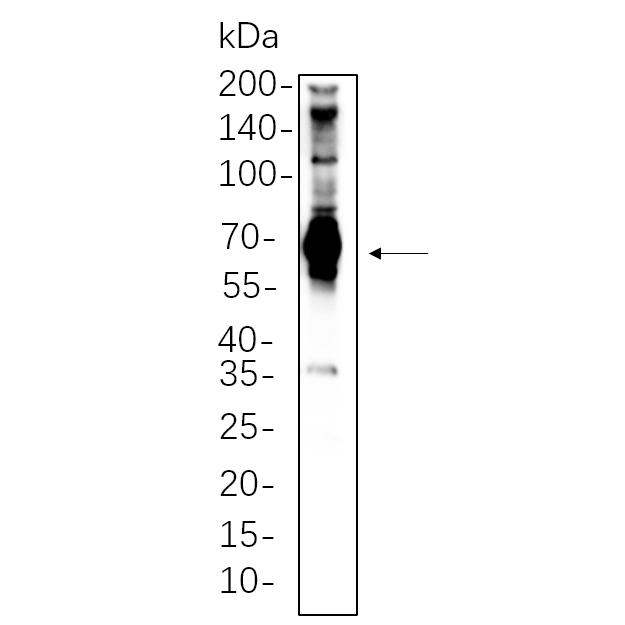
MW(Calculated)68kD
MW(Observed)68kD
Host SpeciesRabbit
IsotypeIgG,Kappa
Conjugate/ModificationUnmodified
Recommended Dilution RatioIHC 1:2000-1:8000; WB 1:2000-1:10000; IF 1:200-1:1000; ELISA 1:5000-1:20000; IP 1:50-1:200; / Note: For IHC, we suggest antigen retrieval with TE buffer pH 9.0 (Cat#WT1004)
FormulationPBS, 50% glycerol, 0.05% Proclin 300, 0.05%BSA
PurificationRecombinant Antibody expressed in animal component-free (ACF) media, purified via Protein A affinity chromatography.
Storage-15°C to -25°C/1 year(Do not lower than -25°C)
Concentration
ClonalityMonoclonal
Clone NumberRM0592R
ImmunogenThe specific immunogen used to produce this antibody is proprietary information.
SpecificityEndogenous
Gene NamePTPN11
Protein NameTyrosine-protein phosphatase non-receptor type 11
Other NamePTPN11; / PTP2C; / SHPTP2; / Tyrosine-protein phosphatase non-receptor type 11; / Protein-tyrosine phosphatase 1D; / PTP-1D; / Protein-tyrosine phosphatase 2C; / PTP-2C; / SH-PTP2; / SHP-2; / Shp2; / SH-PTP3
SpeciesHuman
Gene ID5781
UniprotQ06124,
Species.1Mouse
Gene ID.119247
Uniprot.1P35235,
Species.2Rat
Gene ID.225622
Uniprot.2P41499
Cellular LocalizationCytoplasm, Nucleus
Tissue ExpressionWidely expressed, with highest levels in heart, brain, and skeletal muscle.
Signaling_pathwayOrganismal Systems >> Immune system >> Natural killer cell mediated cytotoxicity;Organismal Systems >> Immune system >> T cell receptor signaling pathway;Organismal Systems >> Immune system >> Leukocyte transendothelial migration;Organismal Systems >> Endocrine system >> Adipocytokine signaling pathway;Organismal Systems >> Nervous system >> Neurotrophin signaling pathway;Human Diseases >> Cancer: overview >> PD-L1 expression and PD-1 checkpoint pathway in cancer;Human Diseases >> Cancer: specific types >> Chronic myeloid leukemia;Human Diseases >> Cancer: specific types >> Renal cell carcinoma;Environmental Information Processing >> Signal transduction >> Ras signaling pathway;Environmental Information Processing >> Signal transduction >> JAK-STAT signaling pathway;Environmental Information Processing >> Signal transduction >> Phospholipase D signaling pathway
Research Areas>>Ras signaling pathway; / >>Phospholipase D signaling pathway; / >>Axon guidance; / >>C-type lectin receptor signaling pathway; / >>JAK-STAT signaling pathway; / >>Natural killer cell mediated cytotoxicity; / >>Leukocyte transendothelial migration; / >>Neurotrophin signaling pathway; / >>Adipocytokine signaling pathway; / >>Insulin resistance; / >>Epithelial cell signaling in Helicobacter pylori infection; / >>Pathogenic Escherichia coli infection; / >>Herpes simplex virus 1 infection; / >>Proteoglycans in cancer; / >>Chemical carcinogenesis - reactive oxygen species; / >>Renal cell carcinoma; / >>Chronic myeloid leukemia; / >>PD-L1 expression and PD-1 checkpoint pathway in cancer
FunctionCatalytic activity:Protein tyrosine phosphate + H(2)O = protein tyrosine + phosphate.,Disease:Defects in PTPN11 are a cause of juvenile myelomonocytic leukemia (JMML) [MIM:607785]. JMML is a pediatric myelodysplastic syndrome that constitutes approximately 30% of childhood cases of myelodysplastic syndrome (MDS) and 2% of leukemia. It is characterized by leukocytosis with tissue infiltration and in vitro hypersensitivity of myeloid progenitors to granulocyte-macrophage colony stimulating factor.,Disease:Defects in PTPN11 are a cause of Noonan-like syndrome [MIM:163955]; also known as Noonan-like/multiple giant cell lesion syndrome. It is an autosomal dominant disorder characterized by Noonan features associates with giant cell lesions of bone and soft tissue.,Disease:Defects in PTPN11 are the cause of LEOPARD syndrome [MIM:151100]. It is an autosomal dominant disorder allelic with Noonan syndrome. The acronym LEOPARD stands for lentigines, electrocardiographic conduction abnormalities, ocular hypertelorism, pulmonic stenosis, abnormalities of genitalia, retardation of growth, and deafness.,Disease:Defects in PTPN11 are the cause of Noonan syndrome 1 (NS1) [MIM:163950]. Noonan syndrome (NS) is a disorder characterized by dysmorphic facial features, short stature, hypertelorism, cardiac anomalies, deafness, motor delay, and a bleeding diathesis. It is a genetically heterogeneous and relatively common syndrome, with an estimated incidence of 1 in 1000-2500 live births. Mutations in PTPN11 account for more than 50% of the cases. Rarely, NS is associated with juvenile myelomonocytic leukemia (JMML). NS1 inheritance is autosomal dominant.,Domain:The SH2 domains repress phosphatase activity. Binding of these domains to phosphotyrosine-containing proteins relieves this auto-inhibition, possibly by inducing a conformational change in the enzyme.,Function:Acts downstream of various receptor and cytoplasmic protein tyrosine kinases to participate in the signal transduction from the cell surface to the nucleus.,PTM:Phosphorylated on Tyr-546 and Tyr-584 upon receptor protein tyrosine kinase activation; which creates a binding site for GRB2 and other SH2-containing proteins.,similarity:Belongs to the protein-tyrosine phosphatase family. Non-receptor class 2 subfamily.,similarity:Contains 1 tyrosine-protein phosphatase domain.,similarity:Contains 2 SH2 domains.,subunit:Interacts with phosphorylated LIME1 and BCAR3. Interacts with SHB and INPP5D/SHIP1 (By similarity). Interacts with PTPNS1 and CD84. Interacts with phosphorylated SIT1 and MPZL1. Interacts with FCRL3, FCRL4, FCRL6 and ANKHD1.,tissue specificity:Widely expressed, with highest levels in heart, brain, and skeletal muscle.,
Please login to post questions

Back to Top
Product has been added to your cart

