SKU: WP14475 Categories: ,

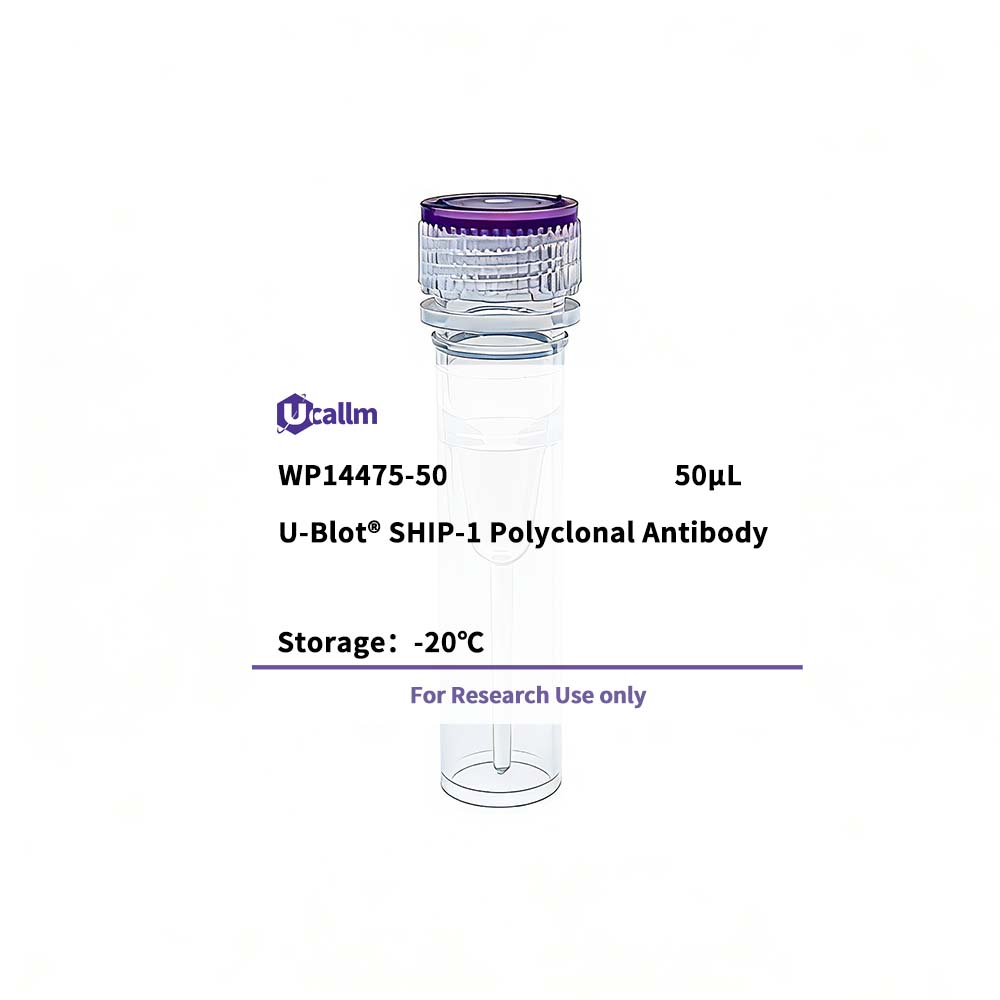
SHIP-1 Polyclonal Antibody

Price range: $268.00 through $328.00

SKU: WP14475-100
Enter the quantity you would like, or drag the panel to find the quantity and price that best for you
Bulk QuoteAuthorize OEM & ODM

Product details

Background:

This gene is a member of the inositol polyphosphate-5-phosphatase (INPP5) family and encodes a protein with an N-terminal SH2 domain, an inositol phosphatase domain, and two C-terminal protein interaction domains. Expression of this protein is restricted to hematopoietic cells where its movement from the cytosol to the plasma membrane is mediated by tyrosine phosphorylation. At the plasma membrane, the protein hydrolyzes the 5' phosphate from phosphatidylinositol (3, 4, 5)-trisphosphate and inositol-1, 3, 4, 5-tetrakisphosphate, thereby affecting multiple signaling pathways. The protein is also partly localized to the nucleus, where it may be involved in nuclear inositol phosphate signaling processes. Overall, the protein functions as a negative regulator of myeloid cell proliferation and survival. Mutations in this gene are associated with defects and cancers of the immune system. A

Specifications

TargetSHIP-1
ReactivityHuman, Mouse, Rat
ApplicationsWB, IHC
MW(Calculated)
MW(Observed)133kD
Host SpeciesRabbit
IsotypeIgG
Conjugate/ModificationUnmodified
Modification
Recommended Dilution RatioWB 1:500-2000; IHC 1:50-300 / Note: For IHC, we suggest antigen retrieval with TE buffer pH 9.0 (Cat#YS0004)
FormulationLiquid in PBS containing 50% glycerol, 0.5% BSA and 0.02% sodium azide.
Source
PurificationThe antibody was affinity-purified from rabbit antiserum by affinity-chromatography using epitope-specific immunogen.
Purity
Storage-15°C to -25°C/1 year(Do not lower than -25°C)
Concentration1 mg/ml
ClonalityPolyclonal
Clone Number
ImmunogenThe antiserum was produced against synthesized peptide derived from human SHIP1. AA range:1140-1189
Sequence
SpecificitySHIP-1 Polyclonal Antibody detects endogenous levels of SHIP-1 protein.
Gene NameINPP5D
Protein NamePhosphatidylinositol 3,4,5-trisphosphate 5-phosphatase 1
Other NameINPP5D; / SHIP; / SHIP1; / Phosphatidylinositol 3; / 4,5-trisphosphate 5-phosphatase 1; / Inositol polyphosphate-5-phosphatase of 145 kDa; / SIP-145; / SH2 domain-containing inositol 5'-phosphatase 1; / SH2 domain-containing inositol phosphatase 1; / SHIP-1
SpeciesHuman
Gene ID-13635
UniprotQ92835,
Species.1Mouse
Gene ID-216331
Uniprot.1Q9ES52,
Species.2Rat
Gene ID-354259
Uniprot.2P97573
Organism-4
Gene ID-4
SwissProt-4
BackgroundThis gene is a member of the inositol polyphosphate-5-phosphatase (INPP5) family and encodes a protein with an N-terminal SH2 domain, an inositol phosphatase domain, and two C-terminal protein interaction domains. Expression of this protein is restricted to hematopoietic cells where its movement from the cytosol to the plasma membrane is mediated by tyrosine phosphorylation. At the plasma membrane, the protein hydrolyzes the 5' phosphate from phosphatidylinositol (3,4,5)-trisphosphate and inositol-1,3,4,5-tetrakisphosphate, thereby affecting multiple signaling pathways. The protein is also partly localized to the nucleus, where it may be involved in nuclear inositol phosphate signaling processes. Overall, the protein functions as a negative regulator of myeloid cell proliferation and survival. Mutations in this gene are associated with defects and cancers of the immune system. A
Cellular LocalizationCytoplasm . Cell membrane; Peripheral membrane protein . Membrane raft . Cytoplasm, cytoskeleton . Membrane; Peripheral membrane protein . Translocates to the plasma membrane when activated, translocation is probably due to different mechanisms depending on the stimulus and cell type. Translocates from the cytoplasm to membrane ruffles in a FCGR3/CD16-dependent manner. Colocalizes with FC-gamma-RIIB receptor (FCGR2B) or FCGR3/CD16 at membrane ruffles. Tyrosine phosphorylation may also participate in membrane localization. .
Tissue ExpressionSpecifically expressed in immune and hematopoietic cells. Expressed in bone marrow and blood cells. Levels vary considerably within this compartment. Present in at least 74% of immature CD34+ cells, whereas within the more mature population of CD33+ cells, it is present in only 10% of cells. Present in the majority of T-cells, while it is present in a minority of B-cells (at protein level).
Signaling_pathwayOrganismal Systems >> Immune system >> B cell receptor signaling pathway;Organismal Systems >> Immune system >> Fc epsilon RI signaling pathway;Organismal Systems >> Immune system >> Fc gamma R-mediated phagocytosis
Research Areas>>Inositol phosphate metabolism; / >>Metabolic pathways; / >>Phosphatidylinositol signaling system; / >>B cell receptor signaling pathway; / >>Fc epsilon RI signaling pathway; / >>Fc gamma R-mediated phagocytosis
FunctionCatalytic activity:Phosphatidylinositol 3,4,5-trisphosphate + H(2)O = phosphatidylinositol 3,4-bisphosphate + phosphate.,Domain:The NPXY sequence motif found in many tyrosine-phosphorylated proteins is required for the specific binding of the PID domain.,Domain:The SH2 domain interacts with tyrosine phosphorylated forms of proteins such as SHC1 or PTPN11/SHP-2. It competes with that of GRB2 for binding to phosphorylated SHC1 to inhibit the Ras pathway. It is also required for tyrosine phosphorylation.,enzyme regulation:Activated upon translocation to the sites of synthesis of PtdIns(3,4,5)P3 in the membrane.,Function:Phosphatidylinositol (PtdIns) phosphatase that specifically hydrolyzes the 5-phosphate of phosphatidylinositol-3,4,5-trisphosphate (PtdIns(3,4,5)P3) to produce PtdIns(3,4)P2, thereby negatively regulating the PI3K (phosphoinositide 3-kinase) pathways. Acts as a negative regulator of B-cell antigen receptor signaling. Mediates signaling from the FC-gamma-RIIB receptor (FCGR2B), playing a central role in terminating signal transduction from activating immune/hematopoietic cell receptor systems. Acts as a negative regulator of myeloid cell proliferation/survival and chemotaxis, mast cell degranulation, immune cells homeostasis, integrin alpha-IIb/beta-3 signaling in platelets and JNK signaling in B-cells. Regulates proliferation of osteoclast precursors, macrophage programming, phagocytosis and activation and is required for endotoxin tolerance. Involved in the control of cell-cell junctions, CD32a signaling in neutrophils and modulation of EGF-induced phospholipase C activity. Key regulator of neutrophil migration, by governing the formation of the leading edge and polarization required for chemotaxis. Modulates FCGR3/CD16-mediated cytotoxicity in NK cells. Mediates the activin/TGF-beta-induced apoptosis through its Smad-dependent expression. May also hydrolyze PtdIns(1,3,4,5)P4, and could thus affect the levels of the higher inositol polyphosphates like InsP6.,PTM:Tyrosine phosphorylated by the members of the SRC family after exposure to a diverse array of extracellular stimuli such as cytokines, growth factors, antibodies, chemokines, integrin ligands and hypertonic and oxidative stress. Phosphorylated upon IgG receptor FCGR2B-binding.,similarity:Belongs to the inositol-1,4,5-trisphosphate 5-phosphatase family.,similarity:Contains 1 SH2 domain.,subcellular location:Translocates to the plasma membrane when activated, translocation is probably due to different mechanisms depending on the stimulus and cell type. Partly translocated via its SH2 domain which mediates interaction with tyrosine phosphorylated receptors such as the FC-gamma-RIIB receptor (FCGR2B) or CD16/FCGR3. Tyrosine phosphorylation may also participate to membrane localization.,subunit:Interacts with tyrosine phosphorylated forms of SHC1, DOK1, DOK3, PTPN11/SHP-2, SLAMF1/CD150. Interacts with PTPN11 in response to IL-3. Interacts with receptors EPOR, MS4A2/FCER1B and FCER1G, FCGR2A, FCGR2B and FCGR3. Interacts with GRB2 and PLCG1. Interacts with tyrosine kinases SRC and TEC. Interacts with FCGR2A, leading to regulate gene expression during the phagocytic process. Interacts with c-Met/MET.,tissue specificity:Specifically expressed in immune and hematopoietic cells. Expressed in bone marrow and blood cells. Levels vary considerably within this compartment. Present in at least 74% of immature CD34+ cells, whereas within the more mature population of CD33+ cells, it is present in only 10% of cells. Present in the majority of T-cells, while it is present in a minority of B-cells (at protein level).,
RRID
Please login to post questions
Back to Top
Product has been added to your cart