SKU: WR5141 Categories: ,

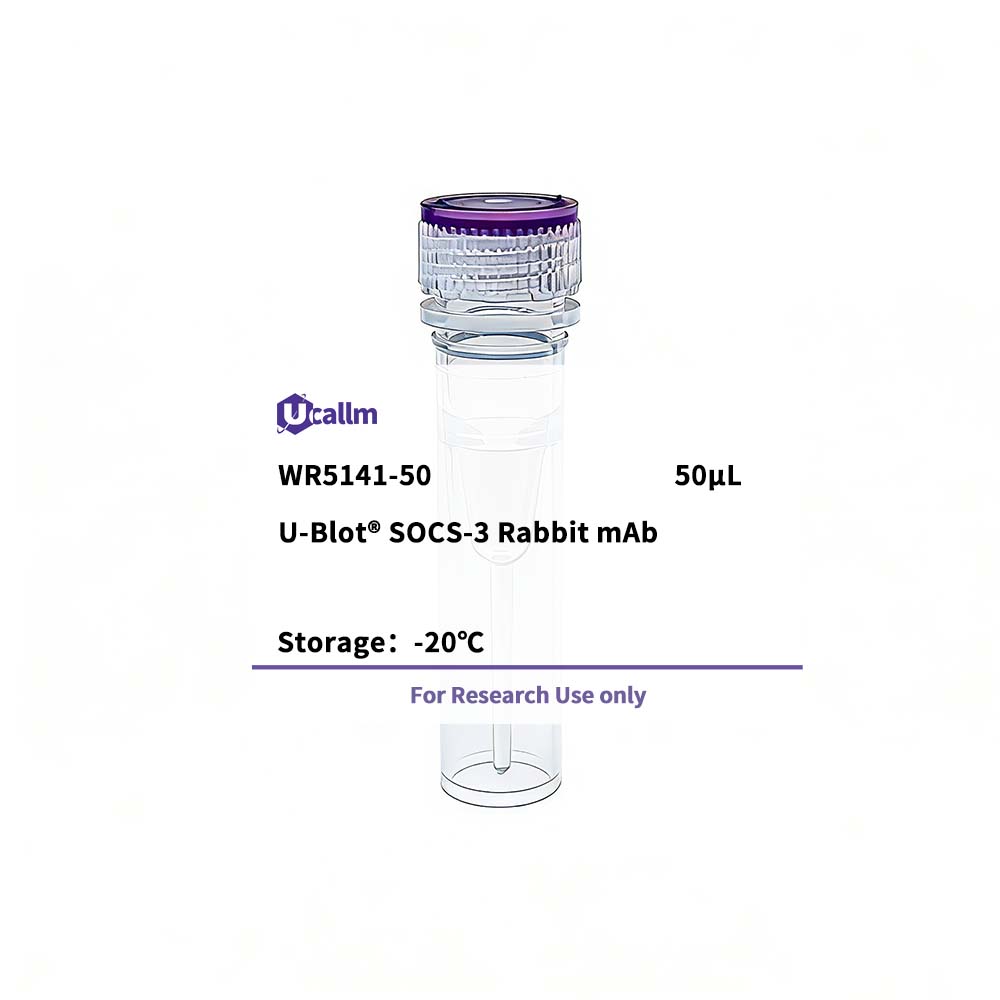
U-Blot® SOCS-3 Rabbit mAb

Price range: $268.00 through $328.00

SKU: WR5141-50
Enter the quantity you would like, or drag the panel to find the quantity and price that best for you
Bulk QuoteAuthorize OEM & ODM

Product details

Background:This gene encodes a member of the STAT-induced STAT inhibitor (SSI), also known as suppressor of cytokine signaling (SOCS), family. SSI family members are cytokine-inducible negative regulators of cytokine signaling. The expression of this gene is induced by various cytokines, including IL6, IL10, and interferon (IFN)-gamma. The protein encoded by this gene can bind to JAK2 kinase, and inhibit the activity of JAK2 kinase. Studies of the mouse counterpart of this gene suggested the roles of this gene in the negative regulation of fetal liver hematopoiesis, and placental development. [provided by RefSeq, Jul 2008],


Specifications

Size50μL/100μL
TargetSOCS-3
ReactivityHuman, Mouse, Rat
ApplicationsWB, IF, ELISA
MW(Calculated)25kD
MW(Observed)26kD
Host SpeciesRabbit
IsotypeIgG,Kappa
Conjugate/ModificationUnmodified
Recommended Dilution RatioWB 1:500-1:2000; IF 1:200-1:1000; ELISA 1:5000-1:20000;
FormulationPBS, 50% glycerol, 0.05% Proclin 300, 0.05%BSA
PurificationRecombinant Antibody expressed in animal component-free (ACF) media, purified via Protein A affinity chromatography.
Storage-15°C to -25°C/1 year(Do not lower than -25°C)
Concentration
ClonalityMonoclonal
Clone NumberRM1370R
ImmunogenThe specific immunogen used to produce this antibody is proprietary information.
SpecificityEndogenous
Gene NameSOCS3 CIS3 SSI3
Protein NameSuppressor of cytokine signaling 3 (SOCS-3) (Cytokine-inducible SH2 protein 3) (CIS-3) (STAT-induced STAT inhibitor 3) (SSI-3)
Other NameSOCS3; / CIS3; / SSI3; / Suppressor of cytokine signaling 3; / SOCS-3; / Cytokine-inducible SH2 protein 3; / CIS-3; / STAT-induced STAT inhibitor 3; / SSI-3
SpeciesHuman
Gene ID9021
UniprotO14543,
Species.1Mouse
Gene ID.112702
Uniprot.1O35718,
Species.2Rat
Gene ID.2
Uniprot.2O88583
Cellular Localizationintracellular,cytoplasm,cytosol,
Tissue ExpressionWidely expressed with high expression in heart, placenta, skeletal muscle, peripheral blood leukocytes, fetal and adult lung, and fetal liver and kidney. Lower levels in thymus.
Signaling_pathwayOrganismal Systems >> Endocrine system >> Insulin signaling pathway;Organismal Systems >> Endocrine system >> Adipocytokine signaling pathway;Organismal Systems >> Endocrine system >> Prolactin signaling pathway;Organismal Systems >> Endocrine system >> Growth hormone synthesis, secretion and action;Organismal Systems >> Development and regeneration >> Osteoclast differentiation;Environmental Information Processing >> Signal transduction >> JAK-STAT signaling pathway;Environmental Information Processing >> Signal transduction >> TNF signaling pathway
Research Areas>>Ubiquitin mediated proteolysis; / >>Osteoclast differentiation; / >>JAK-STAT signaling pathway; / >>TNF signaling pathway; / >>Insulin signaling pathway; / >>Prolactin signaling pathway; / >>Adipocytokine signaling pathway; / >>Type II diabetes mellitus; / >>Insulin resistance; / >>Non-alcoholic fatty liver disease; / >>Growth hormone synthesis, secretion and action; / >>Hepatitis C; / >>Influenza A; / >>Herpes simplex virus 1 infection
FunctionDisease:Genetic variation in the promoter region of SOCS3 may be associated with susceptibility to atopic dermatitis 4 (ATOD4) [MIM:605805]. Atopic dermatitis [MIM:603165], also known as eczema commonly begins in infancy or early childhook and is characterized by ichy and inflamed skin.,Domain:The ESS and SH2 domains are required for JAK phosphotyrosine binding. Further interaction with the KIR domain is necessary for signal and kinase inhibition.,Domain:The SOCS box domain mediates the interaction with the Elongin BC complex, an adapter module in different E3 ubiquitin ligase complexes.,Function:SOCS family proteins form part of a classical negative feedback system that regulates cytokine signal transduction. SOCS3 is involved in negative regulation of cytokines that signal through the JAK/STAT pathway. Inhibits cytokine signal transduction by binding to tyrosine kinase receptors including gp130, LIF, erythropoietin, insulin, IL12, GCSF and leptin receptors. Binding to JAK2 inhibits its kinase activity. Suppresses fetal liver erythropoiesis. Regulates onset and maintenance of allergic responses mediated by T-helper type 2 cells. Regulates IL-6 signaling in vivo (By similarity). Probable substrate recognition component of a SCF-like ECS (Elongin BC-CUL2/5-SOCS-box protein) E3 ubiquitin-protein ligase complex which mediates the ubiquitination and subsequent proteasomal degradation of target proteins. Seems to recognize IL6ST.,pathway:Protein modification; protein ubiquitination.,pharmaceutical:SOCS3 could be used as a possible therapeutic agent for treating rheumatoid arthritis.,PTM:Phosphorylated on tyrosine residues after stimulation by the cytokines, IL-2, EPO or IGF1.,similarity:Contains 1 SH2 domain.,similarity:Contains 1 SOCS box domain.,subunit:Interacts with multiple activated proteins of the tyrosine kinase signaling pathway including IGF1 receptor, insulin receptor and JAK2. Binding to JAK2 is mediated through the KIR and SH2 domains to a phosphorylated tyrosine residue within the JAK2 JH1 domain. Binds specific activated tyrosine residues of the leptin, EPO, IL12, GSCF and gp130 receptors. Interaction with CSNK1E stabilizes SOCS3 protein. Component of the probable ECS(SOCS3) E3 ubiquitin-protein ligase complex which contains CUL5, RNF7/RBX2, Elongin BC complex and SOCS3. Interacts with CUL5, RNF7, TCEB1 and TCEB2. Interacts with CUL2.,tissue specificity:Widely expressed with high expression in heart, placenta, skeletal muscle, peripheral blood leukocytes, fetal and adult lung, and fetal liver and kidney. Lower levels in thymus.,
Please login to post questions
Back to Top
Product has been added to your cart
