


U-Blot® Src Rabbit mAb
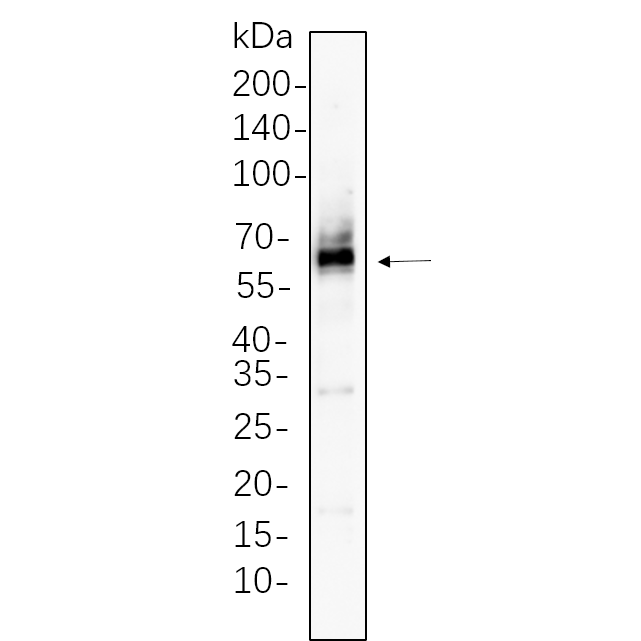
WR4372 Hela whole cell lysates were separated by 10% SDS-PAGE, and the membrane was blotted with primary antibody(1:1000). The HRP-conjugated Goat anti-Rabbit IgG(H + L) antibody was used to detect the antibody.
Price range: $268.00 through $328.00
Product details
Background:This gene is highly similar to the v-src gene of Rous sarcoma virus. This proto-oncogene may play a role in the regulation of embryonic development and cell growth. The protein encoded by this gene is a tyrosine-protein kinase whose activity can be inhibited by phosphorylation by c-SRC kinase. Mutations in this gene could be involved in the malignant progression of colon cancer. Two transcript variants encoding the same protein have been found for this gene. [provided by RefSeq, Jul 2008],
Specifications
| Size | 50μL/100μL |
| Target | c-Src |
| Reactivity | Human, Mouse, Rat |
| Applications | WB, IHC, IF, ELISA |
| MW(Calculated) | 60kD |
| MW(Observed) | 60kD |
| Host Species | Rabbit |
| Isotype | IgG,Kappa |
| Conjugate/Modification | Unmodified |
| Recommended Dilution Ratio | IHC 1:1000-1:4000; WB 1:2000-1:10000; IF 1:200-1:1000; ELISA 1:5000-1:20000; / Note: For IHC, we suggest antigen retrieval with TE buffer pH 9.0 (Cat#WT1004) |
| Formulation | PBS, 50% glycerol, 0.05% Proclin 300, 0.05%BSA |
| Purification | Recombinant Antibody expressed in animal component-free (ACF) media, purified via Protein A affinity chromatography. |
| Storage | -15°C to -25°C/1 year(Do not lower than -25°C) |
| Concentration | |
| Clonality | Monoclonal |
| Clone Number | RM0588R |
| Immunogen | The specific immunogen used to produce this antibody is proprietary information. |
| Specificity | Endogenous |
| Gene Name | SRC SRC1 |
| Protein Name | Proto-oncogene tyrosine-protein kinase Src |
| Other Name | SRC; / SRC1; / Proto-oncogene tyrosine-protein kinase Src; / Proto-oncogene c-Src; / pp60c-src; / p60-Src |
| Species | Human |
| Gene ID | 6714 |
| Uniprot | P12931, |
| Species.1 | Mouse |
| Gene ID.1 | 20779 |
| Uniprot.1 | P05480, |
| Species.2 | Rat |
| Gene ID.2 | |
| Uniprot.2 | Q9WUD9 |
| Cellular Localization | Cytoplasm, Nucleus |
| Tissue Expression | Expressed ubiquitously. Platelets, neurons and osteoclasts express 5-fold to 200-fold higher levels than most other tissues.; [Isoform 1]: Expressed in spleen and liver.; [Isoform 2]: Expressed in brain.; [Isoform 3]: Expressed in brain. |
| Signaling_pathway | Cellular Processes >> Transport and catabolism >> Mitophagy - animal;Cellular Processes >> Cellular community - eukaryotes >> Focal adhesion;Cellular Processes >> Cellular community - eukaryotes >> Adherens junction;Cellular Processes >> Cellular community - eukaryotes >> Tight junction;Cellular Processes >> Cellular community - eukaryotes >> Gap junction;Cellular Processes >> Cell motility >> Regulation of actin cytoskeleton;Organismal Systems >> Immune system >> Platelet activation;Organismal Systems >> Immune system >> Neutrophil extracellular trap formation;Organismal Systems >> Immune system >> Chemokine signaling pathway;Organismal Systems >> Endocrine system >> GnRH signaling pathway;Organismal Systems >> Endocrine system >> Estrogen signaling pathway;Organismal Systems >> Endocrine system >> Prolactin signaling pathway;Organismal Systems >> Endocrine system >> Oxytocin signaling pathway;Organismal Systems >> Endocrine system >> Relaxin signaling pathway;Organismal Systems >> Endocrine system >> Thyroid hormone signaling pathway;Organismal Systems >> Sensory system >> Inflammatory mediator regulation of TRP channels;Human Diseases >> Cancer: specific types >> Bladder cancer;Environmental Information Processing >> Signal transduction >> ErbB signaling pathway;Environmental Information Processing >> Signal transduction >> Rap1 signaling pathway;Environmental Information Processing >> Signal transduction >> VEGF signaling pathway |
| Research Areas | >>EGFR tyrosine kinase inhibitor resistance; / >>Endocrine resistance; / >>ErbB signaling pathway; / >>Rap1 signaling pathway; / >>Chemokine signaling pathway; / >>Mitophagy - animal; / >>Endocytosis; / >>Axon guidance; / >>VEGF signaling pathway; / >>Focal adhesion; / >>Adherens junction; / >>Tight junction; / >>Gap junction; / >>Platelet activation; / >>Neutrophil extracellular trap formation; / >>C-type lectin receptor signaling pathway; / >>GABAergic synapse; / >>Inflammatory mediator regulation of TRP channels; / >>Regulation of actin cytoskeleton; / >>GnRH signaling pathway; / >>Estrogen signaling pathway; / >>Prolactin signaling pathway; / >>Thyroid hormone signaling pathway; / >>Oxytocin signaling pathway; / >>Relaxin signaling pathway; / >>Bacterial invasion of epithelial cells; / >>Epithelial cell signaling in Helicobacter pylori infection; / >>Pathogenic Escherichia coli infection; / >>Shigellosis; / >>Yersinia infection; / >>Tuberculosis; / >>Hepatitis B; / >>Human cytomegalovirus infection; / >>Kaposi sarcoma-associated herpesvirus infection; / >>Herpes simplex virus 1 infection; / >>Viral carcinogenesis; / >>Proteoglycans in cancer; / >>Chemical carcinogenesis - receptor activation; / >>Chemical carcinogenesis - reactive oxygen species; / >>Bladder cancer; / >>Lipid and atherosclerosis; / >>Fluid shear stress and atherosclerosis |
| Function | Catalytic activity:ATP + a [protein]-L-tyrosine = ADP + a [protein]-L-tyrosine phosphate.,PTM:Phosphorylated on Tyr-530 by c-Src kinase (CSK). The phosphorylated form is termed pp60c-src. The phosphorylated tail interacts with the SH2 domain thereby repressing kinase activity.,similarity:Belongs to the protein kinase superfamily. Tyr protein kinase family. SRC subfamily.,similarity:Contains 1 protein kinase domain.,similarity:Contains 1 SH2 domain.,similarity:Contains 1 SH3 domain.,subunit:Interacts with DDEF1/ASAP1; via the SH3 domain. Interacts with CCPG1 (By similarity). Interacts with CDCP1, PELP1, TGFB1I1 and TOM1L2. Interacts with the cytoplasmic domain of MUC1, phosphorylates it and increases binding of MUC1 with beta-catenin. Interacts with RALGPS1; via the SH3 domain. Interacts with HEV ORF3 protein; via the SH3 domain., |
Please login to post questions
Related products



