SKU: WP3594 Categories: ,

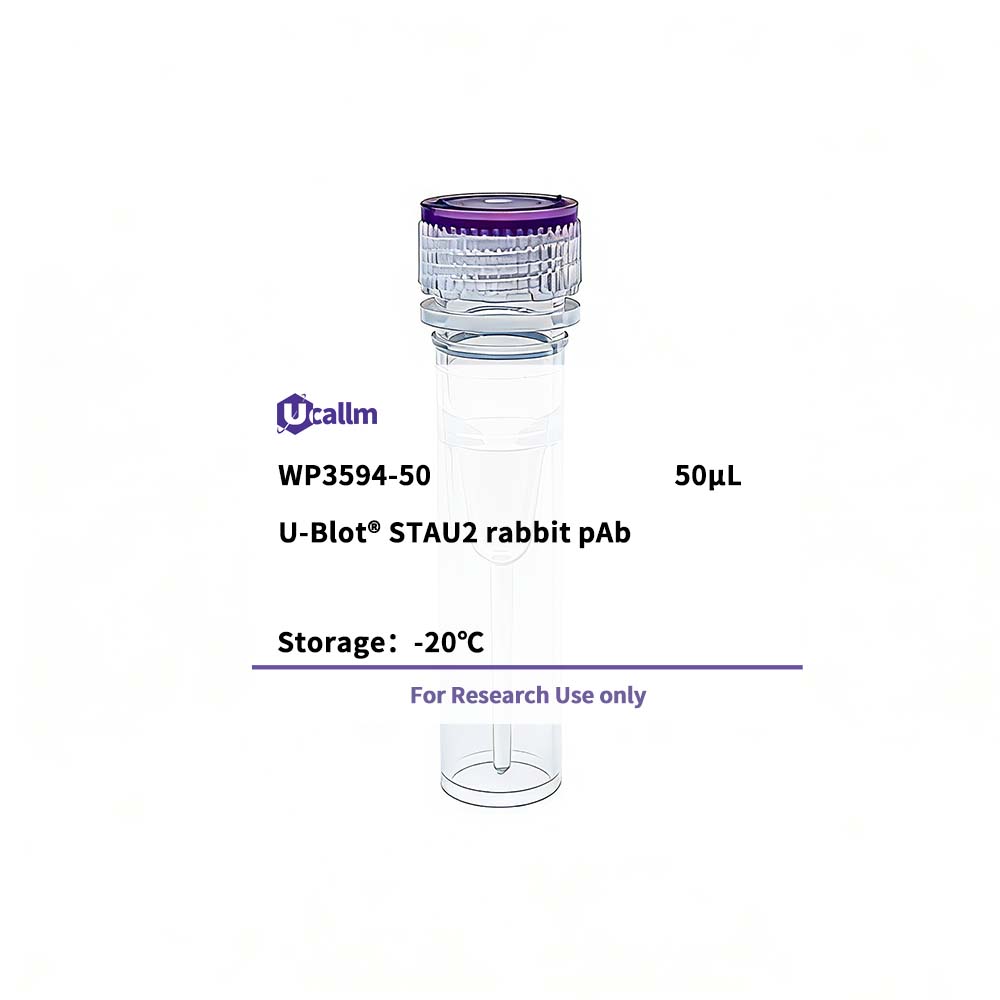
STAU2 rabbit pAb

Price range: $268.00 through $328.00

SKU: WP3594-100
Enter the quantity you would like, or drag the panel to find the quantity and price that best for you
Bulk QuoteAuthorize OEM & ODM

Product details

Background:

Staufen homolog 2 is a member of the family of double-stranded RNA (dsRNA)-binding proteins involved in the transport and/or localization of mRNAs to different subcellular compartments and/or organelles. These proteins are characterized by the presence of multiple dsRNA-binding domains which are required to bind RNAs having double-stranded secondary structures. Staufen homolog 2 shares 48.5% and 59.9% similarity with drosophila and human staufen, respectively. The exact function of Staufen homolog 2 is not known, but since it contains 3 copies of conserved dsRNA binding domain, it could be involved in double-stranded RNA binding events. Several transcript variants encoding different isoforms have been found for this gene. [provided by RefSeq, Aug 2009],

Specifications

Size50μL/100μL
TargetSTAU2
ReactivityHuman, Mouse, Rat
ApplicationsWB
MW(Calculated)
MW(Observed)65kD
Host SpeciesRabbit
IsotypeIgG
Conjugate/ModificationUnmodified
Recommended Dilution RatioWB 1:500-2000
FormulationLiquid in PBS containing 50% glycerol, 0.5% BSA and 0.02% sodium azide.
PurificationThe antibody was affinity-purified from rabbit antiserum by affinity-chromatography using epitope-specific immunogen.
Storage-15°C to -25°C/1 year(Do not lower than -25°C)
Concentration1 mg/ml
ClonalityPolyclonal
Clone Number
ImmunogenSynthesized peptide derived from human STAU2 AA range: 75-125
SpecificityThis antibody detects endogenous levels of STAU2 at Human/Mouse/Rat
Gene NameSTAU2
Protein NameSTAU2
Other NameDouble-stranded RNA-binding protein Staufen homolog 2
SpeciesHuman
Gene ID27067
UniprotQ9NUL3,
Species.1Mouse
Gene ID.129819
Uniprot.1Q8CJ67,
Species.2Rat
Gene ID.2171500
Uniprot.2Q68SB1
Cellular LocalizationCytoplasm. Nucleus. Nucleus, nucleolus. Endoplasmic reticulum. Shuttles between the nucleolus, nucleus and the cytoplasm. Nuclear export of isoform 1 is independent of XPO1/CRM1 and requires the exportin XPO5. Nuclear export of isoform 2 and isoform 3 can occur by both XPO1/CRM1-dependent and XPO1/CRM1-independent pathways. Found in large cytoplasmic ribonucleoprotein (RNP) granules which are present in the actin rich regions of myelinating processes and associated with microtubules, polysomes and the endoplasmic reticulum. Also recruited to stress granules (SGs) upon inhibition of translation or oxidative stress. These structures are thought to harbor housekeeping mRNAs when translation is aborted (By similarity). .
Tissue ExpressionAmygdala,Brain,Cerebellum,Epithelium,Ovary,PCR rescued clones,Placenta,Retina,Teratocarcinoma,Thalamus,Thymus,Trachea,Urinary bladder carcinoma,
Signaling_pathway
Research Areas
FunctionDomain:The DRBM 3 domain appears to be the major RNA-binding determinant. This domain also mediates interaction with XPO5 and is required for XPO1/CRM1-independent nuclear export.,Function:RNA-binding protein required for the microtubule-dependent transport of neuronal RNA from the cell body to the dendrite. As protein synthesis occurs within the dendrite, the localization of specific mRNAs to dendrites may be a prerequisite for neurite outgrowth and plasticity at sites distant from the cell body.,similarity:Contains 4 DRBM (double-stranded RNA-binding) domains.,subcellular location:Shuttles between the nucleolus, nucleus and the cytoplasm. Nuclear export of isoform 1 is independent of XPO1/CRM1 and requires the exportin XPO5. Nuclear export of isoform 2 and isoform 3 can occur by both XPO1/CRM1-dependent and XPO1/CRM1-independent pathways. Found in large cytoplasmic ribonucleoprotein (RNP) granules which are present in the actin rich regions of myelinating processes and associated with microtubules, polysomes and the endoplasmic reticulum. Also recruited to stress granules (SGs) upon inhibition of translation or oxidative stress. These structures are thought to harbor housekeeping mRNAs when translation is aborted.,subunit:Interacts with the exportin XPO5. This requires RNA and RAN bound to GTP. Interacts with microtubules. Isoform 2 and isoform 3 may also interact with ribosomes, and this association is independent of translation.,
Please login to post questions
Back to Top
Product has been added to your cart
