

TCF-3 Polyclonal Antibody
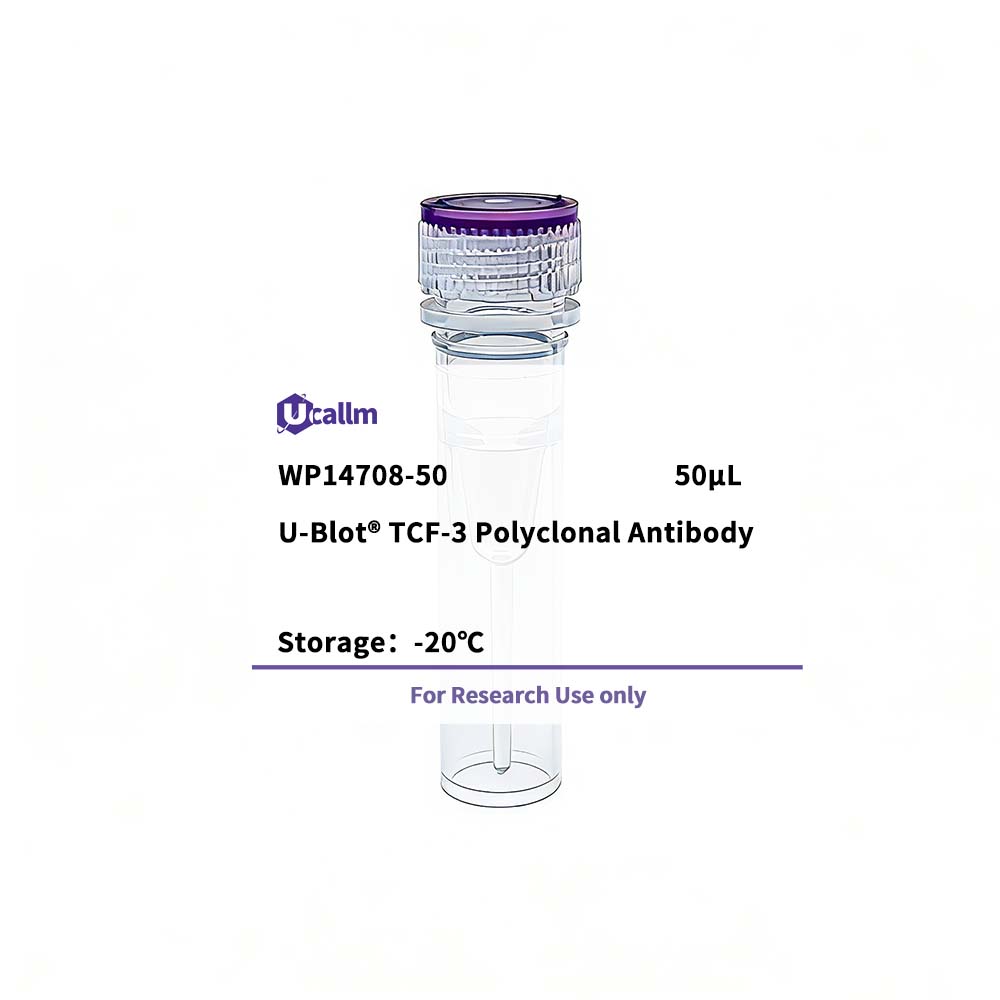
Ucallm_WP14708-50
Price range: $268.00 through $328.00
Product details
Background:
This gene encodes a member of the T cell factor/lymphoid enhancer factor family of transcription factors. These transcription factors are activated by beta catenin, mediate the Wnt signaling pathway and are antagonized by the transforming growth factor beta signaling pathway. The encoded protein contains a high mobility group-box DNA binding domain and participates in the regulation of cell cycle genes and cellular senescence. [provided by RefSeq, Nov 2010],
Specifications
| Size | 50μL/100μL |
| Target | TCF-3 |
| Reactivity | Human, Mouse |
| Applications | WB, ELISA |
| MW(Calculated) | |
| MW(Observed) | 63kD |
| Host Species | Rabbit |
| Isotype | IgG |
| Conjugate/Modification | Unmodified |
| Recommended Dilution Ratio | WB 1:500-1:2000; ELISA 1:10000; Not yet tested in other applications. |
| Formulation | Liquid in PBS containing 50% glycerol, 0.5% BSA and 0.02% sodium azide. |
| Purification | The antibody was affinity-purified from rabbit antiserum by affinity-chromatography using epitope-specific immunogen. |
| Storage | -15°C to -25°C/1 year(Do not lower than -25°C) |
| Concentration | 1 mg/ml |
| Clonality | Polyclonal |
| Clone Number | |
| Immunogen | The antiserum was produced against synthesized peptide derived from human TCF7L1. AA range:321-370 |
| Specificity | TCF-3 Polyclonal Antibody detects endogenous levels of TCF-3 protein. |
| Gene Name | TCF7L1 |
| Protein Name | Transcription factor 7-like 1 |
| Other Name | TCF7L1; / TCF3; / Transcription factor 7-like 1; / HMG box transcription factor 3; / TCF-3 |
| Species | Human |
| Gene ID | 83439 |
| Uniprot | Q9HCS4, |
| Species.1 | Mouse |
| Gene ID.1 | 21415 |
| Uniprot.1 | Q9Z1J1 |
| Species.2 | |
| Gene ID.2 | |
| Uniprot.2 | |
| Cellular Localization | Nucleus. |
| Tissue Expression | Detected in hair follicles and skin keratinocytes, and at lower levels in stomach epithelium. |
| Signaling_pathway | Cellular Processes >> Cellular community - eukaryotes >> Adherens junction;Human Diseases >> Cancer: overview >> Pathways in cancer;Human Diseases >> Cancer: specific types >> Colorectal cancer;Human Diseases >> Cancer: specific types >> Hepatocellular carcinoma;Human Diseases >> Cancer: specific types >> Gastric cancer;Human Diseases >> Cancer: specific types >> Thyroid cancer;Human Diseases >> Cancer: specific types >> Acute myeloid leukemia;Human Diseases >> Cancer: specific types >> Basal cell carcinoma;Human Diseases >> Cancer: specific types >> Prostate cancer;Human Diseases >> Cancer: specific types >> Endometrial cancer;Human Diseases >> Cancer: specific types >> Breast cancer;Environmental Information Processing >> Signal transduction >> Wnt signaling pathway;Environmental Information Processing >> Signal transduction >> Hippo signaling pathway |
| Research Areas | >>Wnt signaling pathway; / >>Hippo signaling pathway; / >>Adherens junction; / >>Melanogenesis; / >>Cushing syndrome; / >>Alcoholic liver disease; / >>Salmonella infection; / >>Human papillomavirus infection; / >>Kaposi sarcoma-associated herpesvirus infection; / >>Pathways in cancer; / >>Colorectal cancer; / >>Endometrial cancer; / >>Prostate cancer; / >>Thyroid cancer; / >>Basal cell carcinoma; / >>Acute myeloid leukemia; / >>Breast cancer; / >>Hepatocellular carcinoma; / >>Gastric cancer; / >>Arrhythmogenic right ventricular cardiomyopathy |
| Function | Domain:The putative Groucho interaction domain between the N-terminal CTNNB1 binding domain and the HMG-box is necessary for repression of the transactivation mediated by TCF7L1 and CTNNB1.,Function:Participates in the Wnt signaling pathway. Binds to DNA and acts as a repressor in the absence of CTNNB1, and as an activator in its presence. Necessary for the terminal differentiation of epidermal cells, the formation of keratohyalin granules and the development of the barrier function of the epidermis (By similarity). Down-regulates NQO1, leading to increased mitomycin c resistance.,similarity:Belongs to the TCF/LEF family.,similarity:Contains 1 HMG box DNA-binding domain.,subunit:Binds the armadillo repeat of CTNNB1 and forms a stable complex.,tissue specificity:Detected in hair follicles and skin keratinocytes, and at lower levels in stomach epithelium., |
Please login to post questions
Related products




