SKU: WP1846 Categories: ,

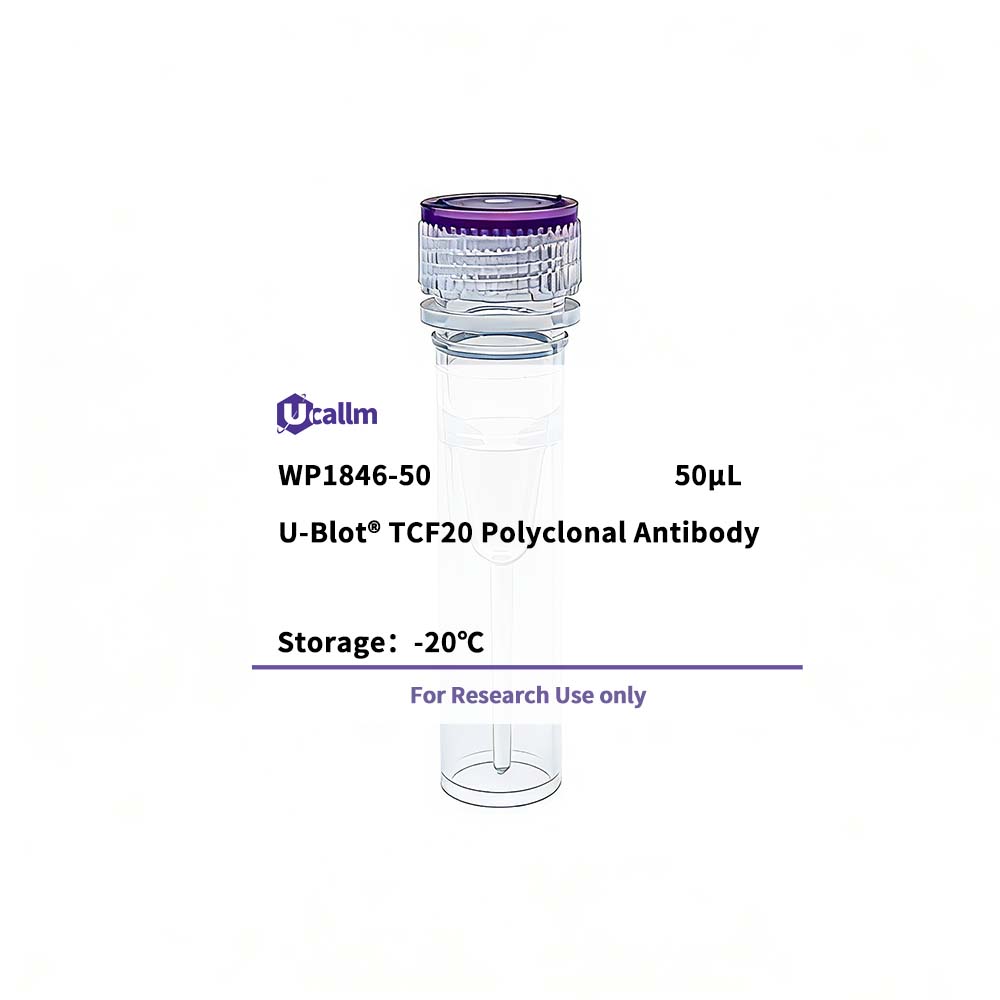
TCF20 Polyclonal Antibody

Price range: $268.00 through $328.00

SKU: WP1846-100
Enter the quantity you would like, or drag the panel to find the quantity and price that best for you
Bulk QuoteAuthorize OEM & ODM

Product details

Background:

This gene encodes a transcription factor that recognizes the platelet-derived growth factor-responsive element in the matrix metalloproteinase 3 promoter. The encoded protein is thought to be a transcriptional coactivator, enhancing the activity of transcription factors such as JUN and SP1. Mutations in this gene are associated with autism spectrum disorders. Alternative splicing results in multiple transcript variants. [provided by RefSeq, Sep 2015],


Specifications

Size50μL/100μL
TargetTCF20
ReactivityHuman, Mouse
ApplicationsWB, ELISA
MW(Calculated)
MW(Observed)215kD
Host SpeciesRabbit
IsotypeIgG
Conjugate/ModificationUnmodified
Recommended Dilution RatioWB 1:500-2000; ELISA 1:5000-20000
FormulationLiquid in PBS containing 50% glycerol,0.5% BSA and 0.02% sodium azide.
PurificationThe antibody was affinity-purified from rabbit antiserum by affinity-chromatography using epitope-specific immunogen.
Storage-15°C to -25°C/1 year(Do not lower than -25°C)
Concentration1 mg/ml
ClonalityPolyclonal
Clone Number
ImmunogenSynthesized peptide derived from part region of human protein
SpecificityTCF20 Polyclonal Antibody detects endogenous levels of protein.
Gene NameTCF20 KIAA0292 SPBP
Protein NameTranscription factor 20 (TCF-20) (Nuclear factor SPBP) (Protein AR1) (Stromelysin-1 PDGF-responsive element-binding protein) (SPRE-binding protein)
Other Name
SpeciesHuman
Gene ID6942
UniprotQ9UGU0,
Species.1Mouse
Gene ID.1
Uniprot.1Q9EPQ8
Species.2
Gene ID.2
Uniprot.2
Cellular LocalizationNucleus .
Tissue ExpressionExpressed in most tissues, except in ovary and prostate. Isoform 1 is exclusively expressed in brain, heart and testis, and this form predominates in liver and kidney. Isoform 2 predominates in lung.
Signaling_pathway
Research Areas
FunctionDomain:The atypical PHD domain functions as a negative modulator of cofactor binding.,Function:Transcriptional activator that binds to the regulatory region of MMP3 and thereby controls stromelysin expression. It stimulates the activity of various transcriptional activators such as JUN, SP1, PAX6 and ETS1, suggesting a function as a coactivator.,PTM:Phosphorylated upon DNA damage, probably by ATM or ATR.,similarity:Contains 1 A.T hook DNA-binding domain.,similarity:Contains 1 PHD-type zinc finger.,subunit:Homodimer (Probable). Interacts with RNF4 and JUN.,tissue specificity:Expressed in most tissues, except in ovary and prostate. Isoform 1 is exclusively expressed in brain, heart and testis, and this form predominates in liver and kidney. Isoform 2 predominates in lung.,
Please login to post questions
Back to Top
Product has been added to your cart