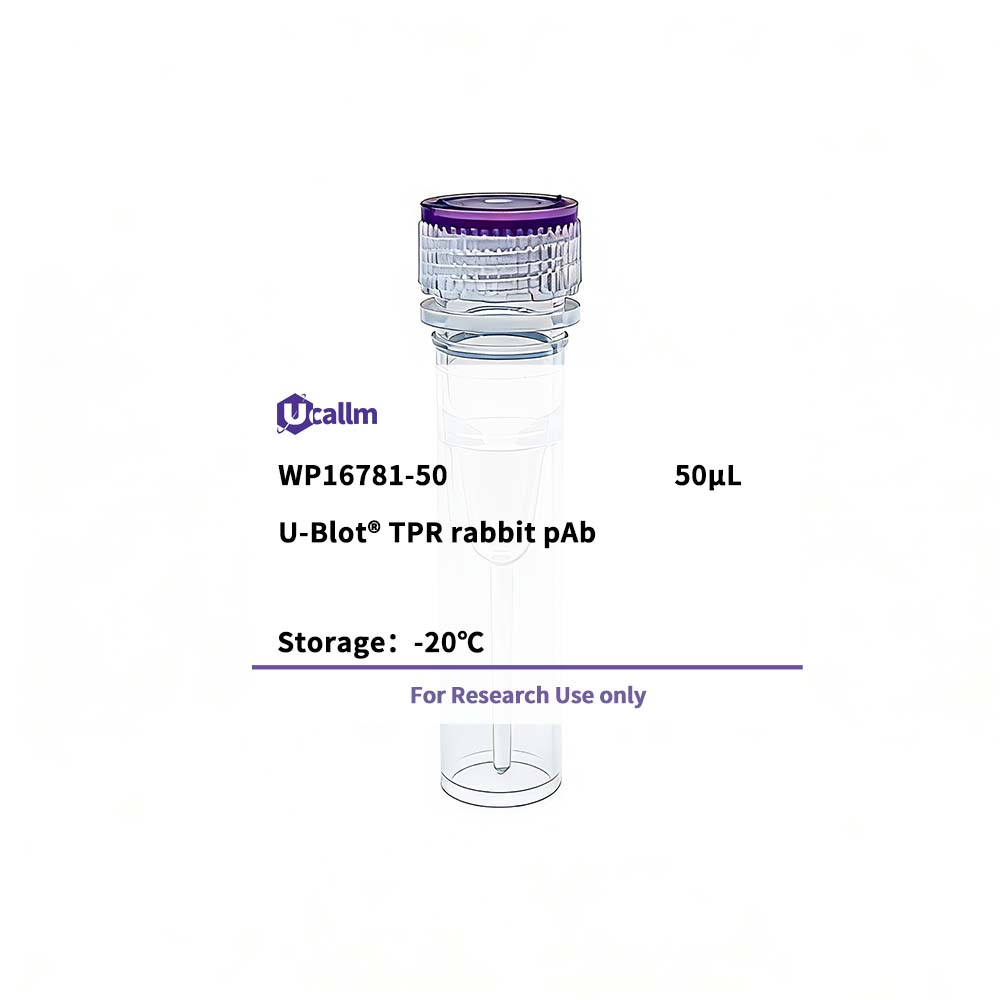
SKU: WP16781 Categories: ,

TPR rabbit pAb

Price range: $268.00 through $328.00

SKU: WP16781-100
Enter the quantity you would like, or drag the panel to find the quantity and price that best for you
Bulk QuoteAuthorize OEM & ODM

Product details

Background:

This gene encodes a large coiled-coil protein that forms intranuclear filaments attached to the inner surface of nuclear pore complexes (NPCs). The protein directly interacts with several components of the NPC. It is required for the nuclear export of mRNAs and some proteins. Oncogenic fusions of the 5' end of this gene with several different kinase genes occur in some neoplasias. [provided by RefSeq, Jul 2008],

Specifications

Size50μL/100μL
TargetTPR
ReactivityHuman, Mouse, Rat
ApplicationsWB
MW(Calculated)260kD
MW(Observed)
Host SpeciesRabbit
IsotypeIgG
Conjugate/ModificationUnmodified
Recommended Dilution RatioWB 1:500-2000
FormulationLiquid in PBS containing 50% glycerol, 0.5% BSA and 0.02% sodium azide.
PurificationThe antibody was affinity-purified from rabbit antiserum by affinity-chromatography using epitope-specific immunogen.
Storage-15°C to -25°C/1 year(Do not lower than -25°C)
Concentration1 mg/ml
ClonalityPolyclonal
Clone Number
ImmunogenSynthesized peptide derived from human TPR AA range: 2191-2241
SpecificityThis antibody detects endogenous levels of TPR at Human
Gene NameTPR
Protein NameTPR
Other Name
SpeciesHuman
Gene ID7175
UniprotP12270
Species.1
Gene ID.1
Uniprot.1
Species.2
Gene ID.2
Uniprot.2
Cellular LocalizationNucleus . Nucleus membrane; Peripheral membrane protein; Nucleoplasmic side . Nucleus envelope . Nucleus, nuclear pore complex . Cytoplasm . Cytoplasm, cytoskeleton, spindle . Chromosome, centromere, kinetochore . Nucleus membrane; Peripheral membrane protein; Cytoplasmic side . Detected as discrete intranuclear foci with IFI204 (By similarity). In interphase, localizes to the nucleoplasmic side of the nuclear pore complex (NPC) core structure, forming a fibrous structure called the nuclear basket. Detected exclusively to the cytoplasmic margin of NPC (PubMed:7798308). Docking to the inner nucleoplasmic side of the NPC is mediated through binding to nucleoporins. Anchored by NUP153 to the NPC. The assembly of the NPC is a stepwise process in which Trp-containing peripheral structures assemble after other components, including p62. Detected as filaments that emanate from the nuclear basket of the NPC and extend to the nucleolus to delineate a chromatin-free network extending from the nuclear envelope to the perinucleolar region. Detected in diffuse and discrete spheroidal intranuclear foci. Nucleocytoplasmic shuttling protein imported into the nucleus in a XPO1/CRM1- and Importin alpha/Importin beta receptor-dependent manner. Remains localized to the nuclear membrane after poliovirus (PV) infection. During mitosis, remains associated with the nuclear envelope until prometaphase. Associated with the mitotic spindle from late prometaphase until anaphase. Reorganized during mitosis in a viscous and dynamic nuclear-derived spindle matrix that embeds the microtubule spindle apparatus from pole to pole in a microtubule-independent manner. Recruited to the reforming nuclear envelope during telophase and cytokinesis. Detected at kinetochores during prometaphase (PubMed:18981471). Colocalizes with MAD2L1 in the spindle matrix but not at kinetochore (PubMed:19273613). Colocalizes with dynein, dynactin, tubulin at kinetochore during the metaphase-anaphase transition. Colocalizes with DYNLL1 at the mitotic spindle. .
Tissue ExpressionExpressed in esophagus, ovary, liver, skin, smooth muscles, cerebrum and fetal cerebellum (at protein level). Highest in testis, lung, thymus, spleen and brain, lower levels in heart, liver and kidney.
Signaling_pathwayHuman Diseases >> Cancer: overview >> Pathways in cancer;Human Diseases >> Cancer: specific types >> Thyroid cancer;Human Diseases >> Neurodegenerative disease >> Amyotrophic lateral sclerosis;Genetic Information Processing >> Translation >> Nucleocytoplasmic transport
Research Areas>>Nucleocytoplasmic transport; / >>Amyotrophic lateral sclerosis; / >>Pathways in cancer; / >>Thyroid cancer
FunctionDisease:Chromosomal aberrations involving TPR are a cause of thyroid papillary carcinoma (PACT) [MIM:188550]. Intrachromosomal rearrangement that links the 5'-end of the TPR gene to the protein kinase domain of NTRK1 forms the fusion protein TRK-T1. TRK-T1 is a 55 kDa protein reacting with antibodies against the carboxy terminus of the NTRK1 protein.,Disease:Involved in tumorigenic rearrangements with the MET or RAF genes.,Function:Component of the cytoplasmic fibrils of the nuclear pore complex implicated in nuclear protein import. Its N-terminus is involved in activation of oncogenic kinases. Plays a role in the mitotic spindle checkpoint.,PTM:Phosphorylated upon DNA damage, probably by ATM or ATR.,subcellular location:The assembly of the NPC is a stepwise process in which Trp-containing peripheral structures assemble after other components, including p62. Detected at kinetochores during prometaphase.,subunit:Interacts with MAD1L1 and MAD2L1.,tissue specificity:Highest in testis, lung, thymus, spleen and brain, lower levels in heart, liver and kidney.,
Please login to post questions
Back to Top
Product has been added to your cart
