

TRPC4 rabbit pAb
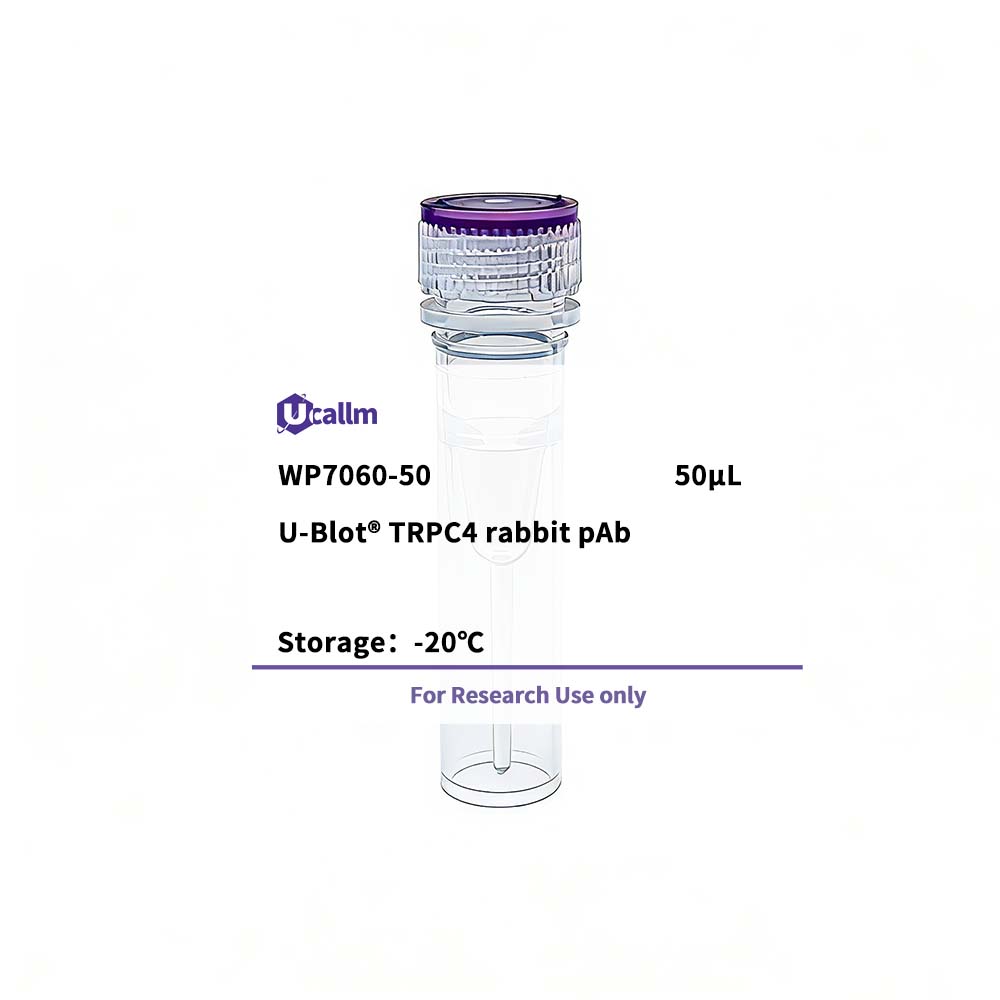
Ucallm_WP7060-50
Price range: $268.00 through $328.00
Product details
Background:
Specifications
| Size | 50μL/100μL |
| Target | TRPC4 |
| Reactivity | Human, Mouse, Rat |
| Applications | WB |
| MW(Calculated) | 107kD |
| MW(Observed) | |
| Host Species | Rabbit |
| Isotype | IgG |
| Conjugate/Modification | Unmodified |
| Recommended Dilution Ratio | WB 1:500-2000 |
| Formulation | Liquid in PBS containing 50% glycerol, 0.5% BSA and 0.02% sodium azide. |
| Purification | The antibody was affinity-purified from rabbit antiserum by affinity-chromatography using epitope-specific immunogen. |
| Storage | -15°C to -25°C/1 year(Do not lower than -25°C) |
| Concentration | 1 mg/ml |
| Clonality | Polyclonal |
| Clone Number | |
| Immunogen | Synthesized peptide derived from human TRPC4 |
| Specificity | This antibody detects endogenous levels of TRPC4 at Human, Mouse,Rat |
| Gene Name | TRPC4 |
| Protein Name | Short transient receptor potential channel 4 (TrpC4) (Trp-related protein 4) (hTrp-4) (hTrp4) |
| Other Name | |
| Species | Human |
| Gene ID | 7223 |
| Uniprot | Q9UBN4, |
| Species.1 | Mouse |
| Gene ID.1 | 22066 |
| Uniprot.1 | Q9QUQ5, |
| Species.2 | Rat |
| Gene ID.2 | |
| Uniprot.2 | O35119 |
| Cellular Localization | Membrane; Multi-pass membrane protein. Cell membrane; Multi-pass membrane protein. Enhanced insertion into the cell membrane after activation of the EGF receptor. |
| Tissue Expression | Strongly expressed in placenta. Expressed at lower levels in heart, pancreas, kidney and brain. Expressed in endothelial cells. Isoform alpha was found to be the predominant isoform. Isoform beta was not found in pancreas and brain. |
| Signaling_pathway | |
| Research Areas | |
| Function | Forms a receptor-activated non-selective calcium permeant cation channel. Acts as a cell-cell contact-dependent endothelial calcium entry channel. Probably operated by a phosphatidylinositol second messenger system activated by receptor tyrosine kinases or G-protein coupled receptors. Mediates cation entry, with an enhanced permeability to barium over calcium. May also be activated by intracellular calcium store depletion. |
Please login to post questions
Related products





