

U-Blot® Actin (pan) Rabbit mAb (Ready to Use)
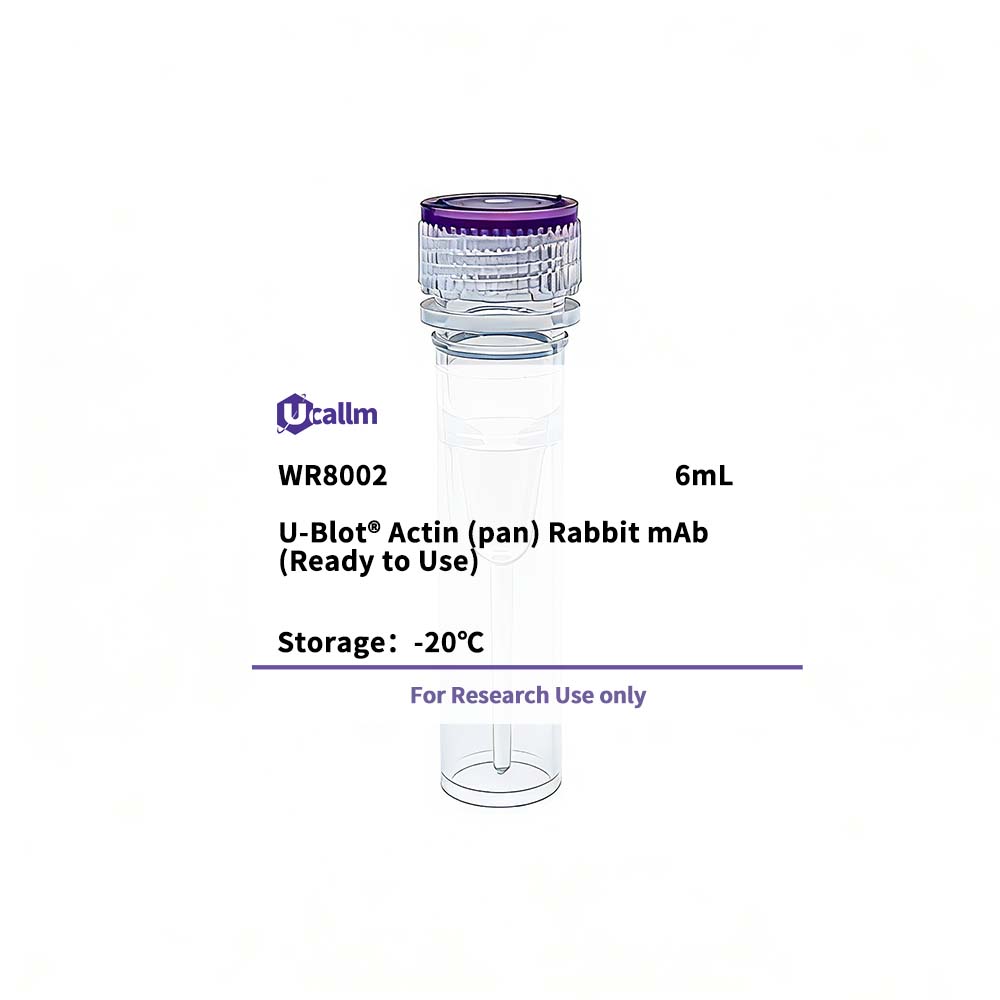
Ucallm_WR8002
$168.00
Product details
Background:
Actin, a ubiquitous eukaryotic protein, is the major component of the cytoskeleton. At least six isoforms are known in mammals. Nonmuscle β- and γ-actin, also known as cytoplasmic actin, are ubiquitously expressed, controlling cell structure and motility . While all actin isoforms are highly homologous, cytoplasmic β- and γ-actin protein sequences differ by only four biochemically similar amino acids. For this reason, antibodies raised to β-actin may cross-react with γ-actin, and vice versa. α-cardiac and α-skeletal actin are expressed in striated cardiac and skeletal muscles, respectively; two smooth muscle actins, α- and γ-actin, are found primarily in vascular smooth muscle and enteric smooth muscle, respectively. These actin isoforms regulate the contractile potential of muscle cells. Actin exists mainly as a fibrous polymer, F-actin. In response to cytoskeletal reorganizing signals during processes such as cytokinesis, endocytosis, or stress, cofilin promotes fragmentation and depolymerization of F-actin, resulting in an increase in the monomeric globular form, G-actin. The ARP2/3 complex stabilizes F-actin fragments and promotes formation of new actin filaments. Research studies have shown that actin is hyperphosphorylated in primary breast tumors. Cleavage of actin under apoptotic conditions has been observed in vitro and in cardiac and skeletal muscle, as shown in research studies. Actin cleavage by caspase-3 may accelerate ubiquitin/proteasome-dependent muscle proteolysis.
Specifications
| Size | 6mL |
| Target | Actin pan |
| Reactivity | Human, Mouse, Rat, Bovine, Pig, Chicken |
| Applications | IHC |
| MW(Calculated) | |
| MW(Observed) | |
| Host Species | Rabbit |
| Isotype | IgG1,Kappa |
| Conjugate/Modification | Unmodified |
| Recommended Dilution Ratio | Ready to use for IHC / Note: For IHC, we suggest antigen retrieval with TE buffer pH 9.0 (Cat#WT1004) |
| Formulation | The prediluted ready-to-use antibody is diluted in phosphate buffer saline containing stabilizing protein and 0.05% Proclin 300 |
| Purification | Recombinant Expression and Affinity purified |
| Storage | 2°C to 8°C/1 year,Ship by ice bag |
| Concentration | |
| Clonality | Monoclonal |
| Clone Number | RM56R |
| Immunogen | Synthesized peptide derived from human Actin pan AA range:300-377 |
| Specificity | This antibody detects endogenous levels of Actin pan |
| Gene Name | ACTC1; ACTA1; ACTA2; ACTB; ACTG1; ACTG2 |
| Protein Name | Actin pan |
| Other Name | Actin, alpha cardiac muscle 1; / Alpha-cardiac actin; / ACTC; / Actin, alpha skeletal muscle; / Alpha-actin-1; / ACTA1; / Actin, aortic smooth muscle; / Alpha-actin-2; / ACTA2; / ACTSA, ACTVS; / Actin, cytoplasmic 1; / Beta-actin; / ACTB; / Actin, cytoplasmic 2; / Gamma-actin; / ACTG1; / ACTG; / Actin, gamma-enteric smooth muscle; / Alpha-actin-3; / Gamma-2-actin; / Smooth muscle gamma-actin; / ACTA3, ACTL3, ACTSG; / ACTG2 |
| Species | Human |
| Gene ID | 70;58;59;60;71;72 |
| Uniprot | P62736;P68032;P60709;P63261;P68133;P63267, |
| Species.1 | Mouse |
| Gene ID.1 | 11475;11464;11465;11468;11459;11461 |
| Uniprot.1 | |
| Species.2 | |
| Gene ID.2 | |
| Uniprot.2 | |
| Cellular Localization | Cytoplasm, cytoskeleton . Nucleus . Localized in cytoplasmic mRNP granules containing untranslated mRNAs. . |
| Tissue Expression | B-cell lymphoma,Brain,Cajal-Retzius cell,Eye,Fetal brain cortex,Foreskin,Hepatocellular car |
| Signaling_pathway | Cellular Processes >> Transport and catabolism >> Phagosome;Cellular Processes >> Cell growth and death >> Apoptosis;Cellular Processes >> Cellular community - eukaryotes >> Focal adhesion;Cellular Processes >> Cellular community - eukaryotes >> Adherens junction;Cellular Processes >> Cellular community - eukaryotes >> Tight junction;Cellular Processes >> Cell motility >> Regulation of actin cytoskeleton;Organismal Systems >> Immune system >> Platelet activation;Organismal Systems >> Immune system >> Neutrophil extracellular trap formation;Organismal Systems >> Immune system >> Leukocyte transendothelial migration;Organismal Systems >> Endocrine system >> Oxytocin signaling pathway;Organismal Systems >> Endocrine system >> Relaxin signaling pathway;Organismal Systems >> Endocrine system >> Thyroid hormone signaling pathway;Organismal Systems >> Circulatory system >> Cardiac muscle contraction;Organismal Systems >> Circulatory system >> Adrenergic signaling in cardiomyocytes;Organismal Systems >> Circulatory system >> Vascular smooth muscle contraction;Human Diseases >> Cancer: specific types >> Hepatocellular carcinoma;Human Diseases >> Neurodegenerative disease >> Amyotrophic lateral sclerosis;Environmental Information Processing >> Signal transduction >> Rap1 signaling pathway;Environmental Information Processing >> Signal transduction >> Hippo signaling pathway;Environmental Information Processing >> Signal transduction >> Apelin signaling pathway;Genetic Information Processing >> Chromosome >> ATP-dependent chromatin remodeling |
| Research Areas | >>Vascular smooth muscle contraction; / >>Apelin signaling pathway; / >>Relaxin signaling pathway |
| Function | Disease:Defects in ACTB are a cause of dystonia juvenile-onset (DYTJ) [MIM:607371]. DYTJ is a form of dystonia with juvenile onset. Dystonia is defined by the presence of sustained involuntary muscle contraction, often leading to abnormal postures. DYTJ patients manifest progressive, generalized, dopa-unresponsive dystonia, developmental malformations and sensory hearing loss.,Function:Actins are highly conserved proteins that are involved in various types of cell motility and are ubiquitously expressed in all eukaryotic cells.,miscellaneous:In vertebrates 3 main groups of actin isoforms, alpha, beta and gamma have been identified. The alpha actins are found in muscle tissues and are a major constituent of the contractile apparatus. The beta and gamma actins coexist in most cell types as components of the cytoskeleton and as mediators of internal cell motility.,similarity:Belongs to the actin family.,subunit:Polymerization of globular actin (G-actin) leads to a structural filament (F-actin) in the form of a two-stranded helix. Each actin can bind to 4 others. Component of the BAF complex, which includes at least actin (ACTB), ARID1A, ARID1B/BAF250, SMARCA2, SMARCA4/BRG1, ACTL6A/BAF53, ACTL6B/BAF53B, SMARCE1/BAF57 SMARCC1/BAF155, SMARCC2/BAF170, SMARCB1/SNF5/INI1, and one or more of SMARCD1/BAF60A, SMARCD2/BAF60B, or SMARCD3/BAF60C. In muscle cells, the BAF complex also contains DPF3. Found in a complex with XPO6, Ran, ACTB and PFN1. Interacts with XPO6., |
Please login to post questions
Related products



