

Specifications
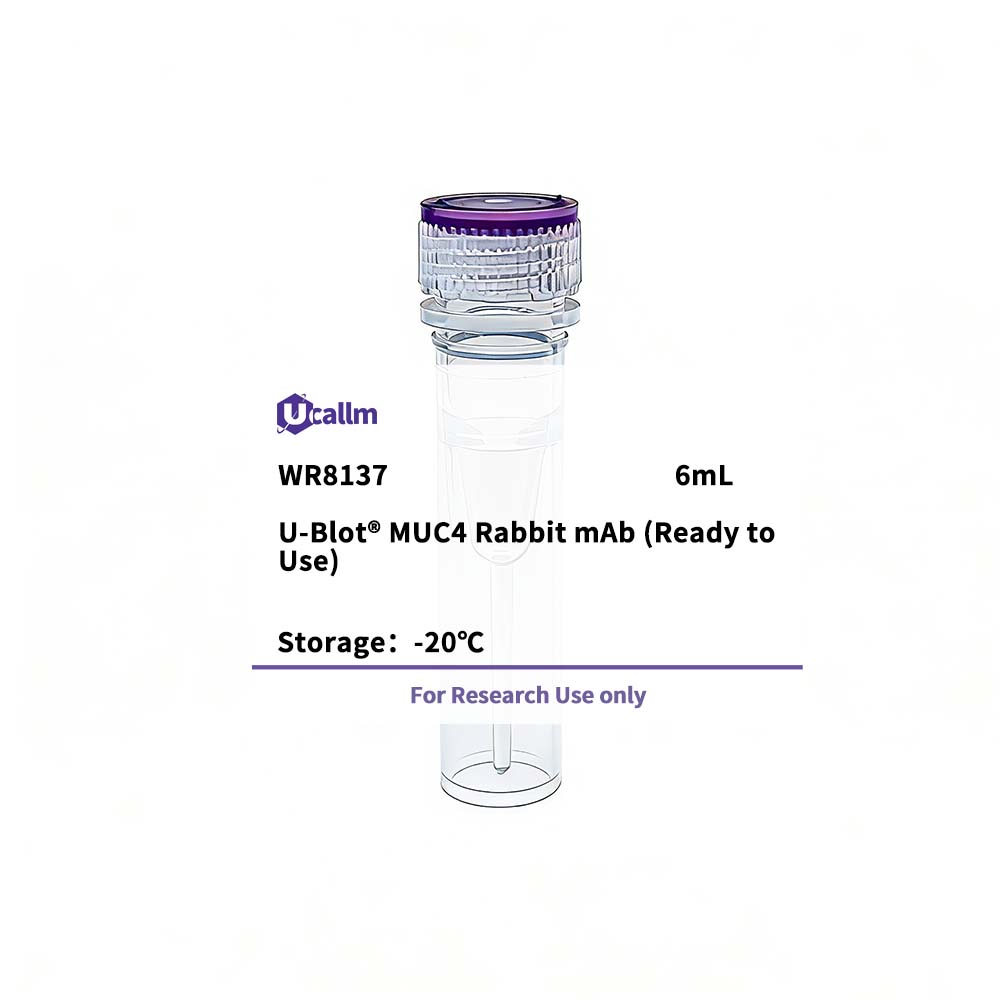
| Size | 6mL |
| Target | MUC4 |
| Reactivity | Human |
| Applications | IHC |
| MW(Calculated) | |
| MW(Observed) | |
| Host Species | Rabbit |
| Isotype | IgG1,Kappa |
| Conjugate/Modification | Unmodified |
| Recommended Dilution Ratio | Ready to use for IHC / Note: For IHC, we suggest antigen retrieval with TE buffer pH 9.0 (Cat#WT1004) |
| Formulation | The prediluted ready-to-use antibody is diluted in phosphate buffer saline containing stabilizing protein and 0.05% Proclin 300 |
| Purification | The antibody was affinity-purified from Cell supernatant by affinity-chromatography using specific immunogen. |
| Storage | 2°C to 8°C/1 year,Ship by ice bag |
| Concentration | |
| Clonality | Monoclonal |
| Clone Number | RM174R |
| Immunogen | Synthesized peptide derived from human MUC4 |
| Specificity | This antibody detects endogenous levels of MUC4 at Human |
| Gene Name | MUC4 |
| Protein Name | MUC4 |
| Other Name | Mucin-4; / MUC-4; / Ascites sialoglycoprotein; / ASGP; / Pancreatic adenocarcinoma mucin; / Testis mucin; / Tracheobronchial mucin; / [Cleaved into: Mucin-4 alpha chain; / Ascites sialoglycoprotein 1; / ASGP-1; / Mucin-4 beta chain; / Ascites sialoglycoprotein 2; / ASGP-2; / ] |
| Species | Human |
| Gene ID | 3662 |
| Uniprot | Q99102 |
| Species.1 | |
| Gene ID.1 | |
| Uniprot.1 | |
| Species.2 | |
| Gene ID.2 | |
| Uniprot.2 | |
| Cellular Localization | [Mucin-4 beta chain]: Cell membrane; Single-pass membrane protein . Isoforms lacking the Cys-rich region, EGF-like domains and transmembrane region are secreted. Secretion occurs by splicing or proteolytic processing. .; [Mucin-4 alpha chain]: Cell membrane . Secreted . Forms a complex with Mucin-4 beta chain at the cell membrane. .; [Isoform 3]: Cell membrane; Single-pass membrane protein .; [Isoform 11]: Secreted .; [Isoform 15]: Secreted .; [Isoform 17]: Cell membrane; Single-pass membrane protein . |
| Tissue Expression | Expressed in the thymus, thyroid, lung, trachea, esophagus, stomach, small intestine, colon, testis, prostate, ovary, uterus, placenta, and mammary and salivary glands. Expressed in carcinomas arising from some of these epithelia, such as lung cancers, squamous cell carcinomas of the upper aerodigestive tract, mammary carcinomas, biliary tract, colon, and cervix cancers. Minimally or not expressed in the normal pancreas or chronic pancreatitis, but is highly expressed in pancreatic tumors and pancreatic tumor cell lines. |
| Signaling_pathway | Organismal Systems >> Immune system >> Th17 cell differentiation |
| Research Areas | |
| Function | Alternative products:Additional isoforms exist,developmental stage:Expressed early in the primitive gut before respiratory and digestive epithelial cells have acquired their tissue and cell specificity. Expressed at the basal surface of the epithelium from week 14 to 26 weeks and then predominantly localized in only parietal cells. Immediately before birth, found in the cytoplasm of the mucous columnar epithelial cells. In the embryo expressed in skin, then disappears late in gestation.,Function:May play a role in tumor progression. Ability to promote tumor growth may be mainly due to repression of apoptosis as opposed to proliferation. Has anti-adhesive properties. Seems to alter cellular behavior through both anti-adhesive effects on cell-cell and cell-extracellular matrix interactions and in its ability to act as an intramembrane ligand for ERBB2. Plays an important role in cell proliferation and differentiation of epithelial cells by inducing specific phosphorylation of ERBB2. The MUC4-ERBB2 complex causes site-specific phosphorylation of the ERBB2 'Tyr-1248'. In polarized epithelilal cells segragates ERBB2 and other ERBB receptors and prevents ERBB2 from acting as a coreceptor. The interaction with ERBB2 leads to enhanced expression of CDKN1B. The formation of a MUC4-ERBB2-ERBB3-NRG1 complex leads to down-regulation of CDKN1B, resulting in repression of apoptosis and stimulation of proliferation.,miscellaneous:Expression is a very useful predictor of poor prognosis in patients with invasive ductal carcinoma and intrahepatic cholangiocarcinoma, mass forming type (IDC,ICC-MF). Patients with IDC or ICC-MF who have high MUC4 expression had a worse survival rate than those with low MUC4 expression.,PTM:Mucin-4 alpha chain is highly O-glycosylated.,PTM:mucin-4 beta chain is predominantly N-glycosylated.,PTM:Proteolytically cleaved into 2 chains, mucin-4 alpha chain and mucin-4 beta chain.,sequence Caution:May be derived from an intron translation.,similarity:Contains 1 AMOP domain.,similarity:Contains 1 NIDO domain.,similarity:Contains 1 VWFD domain.,similarity:Contains 2 EGF-like domains.,subcellular location:Isoforms lacking the Cys-rich region, EGF-like domains and transmembrane region are secreted. Secretion occurs by splicing or proteolytic processing.,subunit:A heterodimeric complex, composed of a mucin-4 alpha chain and a cysteine-rich transmembrane mucin-4 beta chain. Mucin-4 beta chain interacts with ERBB2 via the EGF-like domain 1. In nonpolarized cells, associates with ERBB2 and ERBB3.,tissue specificity:Expressed in the thymus, thyroid, lung, trachea, esophagus, stomach, small intestine, colon, testis, prostate, ovary, uterus, placenta, and mammary and salivary glands. Expressed in carcinomas arising from some of these epithelia, such as lung cancers, squamous cell carcinomas of the upper aerodigestive tract, mammary carcinomas, biliary tract, colon, and cervix cancers. Minimally or not expressed in the normal pancreas or chronic pancreatitis, but is highly expressed in pancreatic tumors and pancreatic tumor cell lines., |




