

Product details
Background:
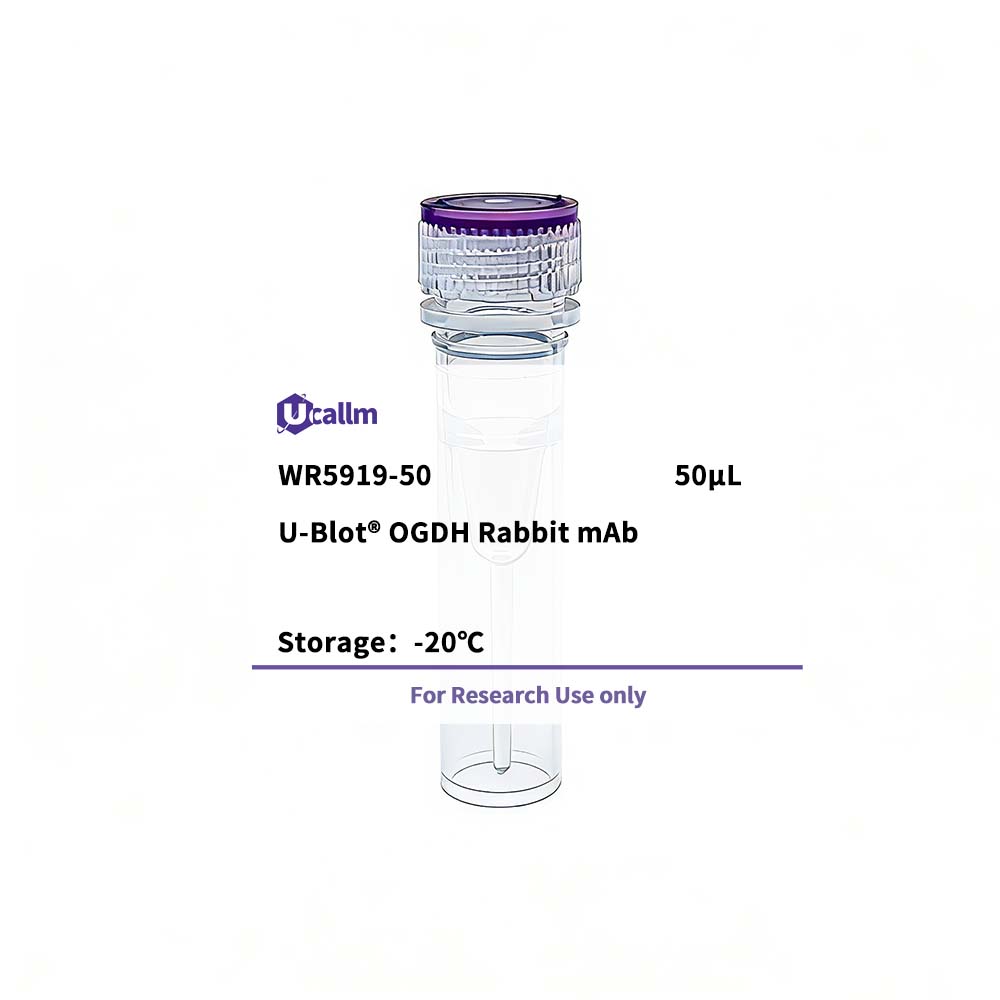
Price range: $268.00 through $328.00
Background:
| Size | 50μL/100μL |
| Target | OGDH |
| Reactivity | Human, Mouse, Rat |
| Applications | WB, IHC, IF, ELISA |
| MW(Calculated) | 116kD |
| MW(Observed) | 116kD |
| Host Species | Rabbit |
| Isotype | IgG,Kappa |
| Conjugate/Modification | Unmodified |
| Recommended Dilution Ratio | IHC 1:200-1:1000; WB 1:2000-1:10000; IF 1:200-1:1000; ELISA 1:5000-1:20000; / Note: For IHC, we suggest antigen retrieval with TE buffer pH 9.0 (Cat#WT1004) |
| Formulation | PBS, 50% glycerol, 0.05% Proclin 300, 0.05%BSA |
| Purification | Recombinant Antibody expressed in animal component-free (ACF) media, purified via Protein A affinity chromatography. |
| Storage | -15°C to -25°C/1 year(Do not lower than -25°C) |
| Concentration | |
| Clonality | Monoclonal |
| Clone Number | RM1909R |
| Immunogen | The specific immunogen used to produce this antibody is proprietary information. |
| Specificity | Endogenous |
| Gene Name | OGDH |
| Protein Name | 2-oxoglutarate dehydrogenase, mitochondrial (2-oxoglutarate dehydrogenase complex component E1) (OGDC-E1) (Alpha-ketoglutarate dehydrogenase) |
| Other Name | |
| Species | Human |
| Gene ID | 4967 |
| Uniprot | Q02218, |
| Species.1 | Mouse |
| Gene ID.1 | 18293 |
| Uniprot.1 | Q60597, |
| Species.2 | Rat |
| Gene ID.2 | 360975 |
| Uniprot.2 | Q5XI78 |
| Cellular Localization | Mitochondrion . Nucleus . Mainly localizes in the mitochondrion. A small fraction localizes to the nucleus, where the 2-oxoglutarate dehydrogenase complex is required for histone succinylation. . |
| Tissue Expression | |
| Signaling_pathway | |
| Research Areas | |
| Function | 2-oxoglutarate dehydrogenase (E1o) component of the 2-oxoglutarate dehydrogenase complex (OGDHC) . Participates in the first step, rate limiting for the overall conversion of 2-oxoglutarate to succinyl-CoA and CO(2) catalyzed by the whole OGDHC . Catalyzes the irreversible decarboxylation of 2-oxoglutarate (alpha-ketoglutarate) via the thiamine diphosphate (ThDP) cofactor and subsequent transfer of the decarboxylated acyl intermediate on an oxidized dihydrolipoyl group that is covalently amidated to the E2 enzyme (dihydrolipoyllysine-residue succinyltransferase or DLST) . Plays a key role in the Krebs (citric acid) cycle, which is a common pathway for oxidation of fuel molecules, including carbohydrates, fatty acids, and amino acids . Can catalyze the decarboxylation of 2-oxoadipate in vitro, but at a much lower rate than 2-oxoglutarate . Mainly active in the mitochondrion . A fraction of the 2-oxoglutarate dehydrogenase complex also localizes in the nucleus and is required for lysine succinylation of histones: associates with KAT2A on chromatin and provides succinyl-CoA to histone succinyltransferase KAT2A . |





