

U-Blot® PEPCK Rabbit mAb
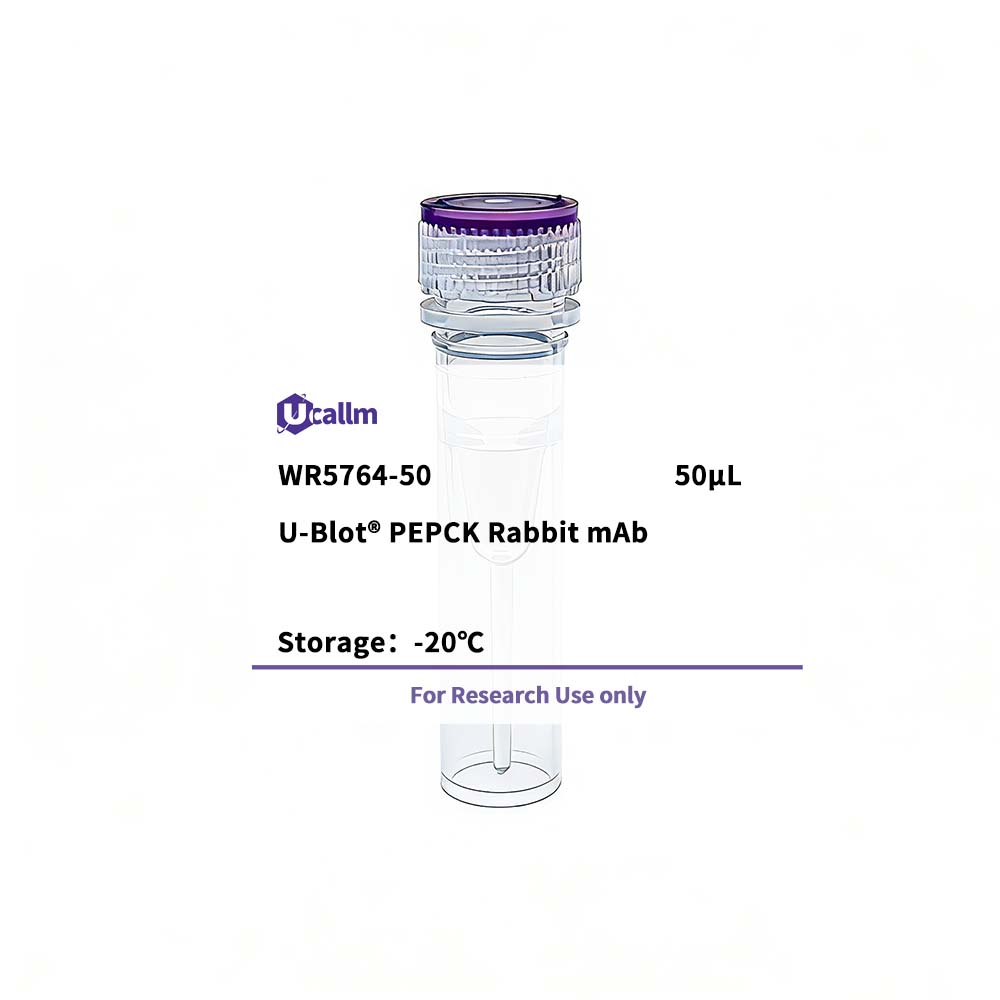
Ucallm_WR5764-50
Price range: $268.00 through $328.00
Specifications
| Size | 50μL/100μL |
| Target | PCK2 |
| Reactivity | Human, Mouse, Rat |
| Applications | WB, IHC, IF, ELISA |
| MW(Calculated) | 71kD |
| MW(Observed) | 68kD |
| Host Species | Rabbit |
| Isotype | IgG,Kappa |
| Conjugate/Modification | Unmodified |
| Recommended Dilution Ratio | IHC 1:200-1:1000; WB 1:2000-1:10000; IF 1:200-1:1000; ELISA 1:5000-1:20000; / Note: For IHC, we suggest antigen retrieval with TE buffer pH 9.0 (Cat#WT1004) |
| Formulation | PBS, 50% glycerol, 0.05% Proclin 300, 0.05%BSA |
| Purification | Recombinant Antibody expressed in animal component-free (ACF) media, purified via Protein A affinity chromatography. |
| Storage | -15°C to -25°C/1 year(Do not lower than -25°C) |
| Concentration | |
| Clonality | Monoclonal |
| Clone Number | RM1727R |
| Immunogen | The specific immunogen used to produce this antibody is proprietary information. |
| Specificity | Endogenous |
| Gene Name | PCK2 |
| Protein Name | Phosphoenolpyruvate carboxykinase [GTP] mitochondrial |
| Other Name | PEPCK; / PCK2; / PEPCK2; / Phosphoenolpyruvate carboxykinase [GTP]; / mitochondrial; / PEPCK-M; / Phosphoenolpyruvate carboxylase |
| Species | Human |
| Gene ID | 5106 |
| Uniprot | Q16822, |
| Species.1 | Mouse |
| Gene ID.1 | 74551 |
| Uniprot.1 | Q8BH04 |
| Species.2 | |
| Gene ID.2 | |
| Uniprot.2 | |
| Cellular Localization | Mitochondrion. |
| Tissue Expression | Liver,Neuroblastoma,Placenta, |
| Signaling_pathway | Organismal Systems >> Endocrine system >> Insulin signaling pathway;Organismal Systems >> Endocrine system >> Glucagon signaling pathway;Organismal Systems >> Endocrine system >> Adipocytokine signaling pathway;Organismal Systems >> Endocrine system >> PPAR signaling pathway;Environmental Information Processing >> Signal transduction >> FoxO signaling pathway;Environmental Information Processing >> Signal transduction >> PI3K-Akt signaling pathway;Environmental Information Processing >> Signal transduction >> AMPK signaling pathway |
| Research Areas | >>Glycolysis / Gluconeogenesis; / >>Citrate cycle (TCA cycle); / >>Pyruvate metabolism; / >>Metabolic pathways; / >>PPAR signaling pathway; / >>FoxO signaling pathway; / >>PI3K-Akt signaling pathway; / >>AMPK signaling pathway; / >>Insulin signaling pathway; / >>Adipocytokine signaling pathway; / >>Glucagon signaling pathway; / >>Insulin resistance; / >>Proximal tubule bicarbonate reclamation |
| Function | Catalytic activity:GTP + oxaloacetate = GDP + phosphoenolpyruvate + CO(2).,cofactor:Binds 1 manganese ion per subunit.,cofactor:Manganese.,Disease:Defects in PCK2 are the cause of mitochondrial phosphoenolpyruvate carboxykinase deficiency (mitochondrial PEPCK deficiency) [MIM:261650]. PEPCK deficiency is a metabolic disorder resulting from impaired gluconeogenesis. It is a rare disease with less than 10 cases reported in the literature. Clinical characteristics include hypotonia, hepatomegaly, failure to thrive, lactic acidosis and hypoglycaemia. Autoposy reveals fatty infiltration of both the liver and kidneys. The disorder is transmitted as an autosomal recessive trait.,Function:Catalyzes the conversion of oxaloacetate (OAA) to phosphoenolpyruvate (PEP), the rate-limiting step in the metabolic pathway that produces glucose from lactate and other precursors derived from the citric acid cycle.,miscellaneous:In eukaryotes there are two isozymes: a cytoplasmic one and a mitochondrial one.,pathway:Carbohydrate biosynthesis; gluconeogenesis.,PTM:Phosphorylated upon DNA damage, probably by ATM or ATR.,similarity:Belongs to the phosphoenolpyruvate carboxykinase [GTP] family.,subunit:Monomer., |
Please login to post questions
Related products





