

U-Blot® Proliferating Cell Nuclear Antigen Mouse mAb (Ready to Use)
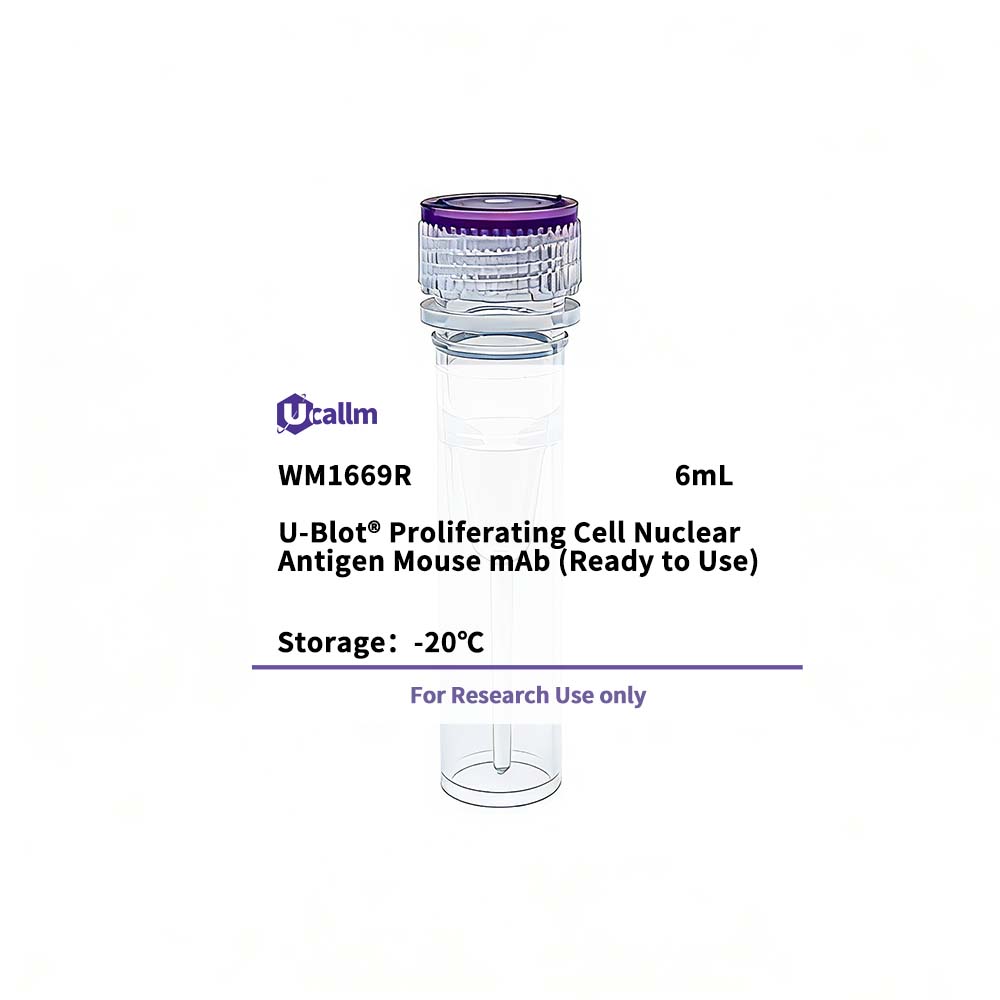
Ucallm_WM1669R
$168.00
Product details
Background:
The protein encoded by this gene is found in the nucleus and is a cofactor of DNA polymerase delta. The encoded protein acts as a homotrimer and helps increase the processivity of leading strand synthesis during DNA replication. In response to DNA damage, this protein is ubiquitinated and is involved in the RAD6-dependent DNA repair pathway. Two transcript variants encoding the same protein have been found for this gene. Pseudogenes of this gene have been described on chromosome 4 and on the X chromosome. [provided by RefSeq, Jul 2008],
Specifications
| Size | 6mL |
| Target | PCNA |
| Reactivity | Human, Mouse, Rat |
| Applications | IHC |
| MW(Calculated) | |
| MW(Observed) | |
| Host Species | Mouse |
| Isotype | IgG2b,Kappa |
| Conjugate/Modification | Unmodified |
| Recommended Dilution Ratio | Ready to use for IHC / Note: For IHC, we suggest antigen retrieval with TE buffer pH 9.0 (Cat#WT1004) |
| Formulation | The prediluted ready-to-use antibody is diluted in phosphate buffer saline containing stabilizing protein and 0.05% Proclin 300 |
| Purification | The antibody was affinity-purified from ascites by affinity-chromatography using specific immunogen. |
| Storage | 2°C to 8°C/1 year,Ship by ice bag |
| Concentration | |
| Clonality | Monoclonal |
| Clone Number | RMM221 |
| Immunogen | Synthesized peptide derived from human Proliferating Cell Nuclear Antigen AA range: 1-100 |
| Specificity | The antibody can specifically recognize human PCNA protein. |
| Gene Name | PCNA |
| Protein Name | Proliferating cell nuclear antigen |
| Other Name | ATLD2; / cb16; / Cyclin; / DNA polymerase delta auxiliary protein; / etID36690.10; / fa28e03; / fb36g03; / HGCN8729; / MGC8367; / Mutagen-sensitive 209 protein; / OTTHUMP00000030189; / OTTHUMP00000030190; / PCNA; / Pcna/cyclin; / PCNA_HUMAN; / PCNAR; / Polymerase delta accessory protein; / Proliferating cell nuclear antigen; / wu:fa28e03; / wu:fb36g03 |
| Species | Human |
| Gene ID | 5111 |
| Uniprot | P12004, |
| Species.1 | Mouse |
| Gene ID.1 | 18538 |
| Uniprot.1 | P17918, |
| Species.2 | Rat |
| Gene ID.2 | 25737 |
| Uniprot.2 | P04961 |
| Cellular Localization | Nuclear |
| Tissue Expression | Tonsil/ Colon |
| Signaling_pathway | Cellular Processes >> Cell growth and death >> Cell cycle;Cellular Processes >> Cellular community - eukaryotes >> Tight junction |
| Research Areas | >>DNA replication; / >>Base excision repair; / >>Nucleotide excision repair; / >>Mismatch repair; / >>Cell cycle; / >>Tight junction; / >>Hepatitis B |
| Function | Disease:Antibodies are present in sera from patients with systemic lupus erythematosus.,Function:This protein is an auxiliary protein of DNA polymerase delta and is involved in the control of eukaryotic DNA replication by increasing the polymerase's processibility during elongation of the leading strand.,online information:PCNA entry,PTM:Upon methyl methanesulfonate-induced DNA damage, mono-ubiquitinated by the UBE2B-RAD18 complex on Lys-164. This induces non-canonical poly-ubiquitination on Lys-164 through 'Lys-63' linkage of ubiquitin moieties by the E2 complex UBE2N-UBE2V2 and the E3 ligases RNF8 and SHPRH, which are required for DNA repair.,similarity:Belongs to the PCNA family.,subunit:Homotrimer. Interacts with KCTD10. Interacts with PPP1R15A (By similarity). Forms a complex with activator 1 heteropentamer in the presence of ATP. Interacts with POLH, POLK, DNMT1, ERCC5/XPG, FEN1, CDC6, APEX2 and POLDIP2. Interacts with EXO1 and SHPRH. Forms a ternary complex with DNTTIP2 and core histone. Interacts with POLD1, POLD3 and POLD4. Interacts with BAZ1B/WSTF; the interaction is direct., |
Please login to post questions
Related products




