SKU: WM0553 Categories: ,

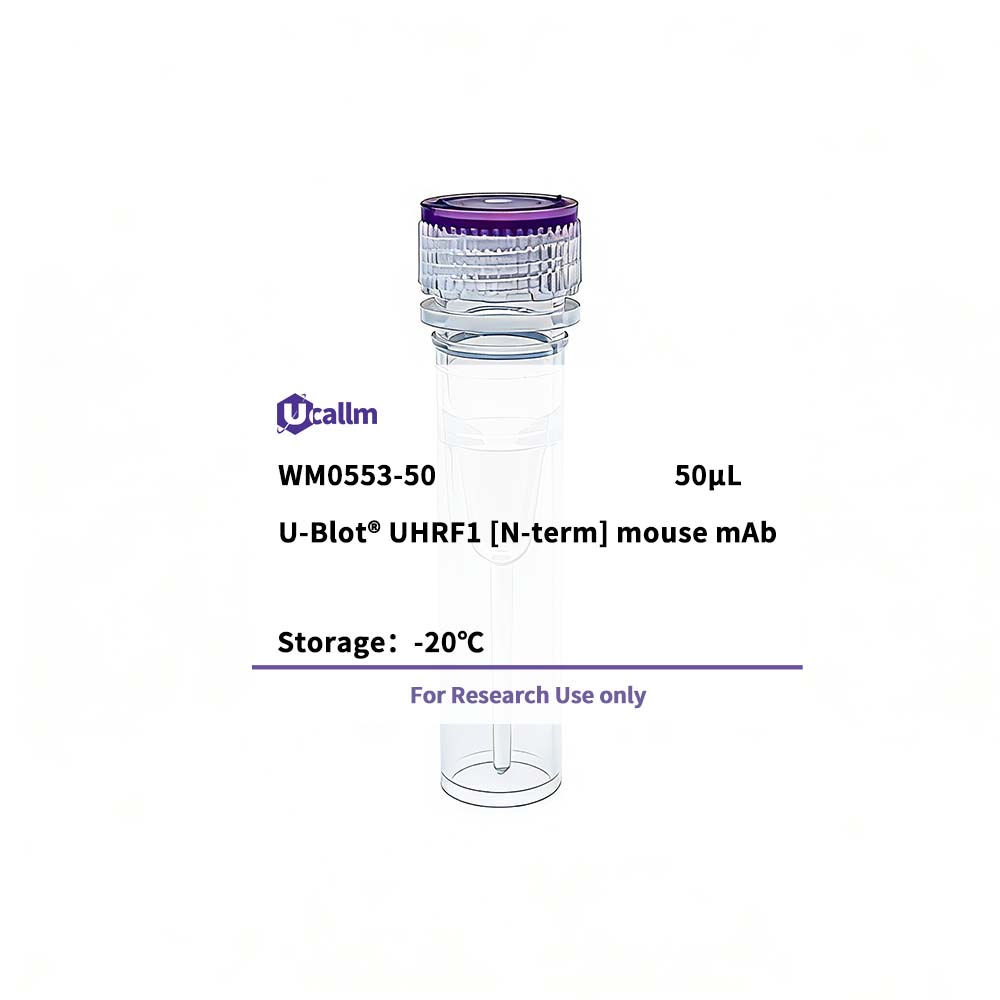
UHRF1 [N-term] mouse mAb

Price range: $268.00 through $328.00

SKU: WM0553-50
Enter the quantity you would like, or drag the panel to find the quantity and price that best for you
Bulk QuoteAuthorize OEM & ODM

Product details

Background:
This gene encodes a member of a subfamily of RING-finger type E3 ubiquitin ligases. The protein binds to specific DNA sequences, and recruits a histone deacetylase to regulate gene expression. Its expression peaks at late G1 phase and continues during G2 and M phases of the cell cycle. It plays a major role in the G1/S transition by regulating topoisomerase IIalpha and retinoblastoma gene expression, and functions in the p53-dependent DNA damage checkpoint. It is regarded as a hub protein for the integration of epigenetic information. This gene is up-regulated in various cancers, and it is therefore considered to be a therapeutic target. Multiple transcript variants encoding different isoforms have been found for this gene. A related pseudogene exists on chromosome 12. [provided by RefSeq, Feb 2014],

Specifications

Size50μL/100μL
TargetUHRF1
ReactivityHuman, Mouse
ApplicationsWB
MW(Calculated)
MW(Observed)90kD
Host SpeciesMouse
Isotype
Conjugate/ModificationUnmodified
Recommended Dilution RatioWB 1:1000
FormulationLiquid in PBS containing 50% glycerol, 0.5% BSA and 0.02% sodium azide.
PurificationThe antibody was affinity-purified from mouse ascites by affinity-chromatography using epitope-specific immunogen.
Storage-15°C to -25°C/1 year(Do not lower than -25°C)
Concentration
ClonalityMonoclonal
Clone Number6G3
ImmunogenPurified recombinant human UHRF1 protein fragments expressed in E.coil.
SpecificityThis antibody detects endogenous levels of UHRF1 and does not cross-react with related proteins
Gene NameUHRF1
Protein Name
Other NameAc2-121; / AL022808; / E3 ubiquitin-protein ligase UHRF1; / FLJ21925; / Hnp95 Huhrf1; / HuNp95; / ICBP90; / Inverted CCAAT box binding protein of 90 kDa; / Inverted CCAAT box binding protein, 90-Kd; / Inverted CCAAT box-binding protein of 90 kDa; / Liver regeneration-related protein LRRG126; / MGC138707; / NP95; / Nuclear phosphoprotein, 95-KD; / Nuclear protein 95; / Nuclear zinc finger protein Np95; / RING finger protein 106; / RNF106; / Transcription factor ICBP90; / Ubiquitin like containing PHD and RING finger domains protein 1; / Ubiquitin like PHD and RING finger domain containing protein 1; / Ubiquitin-like PHD and RING finger domain-containing protein 1; / Ubiquitin-like protein containing PHD and RING finger domains 1; / Ubiquitin-like with PHD and ring finger domains 1; / Ubiquitin-like, containing PHD and RING finger domains, 1; / Ubiquitin-like-containing PHD and RING finger domains protein 1; / UHRF1; / UHRF1_HUMAN.
SpeciesHuman
Gene ID29128
UniprotQ96T88,
Species.1Mouse
Gene ID.1
Uniprot.1Q8VDF2
Species.2
Gene ID.2
Uniprot.2
Cellular LocalizationNucleus . Localizes to replication foci. Enriched in pericentric heterochromatin. Also localizes to euchromatic regions.
Tissue ExpressionExpressed in thymus, bone marrow, testis, lung and heart. Overexpressed in breast cancer.
Signaling_pathway
Research Areas
Functiondevelopmental stage:Expressed in fetal thymus, liver and kidney.,Domain:The RING finger is required for ubiquitin ligase activity.,Domain:The YDG domain mediates the interaction with histone H3.,Function:Putative E3 ubiquitin-protein ligase. May participate in methylation-dependent transcriptional regulation. Binds to inverted 5'-CCAAT-3' box 2 in the TOP2A promoter, and activates TOP2A expression. Important for G1/S transition. May be involved in DNA repair and chromosomal stability.,induction:Up-regulated in proliferating cells, and down-regulated in quiescent cells. Down-regulated upon adriamycin-induced DNA damage, in a TP53/p53 and CDKN1A-dependent way. Induced by E2F1 transcription factor.,pathway:Protein modification; protein ubiquitination.,PTM:Phosphorylated on serine residues. Phosphorylation may enhance DNA-binding activity.,PTM:Ubiquitinated; which leads to proteasomal degradation. Polyubiquitination may be stimulated by DNA damage.,similarity:Contains 1 PHD-type zinc finger.,similarity:Contains 1 ubiquitin-like domain.,similarity:Contains 1 YDG domain.,similarity:Contains 2 RING-type zinc fingers.,subunit:Interacts with histones H3, H1 and H2B (By similarity). Interacts with HDAC1, but not with HDAC2. Interacts with UHRF1BP1. Binds methylated CpG containing oligonucleotides.,tissue specificity:Expressed in thymus, bone marrow, testis, lung and heart. Overexpressed in breast cancer.,
Please login to post questions
Back to Top
Product has been added to your cart
