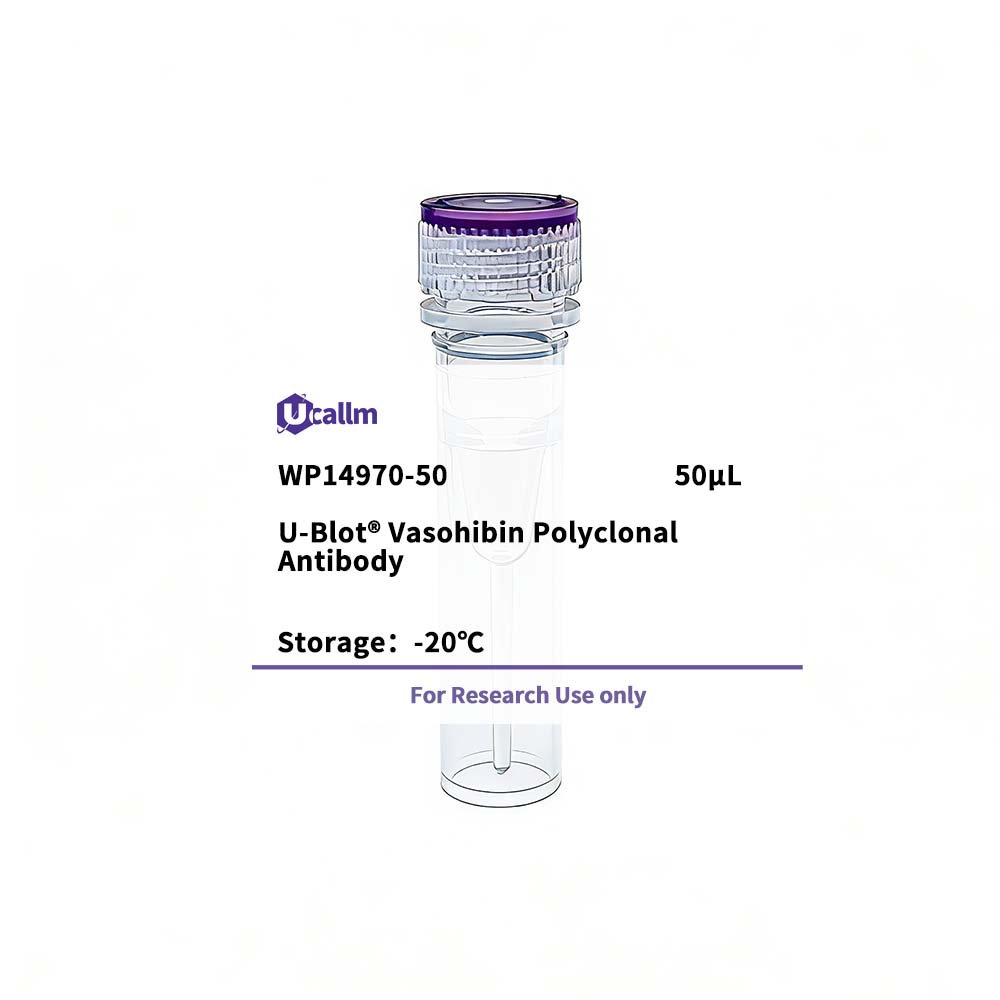
SKU: WP14970 Categories: ,

Vasohibin Polyclonal Antibody

Price range: $268.00 through $328.00

SKU: WP14970-100
Enter the quantity you would like, or drag the panel to find the quantity and price that best for you
Bulk QuoteAuthorize OEM & ODM

Product details

Background:

caution:Although probably secreted, it lacks a canonical signal sequence., function:Angiogenesis inhibitor. Inhibits migration, proliferation and network formation by endothelial cells as well as angiogenesis. This inhibitory effect is selective to endothelial cells as it does not affect the migration of smooth muscle cells or fibroblasts. Does not affect the proliferation of cancer cells in vitro, but inhibits tumor growth and tumor angiogenesis. Acts in an autocrine manner. Inhibits artery neointimal formation and macrophage infiltration. Exhibits heparin-binding activity., induction:By VEGF., PTM:2 major forms (42 and 36 kDa) and 2 minors (32 and 27 kDa) may be processed by proteolytic cleavage. The largest form (42 kDa) seems to be secreted and the other major form (63 kDa) seems to accumulate within the cells or pericellular milieu. Polypeptide consisting of Met-77 to Arg-318 may correspond to the 27 kDa form and that consisting of Met-77 to Val-365 may correspond to the 36 kDa form., similarity:Belongs to the vasohibin family., tissue specificity:Preferentially expressed in endothelial cells. Highly expressed in fetal organs. Expressed in brain and placenta, and at lower level in heart and kidney. Highly detected in microvessels endothelial cells of atherosclerotic lesions.,

Specifications

Size50μL/100μL
TargetVasohibin
ReactivityHuman, Mouse, Rat
ApplicationsWB, IHC, ELISA
MW(Calculated)
MW(Observed)40kD
Host SpeciesRabbit
IsotypeIgG
Conjugate/ModificationUnmodified
Recommended Dilution RatioIHC 1:200-1:1000; WB 1:500-1:2000; ELISA 1:40000; Not yet tested in other applications. / Note: For IHC, we suggest antigen retrieval with TE buffer pH 9.0 (Cat#WT1004)
FormulationLiquid in PBS containing 50% glycerol, 0.5% BSA and 0.02% sodium azide.
PurificationThe antibody was affinity-purified from rabbit antiserum by affinity-chromatography using epitope-specific immunogen.
Storage-15°C to -25°C/1 year(Do not lower than -25°C)
Concentration1 mg/ml
ClonalityPolyclonal
Clone Number
ImmunogenThe antiserum was produced against synthesized peptide derived from human VASH1. AA range:261-310
SpecificityVasohibin Polyclonal Antibody detects endogenous levels of Vasohibin protein.
Gene NameVASH1
Protein NameVasohibin-1
Other NameVASH1; / KIAA1036; / VASH; / Vasohibin-1
SpeciesHuman
Gene ID22846
UniprotQ7L8A9,
Species.1Mouse
Gene ID.1238328
Uniprot.1Q8C1W1
Species.2
Gene ID.2
Uniprot.2
Cellular LocalizationCytoplasm . Secreted . Mainly localizes in the cytoplasm (PubMed:27879017). Some fraction is secreted via a non-canonical secretion system; interaction with SVBP promotes secretion (PubMed:27879017). .
Tissue ExpressionPreferentially expressed in endothelial cells (PubMed:15467828, PubMed:16707096). Highly expressed in fetal organs (PubMed:15467828). Expressed in brain and placenta, and at lower level in heart and kidney (PubMed:15467828). Highly detected in microvessels endothelial cells of atherosclerotic lesions (PubMed:16707096).
Signaling_pathway
Research Areas
FunctionCaution:Although probably secreted, it lacks a canonical signal sequence.,Function:Angiogenesis inhibitor. Inhibits migration, proliferation and network formation by endothelial cells as well as angiogenesis. This inhibitory effect is selective to endothelial cells as it does not affect the migration of smooth muscle cells or fibroblasts. Does not affect the proliferation of cancer cells in vitro, but inhibits tumor growth and tumor angiogenesis. Acts in an autocrine manner. Inhibits artery neointimal formation and macrophage infiltration. Exhibits heparin-binding activity.,induction:By VEGF.,PTM:2 major forms (42 and 36 kDa) and 2 minors (32 and 27 kDa) may be processed by proteolytic cleavage. The largest form (42 kDa) seems to be secreted and the other major form (63 kDa) seems to accumulate within the cells or pericellular milieu. Polypeptide consisting of Met-77 to Arg-318 may correspond to the 27 kDa form and that consisting of Met-77 to Val-365 may correspond to the 36 kDa form.,similarity:Belongs to the vasohibin family.,tissue specificity:Preferentially expressed in endothelial cells. Highly expressed in fetal organs. Expressed in brain and placenta, and at lower level in heart and kidney. Highly detected in microvessels endothelial cells of atherosclerotic lesions.,

Please login to post questions
Back to Top
Product has been added to your cart
