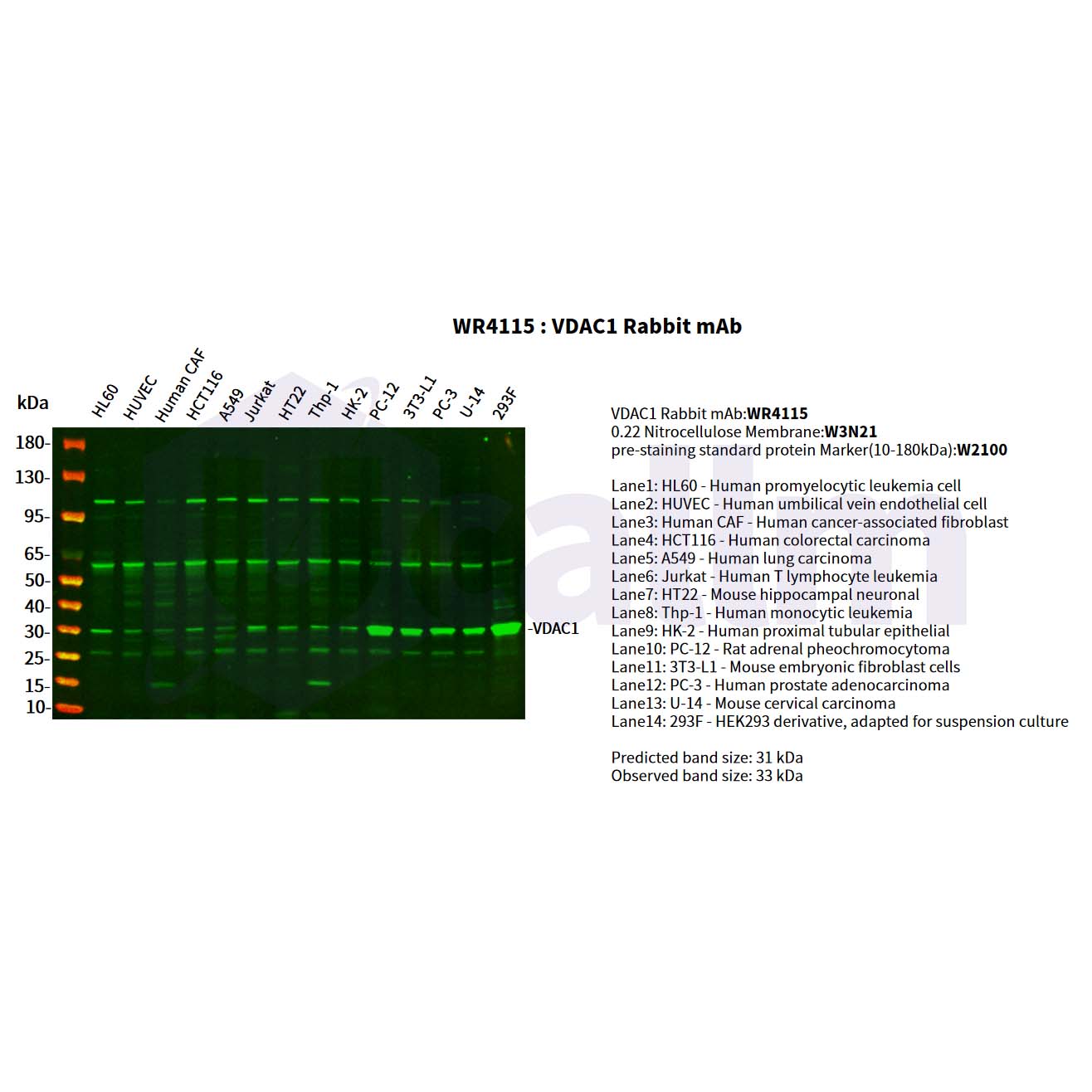
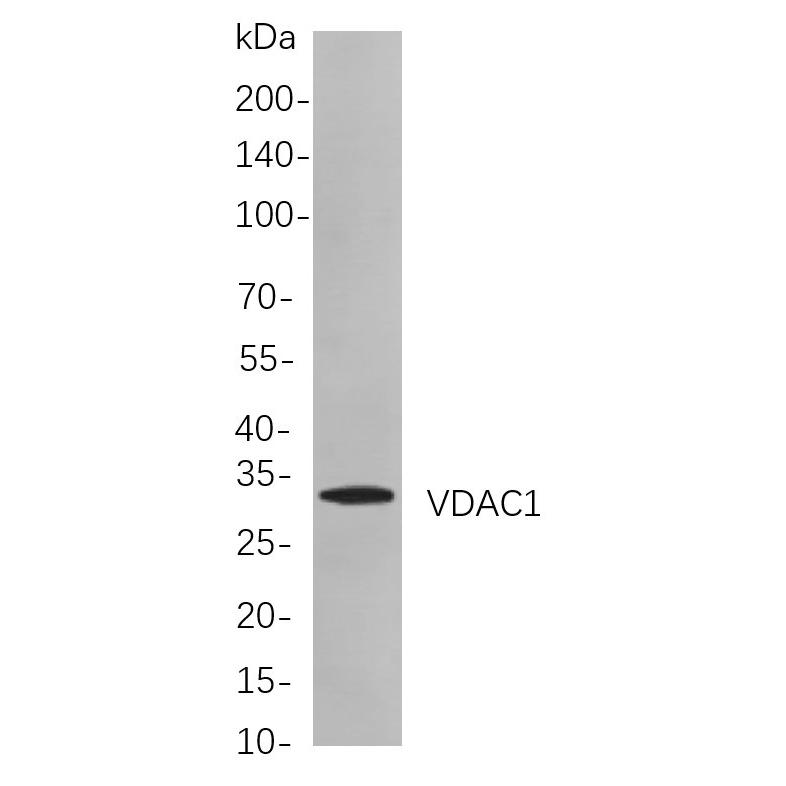
SKU: WR4115 Categories: ,

U-Blot® VDAC1 Rabbit mAb

Price range: $268.00 through $328.00

SKU: WR4115-50
Enter the quantity you would like, or drag the panel to find the quantity and price that best for you
Bulk QuoteAuthorize OEM & ODM

Product details

Background:This gene encodes a voltage-dependent anion channel protein that is a major component of the outer mitochondrial membrane. The encoded protein facilitates the exchange of metabolites and ions across the outer mitochondrial membrane and may regulate mitochondrial functions. This protein also forms channels in the plasma membrane and may be involved in transmembrane electron transport. Alternate splicing results in multiple transcript variants. Multiple pseudogenes of this gene are found on chromosomes 1, 2 3, 6, 9, 12, X and Y.[provided by RefSeq, Sep 2010],

Specifications

Size50μL/100μL
TargetVDAC1
ReactivityHuman, Mouse, Rat
ApplicationsWB, IHC, IF, ELISA
MW(Calculated)31kD
MW(Observed)33kD
Host SpeciesRabbit
IsotypeIgG,Kappa
Conjugate/ModificationUnmodified
Recommended Dilution RatioIHC 1:200-1:1000; WB 1:1000-1:5000; IF 1:200-1:1000; ELISA 1:5000-1:20000; / Note: For IHC, we suggest antigen retrieval with TE buffer pH 9.0 (Cat#WT1004)
FormulationPBS, 50% glycerol, 0.05% Proclin 300, 0.05%BSA
PurificationRecombinant Antibody expressed in animal component-free (ACF) media, purified via Protein A affinity chromatography.
Storage-15°C to -25°C/1 year(Do not lower than -25°C)
Concentration
ClonalityMonoclonal
Clone NumberRM0214R
ImmunogenThe specific immunogen used to produce this antibody is proprietary information.
SpecificityEndogenous
Gene NameVDAC1
Protein NameVoltage-dependent anion-selective channel protein 1
Other NameVDAC1; / VDAC; / Voltage-dependent anion-selective channel protein 1; / VDAC-1; / hVDAC1; / Outer mitochondrial membrane protein porin 1; / Plasmalemmal porin; / Porin 31HL; / Porin 31HM
SpeciesHuman
Gene ID7416
UniprotP21796,
Species.1Mouse
Gene ID.122333
Uniprot.1Q60932,
Species.2Rat
Gene ID.283529
Uniprot.2Q9Z2L0
Cellular LocalizationCytoplasm, Membrane
Tissue ExpressionExpressed in erythrocytes (at protein level) (PubMed:27641616). Expressed in heart, liver and skeletal muscle (PubMed:8420959).
Signaling_pathwayCellular Processes >> Cell growth and death >> Necroptosis;Cellular Processes >> Cell growth and death >> Cellular senescence;Organismal Systems >> Immune system >> Neutrophil extracellular trap formation;Organismal Systems >> Immune system >> NOD-like receptor signaling pathway;Human Diseases >> Neurodegenerative disease >> Alzheimer disease;Human Diseases >> Neurodegenerative disease >> Parkinson disease;Human Diseases >> Neurodegenerative disease >> Amyotrophic lateral sclerosis;Human Diseases >> Neurodegenerative disease >> Huntington disease;Human Diseases >> Neurodegenerative disease >> Spinocerebellar ataxia;Human Diseases >> Neurodegenerative disease >> Prion disease;Human Diseases >> Neurodegenerative disease >> Pathways of neurodegeneration - multiple diseases;Environmental Information Processing >> Signal transduction >> Calcium signaling pathway;Environmental Information Processing >> Signal transduction >> cGMP-PKG signaling pathway
Research Areas>>Calcium signaling pathway; / >>cGMP-PKG signaling pathway; / >>Necroptosis; / >>Cellular senescence; / >>Neutrophil extracellular trap formation; / >>NOD-like receptor signaling pathway; / >>Cholesterol metabolism; / >>Alzheimer disease; / >>Parkinson disease; / >>Amyotrophic lateral sclerosis; / >>Huntington disease; / >>Spinocerebellar ataxia; / >>Prion disease; / >>Pathways of neurodegeneration - multiple diseases; / >>Shigellosis; / >>Influenza A; / >>Human T-cell leukemia virus 1 infection; / >>Chemical carcinogenesis - reactive oxygen species; / >>Diabetic cardiomyopathy
FunctionDomain:Consists mainly of a membrane-spanning beta-barrel formed by 19 beta-strands. The helical N-terminus folds back into the pore opening and plays a role in voltage-gated channel activity.,Function:Forms a channel through the mitochondrial outer membrane and also the plasma membrane. The channel at the outer mitochondrial membrane allows diffusion of small hydrophilic molecules; in the plasma membrane it is involved in cell volume regulation and apoptosis. It adopts an open conformation at low or zero membrane potential and a closed conformation at potentials above 30-40 mV. The open state has a weak anion selectivity whereas the closed state is cation-selective. May participate in the formation of the permeability transition pore complex (PTPC) responsible for the release of mitochondrial products that triggers apoptosis.,similarity:Belongs to the eukaryotic mitochondrial porin family.,subunit:Interacts with hexokinases (By similarity). Interacts with BCL2L1. Interacts with influenza A virus PB1-F2 protein.,tissue specificity:Heart, liver and skeletal muscle.,
Please login to post questions

Back to Top
Product has been added to your cart

