SKU: WR4156 Categories: ,

U-Blot® Paxillin Rabbit mAb

Price range: $268.00 through $328.00

SKU: WR4156-50
Enter the quantity you would like, or drag the panel to find the quantity and price that best for you
Bulk QuoteAuthorize OEM & ODM

Product details

Background:This gene encodes a cytoskeletal protein involved in actin-membrane attachment at sites of cell adhesion to the extracellular matrix (focal adhesion). Alternatively spliced transcript variants encoding different isoforms have been described for this gene. These isoforms exhibit different expression pattern, and have different biochemical, as well as physiological properties (PMID:9054445). [provided by RefSeq, Aug 2011],

Specifications

Size50μL/100μL
TargetPaxillin
ReactivityHuman, Mouse, Rat
ApplicationsWB, IHC, IF, IP, ELISA
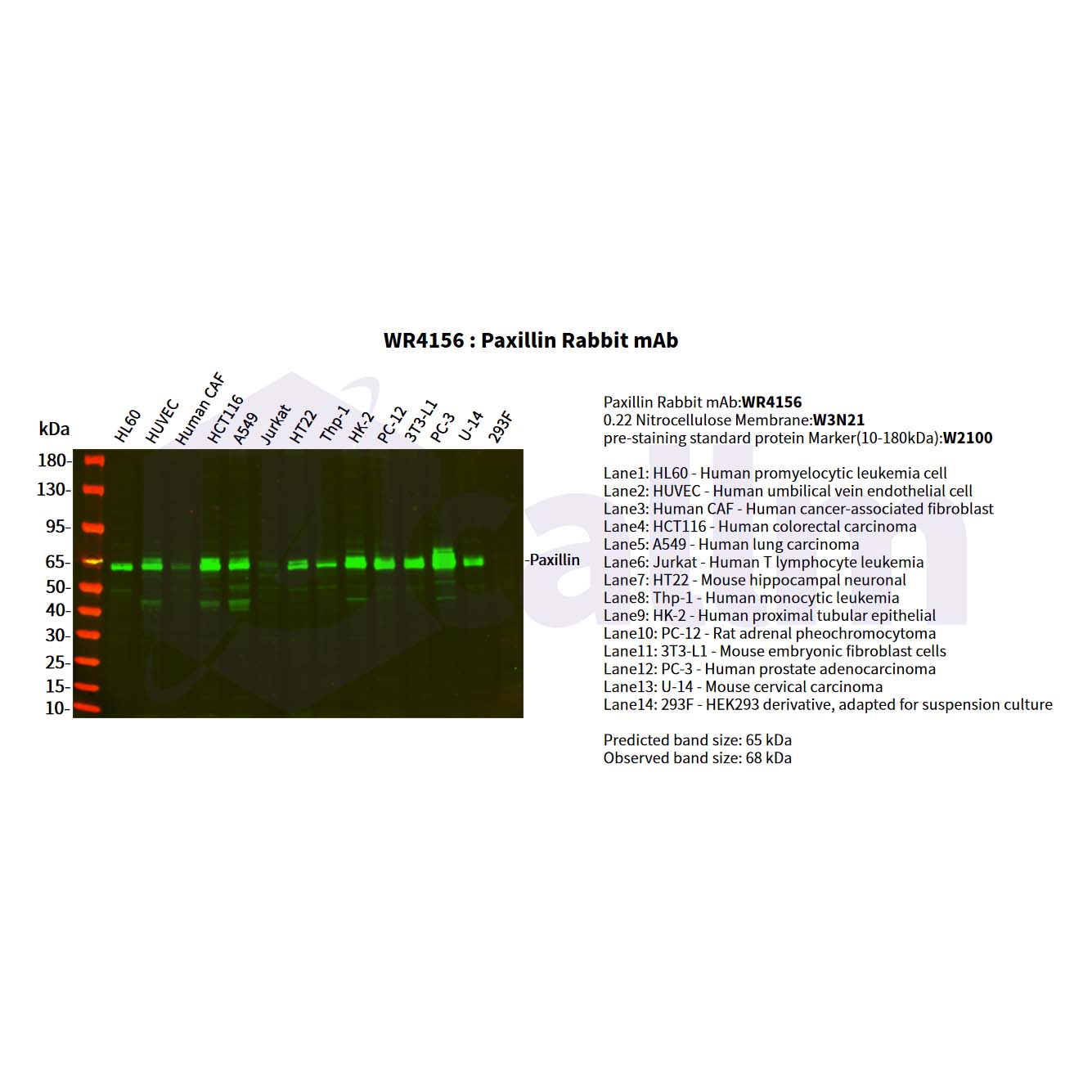
MW(Calculated)65kD
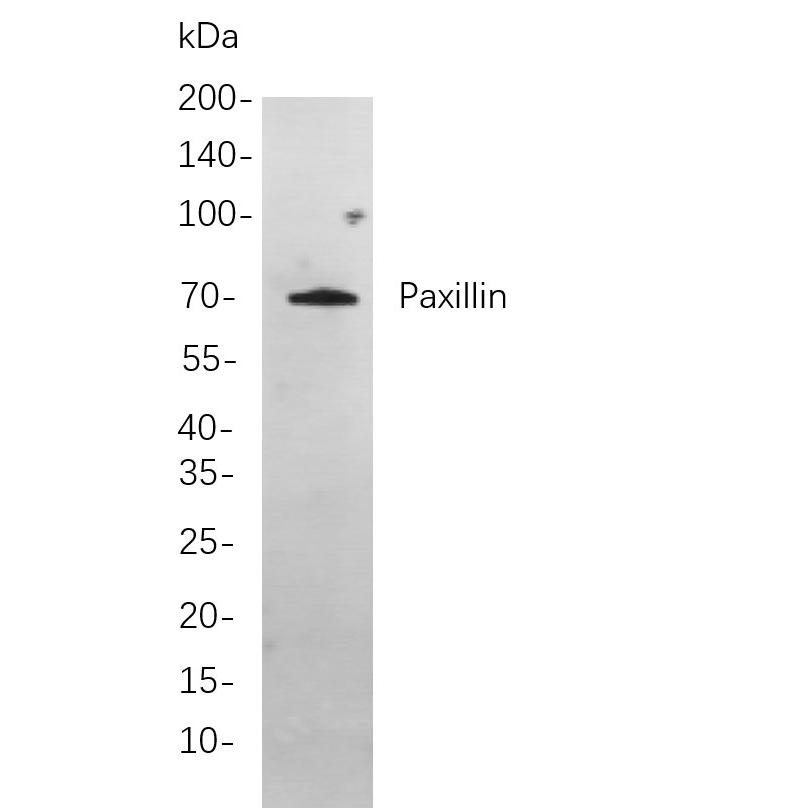
MW(Observed)68kD
Host SpeciesRabbit
IsotypeIgG,Kappa
Conjugate/ModificationUnmodified
Recommended Dilution RatioIHC 1:1000-1:4000; WB 1:1000-1:5000; IF 1:200-1:1000; ELISA 1:5000-1:20000; IP 1:50-1:200; / Note: For IHC, we suggest antigen retrieval with TE buffer pH 9.0 (Cat#WT1004)
FormulationPBS, 50% glycerol, 0.05% Proclin 300, 0.05%BSA
PurificationRecombinant Antibody expressed in animal component-free (ACF) media, purified via Protein A affinity chromatography.
Storage-15°C to -25°C/1 year(Do not lower than -25°C)
Concentration
ClonalityMonoclonal
Clone NumberRM0303R
ImmunogenThe specific immunogen used to produce this antibody is proprietary information.
SpecificityEndogenous
Gene NamePXN
Protein NamePaxillin
Other NamePXN; / Paxillin
SpeciesHuman
Gene ID5829
UniprotP49023,
Species.1Mouse
Gene ID.119303
Uniprot.1Q8VI36,
Species.2Rat
Gene ID.2360820
Uniprot.2Q66H76
Cellular LocalizationCytoplasm
Tissue ExpressionBrain,Epithelium,Lung,Placenta,T-cell,Uterus,
Signaling_pathwayCellular Processes >> Cellular community - eukaryotes >> Focal adhesion;Cellular Processes >> Cell motility >> Regulation of actin cytoskeleton;Organismal Systems >> Immune system >> Leukocyte transendothelial migration;Organismal Systems >> Immune system >> Chemokine signaling pathway;Environmental Information Processing >> Signal transduction >> VEGF signaling pathway
Research Areas>>Chemokine signaling pathway; / >>VEGF signaling pathway; / >>Focal adhesion; / >>Leukocyte transendothelial migration; / >>Regulation of actin cytoskeleton; / >>Bacterial invasion of epithelial cells; / >>Shigellosis; / >>Yersinia infection; / >>Human cytomegalovirus infection; / >>Human papillomavirus infection; / >>Human immunodeficiency virus 1 infection; / >>Viral carcinogenesis; / >>Proteoglycans in cancer
FunctionFunction:Cytoskeletal protein involved in actin-membrane attachment at sites of cell adhesion to the extracellular matrix (focal adhesion).,PTM:Phosphorylated on tyrosine residues during integrin-mediated cell adhesion, embryonic development, fibroblast transformation and following stimulation of cells by mitogens.,similarity:Belongs to the paxillin family.,similarity:Contains 3 LIM zinc-binding domains.,similarity:Contains 4 LIM zinc-binding domains.,subunit:Binds in vitro to vinculin as well as to the SH3 domain of c-SRC and, when tyrosine phosphorylated, to the SH2 domain of V-CRK. Isoform beta binds to focal adhesion kinase but weakly to vinculin. Isoform gamma binds to vinculin but only weakly to focal adhesion kinase. Interacts with GIT1, NUDT16L1/SDOS, PARVA and TGFB1I1. Component of cytoplasmic complexes, which also contain GIT1, ARHGEF6 and PAK1 (By similarity). Binds ASAP2. Interacts with unphosphorylated ITGA4. Interacts with RNF5.,
Please login to post questions

Back to Top
Product has been added to your cart


