SKU: WR4226 Categories: ,

U-Blot® JAK3 Rabbit mAb

Price range: $268.00 through $328.00

SKU: WR4226-50
Enter the quantity you would like, or drag the panel to find the quantity and price that best for you
Bulk QuoteAuthorize OEM & ODM

Product details

Background:The protein encoded by this gene is a member of the Janus kinase (JAK) family of tyrosine kinases involved in cytokine receptor-mediated intracellular signal transduction. It is predominantly expressed in immune cells and transduces a signal in response to its activation via tyrosine phosphorylation by interleukin receptors. Mutations in this gene are associated with autosomal SCID (severe combined immunodeficiency disease). [provided by RefSeq, Jul 2008],

Specifications

Size50μL/100μL
TargetJAK3
ReactivityHuman
ApplicationsWB, IF, IP, ELISA
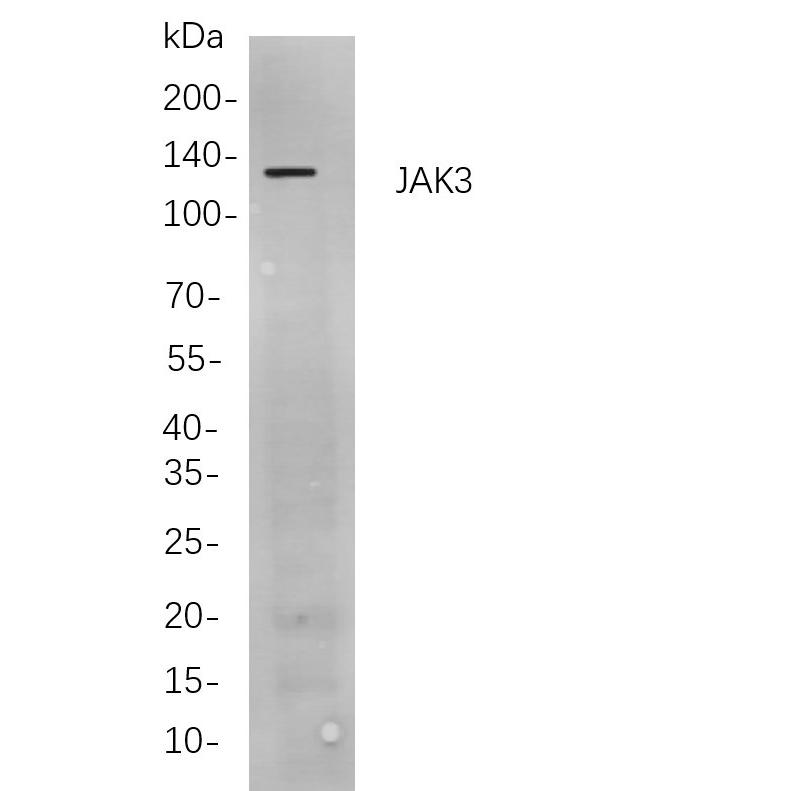
MW(Calculated)125kD
MW(Observed)125kD
Host SpeciesRabbit
IsotypeIgG,Kappa
Conjugate/ModificationUnmodified
Recommended Dilution RatioWB 1:1000-1:5000; IF 1:200-1:1000; ELISA 1:5000-1:20000; IP 1:50-1:200;
FormulationPBS, 50% glycerol, 0.05% Proclin 300, 0.05%BSA
PurificationRecombinant Antibody expressed in animal component-free (ACF) media, purified via Protein A affinity chromatography.
Storage-15°C to -25°C/1 year(Do not lower than -25°C)
Concentration
ClonalityMonoclonal
Clone NumberRM0405R
ImmunogenThe specific immunogen used to produce this antibody is proprietary information.
SpecificityEndogenous
Gene NameJAK3
Protein NameTyrosine-protein kinase JAK3
Other NameJAK3; / Tyrosine-protein kinase JAK3; / Janus kinase 3; / JAK-3; / Leukocyte janus kinase; / L-JAK
SpeciesHuman
Gene ID3718
UniprotP52333,
Species.1Mouse
Gene ID.116453
Uniprot.1Q62137,
Species.2Rat
Gene ID.2
Uniprot.2Q63272
Cellular LocalizationCytoplasm
Tissue ExpressionIn NK cells and an NK-like cell line but not in resting T-cells or in other tissues. The S-form is more commonly seen in hematopoietic lines, whereas the B-form is detected in cells both of hematopoietic and epithelial origins.
Signaling_pathwayCellular Processes >> Cell growth and death >> Necroptosis;Cellular Processes >> Cellular community - eukaryotes >> Signaling pathways regulating pluripotency of stem cells;Organismal Systems >> Immune system >> Th1 and Th2 cell differentiation;Organismal Systems >> Immune system >> Th17 cell differentiation;Organismal Systems >> Immune system >> Chemokine signaling pathway;Human Diseases >> Cancer: overview >> Pathways in cancer;Human Diseases >> Cancer: specific types >> Non-small cell lung cancer;Human Diseases >> Immune disease >> Primary immunodeficiency;Environmental Information Processing >> Signal transduction >> JAK-STAT signaling pathway;Environmental Information Processing >> Signal transduction >> PI3K-Akt signaling pathway
Research Areas>>Chemokine signaling pathway; / >>PI3K-Akt signaling pathway; / >>Necroptosis; / >>Signaling pathways regulating pluripotency of stem cells; / >>JAK-STAT signaling pathway; / >>Th1 and Th2 cell differentiation; / >>Th17 cell differentiation; / >>Hepatitis B; / >>Measles; / >>Human T-cell leukemia virus 1 infection; / >>Epstein-Barr virus infection; / >>Pathways in cancer; / >>Viral carcinogenesis; / >>Non-small cell lung cancer; / >>Primary immunodeficiency
FunctionCatalytic activity:ATP + a [protein]-L-tyrosine = ADP + a [protein]-L-tyrosine phosphate.,Disease:Defects in JAK3 are a cause of severe combined immunodeficiency autosomal recessive T-cell-negative/B-cell-positive/NK-cell-negative (T(-)B(+)NK(-)SCID) [MIM:600802]. SCID refers to a genetically and clinically heterogeneous group of rare congenital disorders characterized by impairment of both humoral and cell-mediated immunity, leukopenia, and low or absent antibody levels. Patients with SCID present in infancy with recurrent, persistent infections by opportunistic organisms. The common characteristic of all types of SCID is absence of T-cell-mediated cellular immunity due to a defect in T-cell development.,Domain:Possesses two phosphotransferase domains. The second one probably contains the catalytic domain (By similarity), while the presence of slight differences suggest a different role for domain 1.,Function:Tyrosine kinase of the non-receptor type, involved in the interleukin-2 and interleukin-4 signaling pathway. Phosphorylates STAT6, IRS1, IRS2 and PI3K.,online information:JAK3 mutation db,PTM:Tyrosine phosphorylated in response to IL-2 and IL-4.,similarity:Belongs to the protein kinase superfamily. Tyr protein kinase family. JAK subfamily.,similarity:Contains 1 FERM domain.,similarity:Contains 1 protein kinase domain.,similarity:Contains 1 SH2 domain.,subcellular location:Wholly intracellular, possibly membrane associated.,subunit:Interacts with STAM2 and MYO18A (By similarity). Interacts with SHB.,tissue specificity:In NK cells and an NK-like cell line but not in resting T-cells or in other tissues. The S-form is more commonly seen in hematopoietic lines, whereas the B- and M-forms are detected in cells both of hematopoietic and epithelial origins.,
Please login to post questions

Back to Top
Product has been added to your cart

