SKU: WR4437 Categories: ,

U-Blot® ZAP-70 Rabbit mAb

Price range: $268.00 through $328.00

SKU: WR4437-50
Enter the quantity you would like, or drag the panel to find the quantity and price that best for you
Bulk QuoteAuthorize OEM & ODM

Product details

Background:This gene encodes an enzyme belonging to the protein tyrosine kinase family, and it plays a role in T-cell development and lymphocyte activation. This enzyme, which is phosphorylated on tyrosine residues upon T-cell antigen receptor (TCR) stimulation, functions in the initial step of TCR-mediated signal transduction in combination with the Src family kinases, Lck and Fyn. This enzyme is also essential for thymocyte development. Mutations in this gene cause selective T-cell defect, a severe combined immunodeficiency disease characterized by a selective absence of CD8-positive T-cells. Two transcript variants that encode different isoforms have been found for this gene. [provided by RefSeq, Jul 2008],

Specifications

TargetZAP-70
ReactivityHuman, Mouse, Rat
ApplicationsWB, IHC, IF, IP, ELISA
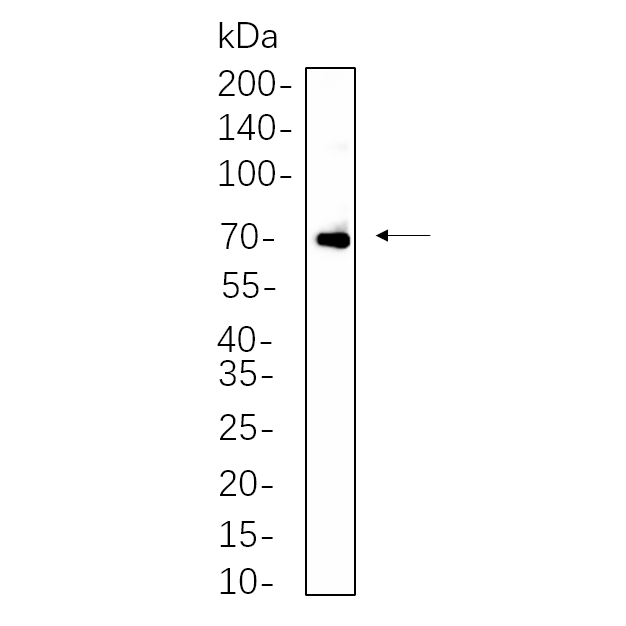
MW(Calculated)70kD
MW(Observed)70kD
Host SpeciesRabbit
IsotypeIgG,Kappa
Conjugate/ModificationUnmodified
Modification
Recommended Dilution RatioIHC 1:200-1:1000; WB 1:2000-1:10000; IF 1:200-1:1000; ELISA 1:5000-1:20000; IP 1:50-1:200; / Note: For IHC, we suggest antigen retrieval with TE buffer pH 9.0 (Cat#YS0004)
FormulationPBS, 50% glycerol, 0.05% Proclin 300, 0.05%BSA
Source
PurificationRecombinant Antibody expressed in animal component-free (ACF) media, purified via Protein A affinity chromatography.
Purity
Storage-15°C to -25°C/1 year(Do not lower than -25°C)
Concentration
ClonalityMonoclonal
Clone NumberPT0656R
ImmunogenThe specific immunogen used to produce this antibody is proprietary information.
Sequence
SpecificityEndogenous
Gene NameZAP70
Protein NameTyrosine-protein kinase ZAP-70
Other NameZAP70; / SRK; / Tyrosine-protein kinase ZAP-70; / 70 kDa zeta-chain associated protein; / Syk-related tyrosine kinase
SpeciesHuman
Gene ID-17535
UniprotP43403,
Species.1Mouse
Gene ID-222637
Uniprot.1P43404
Species.2
Gene ID-3
Uniprot.2
Organism-4
Gene ID-4
SwissProt-4
BackgroundThis gene encodes an enzyme belonging to the protein tyrosine kinase family, and it plays a role in T-cell development and lymphocyte activation. This enzyme, which is phosphorylated on tyrosine residues upon T-cell antigen receptor (TCR) stimulation, functions in the initial step of TCR-mediated signal transduction in combination with the Src family kinases, Lck and Fyn. This enzyme is also essential for thymocyte development. Mutations in this gene cause selective T-cell defect, a severe combined immunodeficiency disease characterized by a selective absence of CD8-positive T-cells. Two transcript variants that encode different isoforms have been found for this gene. [provided by RefSeq, Jul 2008],
Cellular LocalizationCytoplasm . Cell membrane; Peripheral membrane protein . In quiescent T-lymphocytes, it is cytoplasmic. Upon TCR activation, it is recruited at the plasma membrane by interacting with CD247/CD3Z. Colocalizes together with RHOH in the immunological synapse. RHOH is required for its proper localization to the cell membrane and cytoskeleton fractions in the thymocytes (By similarity). .
Tissue ExpressionExpressed in T- and natural killer cells. Also present in early thymocytes and pro/pre B-cells.
Signaling_pathwayOrganismal Systems >> Immune system >> Natural killer cell mediated cytotoxicity;Organismal Systems >> Immune system >> T cell receptor signaling pathway;Organismal Systems >> Immune system >> Th1 and Th2 cell differentiation;Organismal Systems >> Immune system >> Th17 cell differentiation;Human Diseases >> Cancer: overview >> PD-L1 expression and PD-1 checkpoint pathway in cancer;Human Diseases >> Immune disease >> Primary immunodeficiency;Environmental Information Processing >> Signal transduction >> Ras signaling pathway;Environmental Information Processing >> Signal transduction >> NF-kappa B signaling pathway
Research Areas>>Ras signaling pathway; / >>NF-kappa B signaling pathway; / >>Natural killer cell mediated cytotoxicity; / >>Th1 and Th2 cell differentiation; / >>Th17 cell differentiation; / >>T cell receptor signaling pathway; / >>Yersinia infection; / >>PD-L1 expression and PD-1 checkpoint pathway in cancer; / >>Primary immunodeficiency
FunctionCatalytic activity:ATP + a [protein]-L-tyrosine = ADP + a [protein]-L-tyrosine phosphate.,Disease:Defects in ZAP70 are the cause of selective T-cell defect (STD) [MIM:176947]. STD is an autosomal recessive form of severe combined immunodeficiency characterized by a selective absence of CD8-type T-cells.,Domain:The SH2 domain binds to the phosphorylated tyrosine-based activation motif (TAM) of CD3Z.,Function:Plays a role in T-cell development and lymphocyte activation. Essential for TCR-mediated IL-2 production. Isoform 1 induces TCR-mediated signal transduction, isoform 2 does not.,online information:ZAP70 mutation db,PTM:Phosphorylated on tyrosine residues upon T-cell antigen receptor (TCR) stimulation. Tyr-319 phosphorylation is essential for full activity.,similarity:Belongs to the protein kinase superfamily. Tyr protein kinase family. SYK/ZAP-70 subfamily.,similarity:Contains 1 protein kinase domain.,similarity:Contains 2 SH2 domains.,subcellular location:After antigen stimulation, isoform 1 concentrates at the immunological synapse and isoform 2 remains cytoplasmic.,subunit:Interacts with SLA2 when it is phosphorylated. Interacts with CD3Z and with phosphorylated NFAM1. Interacts with CBLB (By similarity). Interacts with CBL and SLA when it is phosphorylated. The association with SLA (or SLA2) and CBL probably leads to its destruction. Interacts with SHB. Interacts with DEF6 (By similarity). Interacts with FCRL3.,tissue specificity:Expressed in T- and natural killer cells.,
RRID
Please login to post questions

Back to Top
Product has been added to your cart