SKU: WR4539 Categories: ,

U-Blot® Insulin Rabbit mAb

Price range: $268.00 through $328.00

SKU: WR4539-50
Enter the quantity you would like, or drag the panel to find the quantity and price that best for you
Bulk QuoteAuthorize OEM & ODM

Product details

Background:After removal of the precursor signal peptide, proinsulin is post-translationally cleaved into three peptides: the B chain and A chain peptides, which are covalently linked via two disulfide bonds to form insulin, and C-peptide. Binding of insulin to the insulin receptor (INSR) stimulates glucose uptake. A multitude of mutant alleles with phenotypic effects have been identified. There is a read-through gene, INS-IGF2, which overlaps with this gene at the 5' region and with the IGF2 gene at the 3' region. Alternative splicing results in multiple transcript variants. [provided by RefSeq, Jun 2010],

Specifications

Size50μL/100μL
TargetInsulin
ReactivityHuman, Mouse, Rat
ApplicationsWB, IHC, IF, ELISA
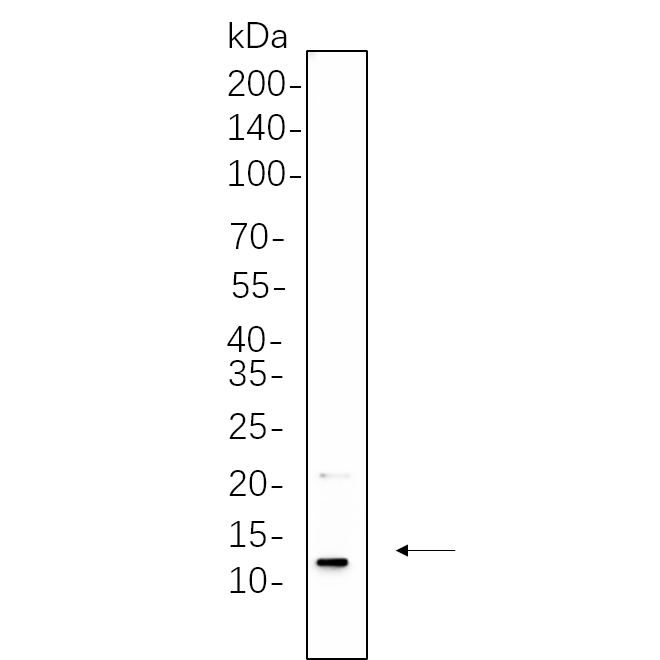
MW(Calculated)12kD
MW(Observed)12kD
Host SpeciesRabbit
IsotypeIgG,Kappa
Conjugate/ModificationUnmodified
Recommended Dilution RatioIHC 1:200-1:1000; WB 1:1000-1:5000; IF 1:200-1:1000; ELISA 1:5000-1:20000; / Note: For IHC, we suggest antigen retrieval with TE buffer pH 9.0 (Cat#WT1004)
FormulationPBS, 50% glycerol, 0.05% Proclin 300, 0.05%BSA
PurificationRecombinant Antibody expressed in animal component-free (ACF) media, purified via Protein A affinity chromatography.
Storage-15°C to -25°C/1 year(Do not lower than -25°C)
Concentration
ClonalityMonoclonal
Clone NumberRM0764R
ImmunogenThe specific immunogen used to produce this antibody is proprietary information.
SpecificityEndogenous
Gene NameINS
Protein NameInsulin
Other Name
SpeciesHuman
Gene ID3630
UniprotP01308
Species.1
Gene ID.1
Uniprot.1
Species.2
Gene ID.2
Uniprot.2
Cellular LocalizationCytoplasmic
Tissue ExpressionBlood,Liver,Muscle,Pancreas,
Signaling_pathwayCellular Processes >> Transport and catabolism >> Autophagy - animal;Cellular Processes >> Cell motility >> Regulation of actin cytoskeleton;Organismal Systems >> Endocrine system >> Insulin secretion;Organismal Systems >> Endocrine system >> Insulin signaling pathway;Organismal Systems >> Endocrine system >> Prolactin signaling pathway;Organismal Systems >> Aging >> Longevity regulating pathway;Organismal Systems >> Aging >> Longevity regulating pathway - multiple species;Human Diseases >> Cancer: specific types >> Prostate cancer;Human Diseases >> Neurodegenerative disease >> Alzheimer disease;Environmental Information Processing >> Signal transduction >> MAPK signaling pathway;Environmental Information Processing >> Signal transduction >> Ras signaling pathway;Environmental Information Processing >> Signal transduction >> Rap1 signaling pathway;Environmental Information Processing >> Signal transduction >> HIF-1 signaling pathway;Environmental Information Processing >> Signal transduction >> FoxO signaling pathway;Environmental Information Processing >> Signal transduction >> Phospholipase D signaling pathway;Environmental Information Processing >> Signal transduction >> cGMP-PKG signaling pathway;Environmental Information Processing >> Signal transduction >> PI3K-Akt signaling pathway;Environmental Information Processing >> Signal transduction >> AMPK signaling pathway;Environmental Information Processing >> Signal transduction >> mTOR signaling pathway
Research Areas>>MAPK signaling pathway; / >>Ras signaling pathway; / >>Rap1 signaling pathway; / >>cGMP-PKG signaling pathway; / >>HIF-1 signaling pathway; / >>FoxO signaling pathway; / >>Phospholipase D signaling pathway; / >>Oocyte meiosis; / >>Autophagy - animal; / >>mTOR signaling pathway; / >>PI3K-Akt signaling pathway; / >>AMPK signaling pathway; / >>Longevity regulating pathway; / >>Longevity regulating pathway - multiple species; / >>Regulation of actin cytoskeleton; / >>Insulin signaling pathway; / >>Insulin secretion; / >>Ovarian steroidogenesis; / >>Progesterone-mediated oocyte maturation; / >>Prolactin signaling pathway; / >>Regulation of lipolysis in adipocytes; / >>Type II diabetes mellitus; / >>Insulin resistance; / >>Non-alcoholic fatty liver disease; / >>Type I diabetes mellitus; / >>Maturity onset diabetes of the young; / >>Aldosterone-regulated sodium reabsorption; / >>Alzheimer disease; / >>Prostate cancer; / >>Diabetic cardiomyopathy
FunctionDisease:Defects in INS are the cause of familial hyperproinsulinemia [MIM:176730].,Function:Insulin decreases blood glucose concentration. It increases cell permeability to monosaccharides, amino acids and fatty acids. It accelerates glycolysis, the pentose phosphate cycle, and glycogen synthesis in liver.,Function:Preptin undergoes glucose-mediated co-secretion with insulin, and acts as physiological amplifier of glucose-mediated insulin secretion. Exhibits osteogenic properties by increasing osteoblast mitogenic activity through phosphoactivation of MAPK1 and MAPK3.,Function:The insulin-like growth factors possess growth-promoting activity. In vitro, they are potent mitogens for cultured cells. IGF-II is influenced by placental lactogen and may play a role in fetal development.,mass spectrometry: PubMed:12586351; PubMed:15359740,online information:Clinical information on Eli Lilly insulin products,online information:Insulin entry,online information:Insulin-like growth factor 2 entry,online information:Protein of the 20th century - Issue 9 of April 2001,pharmaceutical:Available under the names Humulin or Humalog (Eli Lilly) and Novolin (Novo Nordisk). Used in the treatment of diabetes. Humalog is an insulin analog with 52-Lys-Pro-53 instead of 52-Pro-Lys-53.,similarity:Belongs to the insulin family.,subunit:Heterodimer of a B chain and an A chain linked by two disulfide bonds.,
Please login to post questions

Back to Top
Product has been added to your cart
