SKU: WR4558 Categories: ,

U-Blot® CACNA1F Rabbit mAb

Price range: $268.00 through $328.00

SKU: WR4558-50
Enter the quantity you would like, or drag the panel to find the quantity and price that best for you
Bulk QuoteAuthorize OEM & ODM

Product details

Background:calcium voltage-gated channel subunit alpha1 F(CACNA1F) Homo sapiens This gene encodes a multipass transmembrane protein that functions as an alpha-1 subunit of the voltage-dependent calcium channel, which mediates the influx of calcium ions into the cell. The encoded protein forms a complex of alpha-1, alpha-2/delta, beta, and gamma subunits in a 1:1:1:1 ratio. Mutations in this gene can cause X-linked eye disorders, including congenital stationary night blindness type 2A, cone-rod dystropy, and Aland Island eye disease. Alternatively spliced transcript variants encoding multiple isoforms have been observed. [provided by RefSeq, Aug 2013],

Specifications

TargetCACNA1F
ReactivityHuman
ApplicationsWB, FC
MW(Calculated)
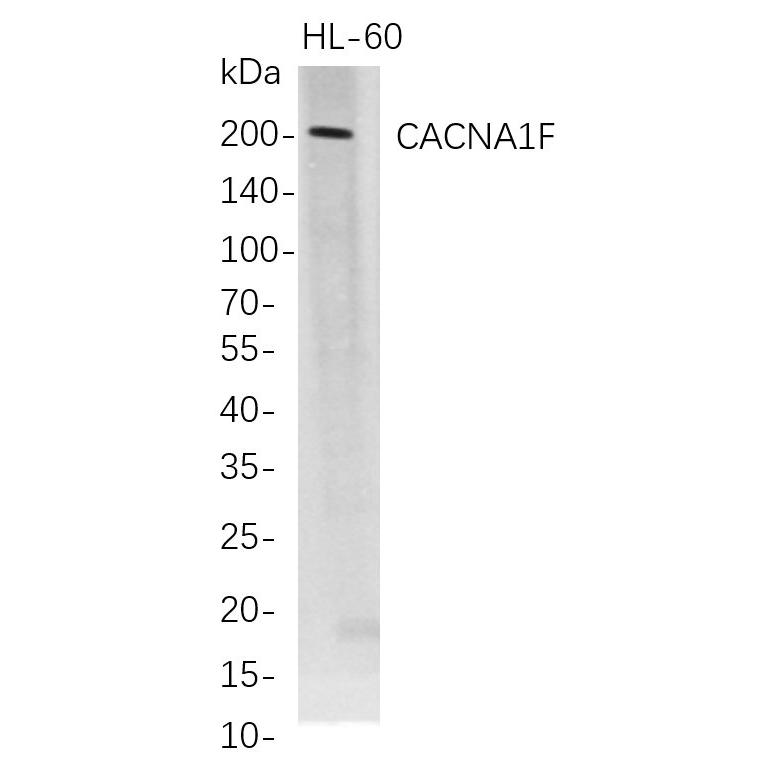
MW(Observed)217kD
Host SpeciesRabbit
IsotypeIgG,Kappa
Conjugate/ModificationUnmodified
Modification
Recommended Dilution RatioWB 1:1000-5000; FC 1:100-300
FormulationPBS, 50% glycerol, 0.05% Proclin 300, 0.05%BSA
Source
PurificationRecombinant Antibody expressed in animal component-free (ACF) media, purified via Protein A affinity chromatography.
Purity
Storage-15°C to -25°C/1 year(Do not lower than -25°C)
Concentration
ClonalityMonoclonal
Clone NumberPT0769R
ImmunogenThe specific immunogen used to produce this antibody is proprietary information.
Sequence
SpecificityEndogenous
Gene NameCACNA1F; CACNAF1
Protein NameVoltage-dependent L-type calcium channel subunit alpha-1F; Voltage-gated calcium channel subunit alpha Cav1.4
Other NameCACNA1F; / CACNAF1; / Voltage-dependent L-type calcium channel subunit alpha-1F; / Voltage-gated calcium channel subunit alpha Cav1.4
SpeciesHuman
Gene ID-1778
UniprotO60840,
Species.1Mouse
Gene ID-2
Uniprot.1Q9JIS7
Species.2
Gene ID-3
Uniprot.2
Organism-4
Gene ID-4
SwissProt-4
Backgroundcalcium voltage-gated channel subunit alpha1 F(CACNA1F) Homo sapiens This gene encodes a multipass transmembrane protein that functions as an alpha-1 subunit of the voltage-dependent calcium channel, which mediates the influx of calcium ions into the cell. The encoded protein forms a complex of alpha-1, alpha-2/delta, beta, and gamma subunits in a 1:1:1:1 ratio. Mutations in this gene can cause X-linked eye disorders, including congenital stationary night blindness type 2A, cone-rod dystropy, and Aland Island eye disease. Alternatively spliced transcript variants encoding multiple isoforms have been observed. [provided by RefSeq, Aug 2013],
Cellular LocalizationMembrane; Multi-pass membrane protein.
Tissue ExpressionExpression in skeletal muscle and retina (PubMed:10873387). Isoform 4 is expressed in retina (PubMed:27226626). {ECO:0000269|PubMed:10873387, ECO:0000269|PubMed:27226626}.
Signaling_pathwayOrganismal Systems >> Endocrine system >> Insulin secretion;Organismal Systems >> Endocrine system >> GnRH signaling pathway;Organismal Systems >> Endocrine system >> Oxytocin signaling pathway;Organismal Systems >> Endocrine system >> Growth hormone synthesis, secretion and action;Organismal Systems >> Endocrine system >> Aldosterone synthesis and secretion;Organismal Systems >> Circulatory system >> Cardiac muscle contraction;Organismal Systems >> Circulatory system >> Adrenergic signaling in cardiomyocytes;Organismal Systems >> Circulatory system >> Vascular smooth muscle contraction;Organismal Systems >> Nervous system >> Cholinergic synapse;Human Diseases >> Neurodegenerative disease >> Alzheimer disease;Human Diseases >> Neurodegenerative disease >> Prion disease;Human Diseases >> Neurodegenerative disease >> Pathways of neurodegeneration - multiple diseases;Environmental Information Processing >> Signal transduction >> MAPK signaling pathway;Environmental Information Processing >> Signal transduction >> Calcium signaling pathway;Environmental Information Processing >> Signal transduction >> cAMP signaling pathway;Environmental Information Processing >> Signal transduction >> cGMP-PKG signaling pathway
Research Areas>>MAPK signaling pathway; / >>Calcium signaling pathway; / >>cGMP-PKG signaling pathway; / >>cAMP signaling pathway; / >>Cardiac muscle contraction; / >>Adrenergic signaling in cardiomyocytes; / >>Vascular smooth muscle contraction; / >>Retrograde endocannabinoid signaling; / >>Cholinergic synapse; / >>Serotonergic synapse; / >>GABAergic synapse; / >>Insulin secretion; / >>GnRH signaling pathway; / >>Oxytocin signaling pathway; / >>Renin secretion; / >>Aldosterone synthesis and secretion; / >>Cortisol synthesis and secretion; / >>GnRH secretion; / >>Cushing syndrome; / >>Growth hormone synthesis, secretion and action; / >>Alzheimer disease; / >>Prion disease; / >>Pathways of neurodegeneration - multiple diseases; / >>Chemical carcinogenesis - receptor activation; / >>Hypertrophic cardiomyopathy; / >>Arrhythmogenic right ventricular cardiomyopathy; / >>Dilated cardiomyopathy
Function[Isoform 1]: Voltage-sensitive calcium channels (VSCC) mediate the entry of calcium ions into excitable cells and are also involved in a variety of calcium-dependent processes, including muscle contraction, hormone or neurotransmitter release, gene expression, cell motility, cell division and cell death. The isoform alpha-1F gives rise to L-type calcium currents. Long-lasting (L-type) calcium channels belong to the 'high-voltage activated' (HVA) group. They are blocked by dihydropyridines (DHP), phenylalkylamines, and by benzothiazepines. Activates at more negative voltages and does not undergo calcium-dependent inactivation (CDI), due to incoming calcium ions, during depolarization. {ECO:0000269|PubMed:15897456, ECO:0000269|PubMed:27226626}.; [Isoform 4]: Voltage-dependent L-type calcium channel activates at more hyperpolarized voltages and exhibits a robust calcium-dependent inactivation (CDI), due to incoming calcium ions, during depolarizations. {ECO:0000269|PubMed:27226626}.; [Isoform 5]: Voltage-sensitive calcium channels (VSCC) mediate the entry of calcium ions into excitable cells and are also involved in a variety of calcium-dependent processes, including muscle contraction, hormone or neurotransmitter release, gene expression, cell motility, cell division and cell death. {ECO:0000269|PubMed:27226626}.; [Isoform 6]: Voltage-dependent L-type calcium channel activates at more hyperpolarized voltages and exhibits a robust calcium-dependent inactivation (CDI), due to incoming calcium ions, during depolarizations. {ECO:0000269|PubMed:27226626}.
RRID
Please login to post questions

Back to Top
Product has been added to your cart