SKU: WR4585 Categories: ,

U-Blot® JNK2 Rabbit mAb

Price range: $268.00 through $328.00

SKU: WR4585-50
Enter the quantity you would like, or drag the panel to find the quantity and price that best for you
Bulk QuoteAuthorize OEM & ODM

Product details

Background:The protein encoded by this gene is a member of the MAP kinase family. MAP kinases act as an integration point for multiple biochemical signals, and are involved in a wide variety of cellular processes such as proliferation, differentiation, transcription regulation and development. This kinase targets specific transcription factors, and thus mediates immediate-early gene expression in response to various cell stimuli. It is most closely related to MAPK8, both of which are involved in UV radiation induced apoptosis, thought to be related to the cytochrome c-mediated cell death pathway. This gene and MAPK8 are also known as c-Jun N-terminal kinases. This kinase blocks the ubiquitination of tumor suppressor p53, and thus it increases the stability of p53 in nonstressed cells. Studies of this gene's mouse counterpart suggest a key role in T-cell differentiation. Several alternative


Specifications

Size50μL/100μL
TargetJNK2
ReactivityHuman, Mouse, Rat
ApplicationsWB, IHC, IF, IP, ELISA
MW(Calculated)48kD
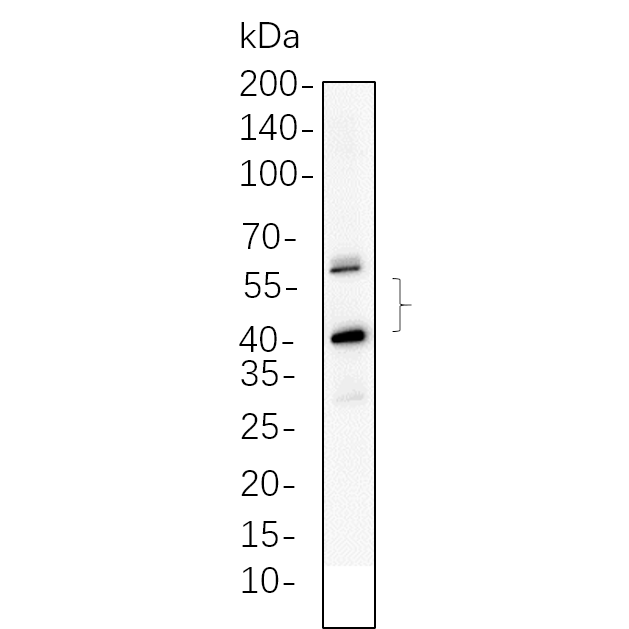
MW(Observed)46,54kD
Host SpeciesRabbit
IsotypeIgG,Kappa
Conjugate/ModificationUnmodified
Recommended Dilution RatioIHC 1:2000-1:10000; WB 1:2000-1:10000; IF 1:200-1:1000; ELISA 1:5000-1:20000; IP 1:50-1:200; / Note: For IHC, we suggest antigen retrieval with TE buffer pH 9.0 (Cat#WT1004)
FormulationPBS, 50% glycerol, 0.05% Proclin 300, 0.05%BSA
PurificationRecombinant Antibody expressed in animal component-free (ACF) media, purified via Protein A affinity chromatography.
Storage-15°C to -25°C/1 year(Do not lower than -25°C)
Concentration
ClonalityMonoclonal
Clone NumberRM0852R
ImmunogenThe specific immunogen used to produce this antibody is proprietary information.
SpecificityEndogenous
Gene NameMAPK9
Protein NameMitogen-activated protein kinase 9
Other NameMAPK9; / JNK2; / PRKM9; / SAPK1A; / Mitogen-activated protein kinase 9; / MAP kinase 9; / MAPK 9; / JNK-55; / Stress-activated protein kinase 1a; / SAPK1a; / Stress-activated protein kinase JNK2; / c-Jun N-terminal kinase 2
SpeciesHuman
Gene ID5601
UniprotP45984,
Species.1Mouse
Gene ID.126420
Uniprot.1Q9WTU6,
Species.2Rat
Gene ID.250658
Uniprot.2P49186
Cellular LocalizationCytoplasm . Nucleus . Colocalizes with POU5F1 in the nucleus. .
Tissue ExpressionBrain,Skin,
Signaling_pathwayCellular Processes >> Transport and catabolism >> Autophagy - animal;Cellular Processes >> Transport and catabolism >> Mitophagy - animal;Cellular Processes >> Cell growth and death >> Apoptosis;Cellular Processes >> Cell growth and death >> Apoptosis - multiple species;Cellular Processes >> Cell growth and death >> Necroptosis;Cellular Processes >> Cellular community - eukaryotes >> Focal adhesion;Cellular Processes >> Cellular community - eukaryotes >> Tight junction;Organismal Systems >> Immune system >> Toll-like receptor signaling pathway;Organismal Systems >> Immune system >> NOD-like receptor signaling pathway;Organismal Systems >> Immune system >> RIG-I-like receptor signaling pathway;Organismal Systems >> Immune system >> T cell receptor signaling pathway;Organismal Systems >> Immune system >> Th1 and Th2 cell differentiation;Organismal Systems >> Immune system >> Th17 cell differentiation;Organismal Systems >> Immune system >> IL-17 signaling pathway;Organismal Systems >> Immune system >> Fc epsilon RI signaling pathway;Organismal Systems >> Endocrine system >> Insulin signaling pathway;Organismal Systems >> Endocrine system >> Adipocytokine signaling pathway;Organismal Systems >> Endocrine system >> GnRH signaling pathway;Organismal Systems >> Endocrine system >> Prolactin signaling pathway;Organismal Systems >> Endocrine system >> Relaxin signaling pathway;Organismal Systems >> Endocrine system >> Growth hormone synthesis, secretion and action;Organismal Systems >> Nervous system >> Dopaminergic synapse;Organismal Systems >> Nervous system >> Neurotrophin signaling pathway;Organismal Systems >> Sensory system >> Inflammatory mediator regulation of TRP channels;Organismal Systems >> Development and regeneration >> Osteoclast differentiation;Human Diseases >> Cancer: overview >> Pathways in cancer;Human Diseases >> Cancer: specific types >> Colorectal cancer;Human Diseases >> Cancer: specific types >> Pancreatic cancer;Human Diseases >> Neurodegenerative disease >> Alzheimer disease;Human Diseases >> Neurodegenerative disease >> Parkinson disease;Human Diseases >> Neurodegenerative disease >> Huntington disease;Human Diseases >> Neurodegenerative disease >> Spinocerebellar ataxia;Human Diseases >> Neurodegenerative disease >> Prion disease;Human Diseases >> Neurodegenerative disease >> Pathways of neurodegeneration - multiple diseases;Environmental Information Processing >> Signal transduction >> MAPK signaling pathway;Environmental Information Processing >> Signal transduction >> ErbB signaling pathway;Environmental Information Processing >> Signal transduction >> Ras signaling pathway;Environmental Information Processing >> Signal transduction >> Wnt signaling pathway;Environmental Information Processing >> Signal transduction >> TNF signaling pathway;Environmental Information Processing >> Signal transduction >> FoxO signaling pathway;Environmental Information Processing >> Signal transduction >> Sphingolipid signaling pathway;Environmental Information Processing >> Signal transduction >> cAMP signaling pathway
Research Areas>>Endocrine resistance; / >>MAPK signaling pathway; / >>ErbB signaling pathway; / >>Ras signaling pathway; / >>cAMP signaling pathway; / >>FoxO signaling pathway; / >>Sphingolipid signaling pathway; / >>Mitophagy - animal; / >>Autophagy - animal; / >>Protein processing in endoplasmic reticulum; / >>Apoptosis; / >>Apoptosis - multiple species; / >>Necroptosis; / >>Wnt signaling pathway; / >>Osteoclast differentiation; / >>Focal adhesion; / >>Tight junction; / >>Toll-like receptor signaling pathway; / >>NOD-like receptor signaling pathway; / >>RIG-I-like receptor signaling pathway; / >>C-type lectin receptor signaling pathway; / >>IL-17 signaling pathway; / >>Th1 and Th2 cell differentiation; / >>Th17 cell differentiation; / >>T cell receptor signaling pathway; / >>Fc epsilon RI signaling pathway; / >>TNF signaling pathway; / >>Neurotrophin signaling pathway; / >>Retrograde endocannabinoid signaling; / >>Dopaminergic synapse; / >>Inflammatory mediator regulation of TRP channels; / >>Insulin signaling pathway; / >>GnRH signaling pathway; / >>Progesterone-mediated oocyte maturation; / >>Prolactin signaling pathway; / >>Adipocytokine signaling pathway; / >>Relaxin signaling pathway; / >>Type II diabetes mellitus; / >>Insulin resistance; / >>Non-alcoholic fatty liver disease; / >>AGE-RAGE signaling pathway in diabetic complications; / >>Growth hormone synthesis, secretion and action; / >>Alcoholic liver disease; / >>Alzheimer disease; / >>Parkinson disease; / >>Huntington disease; / >>Spinocerebellar ataxia; / >>Prion disease; / >>Pathways of neurodegeneration - multiple diseases; / >>Epithelial cell signaling in Helicobacter pylori infection; / >>Pathogenic Escherichia coli infection; / >>Shigellosis; / >>Salmonella infection; / >>Pertussis; / >>Yersinia infection; / >>Chagas disease; / >>Toxoplasmosis; / >>Tuberculosis; / >>Hepatitis B; / >>Measles; / >>Human T-cell leukemia virus 1 infection; / >>Kaposi sarcoma-associated herpesvirus infection; / >>Epstein-Barr virus infection; / >>Human immunodeficiency virus 1 infection; / >>Coronavirus disease - COVID-19; / >>Pathways in cancer; / >>Chemical carcinogenesis - reactive oxygen species; / >>Colorectal cancer; / >>Pancreatic cancer; / >>Choline metabolism in cancer; / >>Diabetic cardiomyopathy; / >>Lipid and atherosclerosis; / >>Fluid shear stress and atherosclerosis
FunctionCatalytic activity:ATP + a protein = ADP + a phosphoprotein.,cofactor:Magnesium.,Domain:The TXY motif contains the threonine and tyrosine residues whose phosphorylation activates the MAP kinases.,enzyme regulation:Activated by threonine and tyrosine phosphorylation by either of two dual specificity kinases, MAP2K4 and MAP2K7. Inhibited by dual specificity phosphatases, such as DUSP1.,Function:JNK2 isoforms display different binding patterns: alpha-1 and alpha-2 preferentially bind to c-Jun, whereas beta-1 and beta-2 bind to ATF2. However, there is no correlation between binding and phosphorylation, which is achieved at about the same efficiency by all isoforms. JUNB is not a substrate for JNK2 alpha-2, and JUND binds only weakly to it.,Function:Responds to activation by environmental stress and pro-inflammatory cytokines by phosphorylating a number of transcription factors, primarily components of AP-1 such as c-Jun and ATF2 and thus regulates AP-1 transcriptional activity. In T-cells, JNK1 and JNK2 are required for polarized differentiation of T-helper cells into Th1 cells.,PTM:Dually phosphorylated on Thr-183 and Tyr-185, which activates the enzyme. Autophosphorylated in vitro.,similarity:Belongs to the protein kinase superfamily. CMGC Ser/Thr protein kinase family. MAP kinase subfamily.,similarity:Contains 1 protein kinase domain.,subunit:Binds to at least four scaffolding proteins, MAPK8IP1/JIP-1, MAPK8IP2/JIP-2, MAPK8IP3/JIP-3/JSAP1 and SPAG9/MAPK8IP4/JIP-4. These proteins also bind other components of the JNK signaling pathway. Interacts with NFATC4.,
Please login to post questions

Back to Top
Product has been added to your cart