SKU: WM0163 Categories: ,

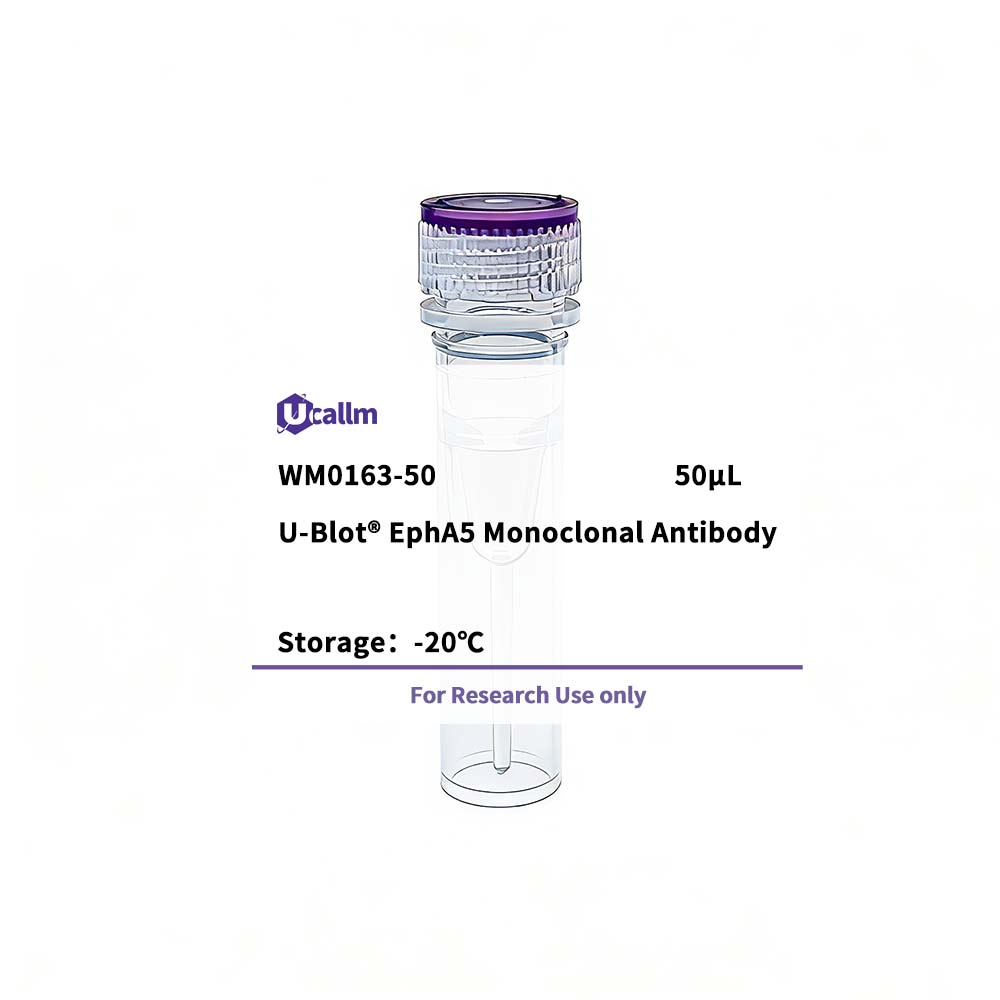
EphA5 Monoclonal Antibody

Price range: $268.00 through $328.00

SKU: WM0163-50
Enter the quantity you would like, or drag the panel to find the quantity and price that best for you
Bulk QuoteAuthorize OEM & ODM

Product details

Background:
This gene belongs to the ephrin receptor subfamily of the protein-tyrosine kinase family. EPH and EPH-related receptors have been implicated in mediating developmental events, particularly in the nervous system. Receptors in the EPH subfamily typically have a single kinase domain and an extracellular region containing a Cys-rich domain and 2 fibronectin type III repeats. The ephrin receptors are divided into 2 groups based on the similarity of their extracellular domain sequences and their affinities for binding ephrin-A and ephrin-B ligands. Alternatively spliced transcript variants encoding different isoforms have been described. [provided by RefSeq, Aug 2013],


Specifications

Size50μL/100μL
TargetEphA5
ReactivityHuman
ApplicationsWB, ELISA
MW(Calculated)115kD
MW(Observed)
Host SpeciesMouse
Isotype
Conjugate/ModificationUnmodified
Recommended Dilution RatioWB 1:500-1:2000; ELISA 1:10000; Not yet tested in other applications.
FormulationLiquid in PBS containing 50% glycerol, 0.5% BSA and 0.02% sodium azide.
PurificationAffinity purification
Storage-15°C to -25°C/1 year(Do not lower than -25°C)
Concentration
ClonalityMonoclonal
Clone Number3G2
ImmunogenPurified recombinant fragment of EphA5 (aa620-774) expressed in E. Coli.
SpecificityEphA5 Monoclonal Antibody detects endogenous levels of EphA5 protein.
Gene NameEPHA5
Protein NameEphrin type-A receptor 5
Other NameEPHA5; / BSK; / EHK1; / HEK7; / TYRO4; / Ephrin type-A receptor 5; / Brain-specific kinase; / EPH homology kinase 1; / EHK-1; / EPH-like kinase 7; / EK7; / hEK7
SpeciesHuman
Gene ID2044
UniprotP54756,
Species.1Mouse
Gene ID.1
Uniprot.1Q60629
Species.2
Gene ID.2
Uniprot.2
Cellular LocalizationCell membrane; Single-pass type I membrane protein . Cell projection, axon . Cell projection, dendrite .
Tissue ExpressionAlmost exclusively expressed in the nervous system in cortical neurons, cerebellar Purkinje cells and pyramidal neurons within the cortex and hippocampus. Display an increasing gradient of expression from the forebrain to hindbrain and spinal cord.
Signaling_pathway
Research Areas>>Axon guidance
FunctionAlternative products:Additional isoforms seem to exist,Catalytic activity:ATP + a [protein]-L-tyrosine = ADP + a [protein]-L-tyrosine phosphate.,Function:Receptor for members of the ephrin-A family. Binds to ephrin-A1, -A2, -A3, -A4 and -A5.,similarity:Belongs to the protein kinase superfamily. Tyr protein kinase family.,similarity:Belongs to the protein kinase superfamily. Tyr protein kinase family. Ephrin receptor subfamily.,similarity:Contains 1 protein kinase domain.,similarity:Contains 1 SAM (sterile alpha motif) domain.,similarity:Contains 2 fibronectin type-III domains.,tissue specificity:Almost exclusively expressed in the nervous system.,
Please login to post questions
Back to Top
Product has been added to your cart
