

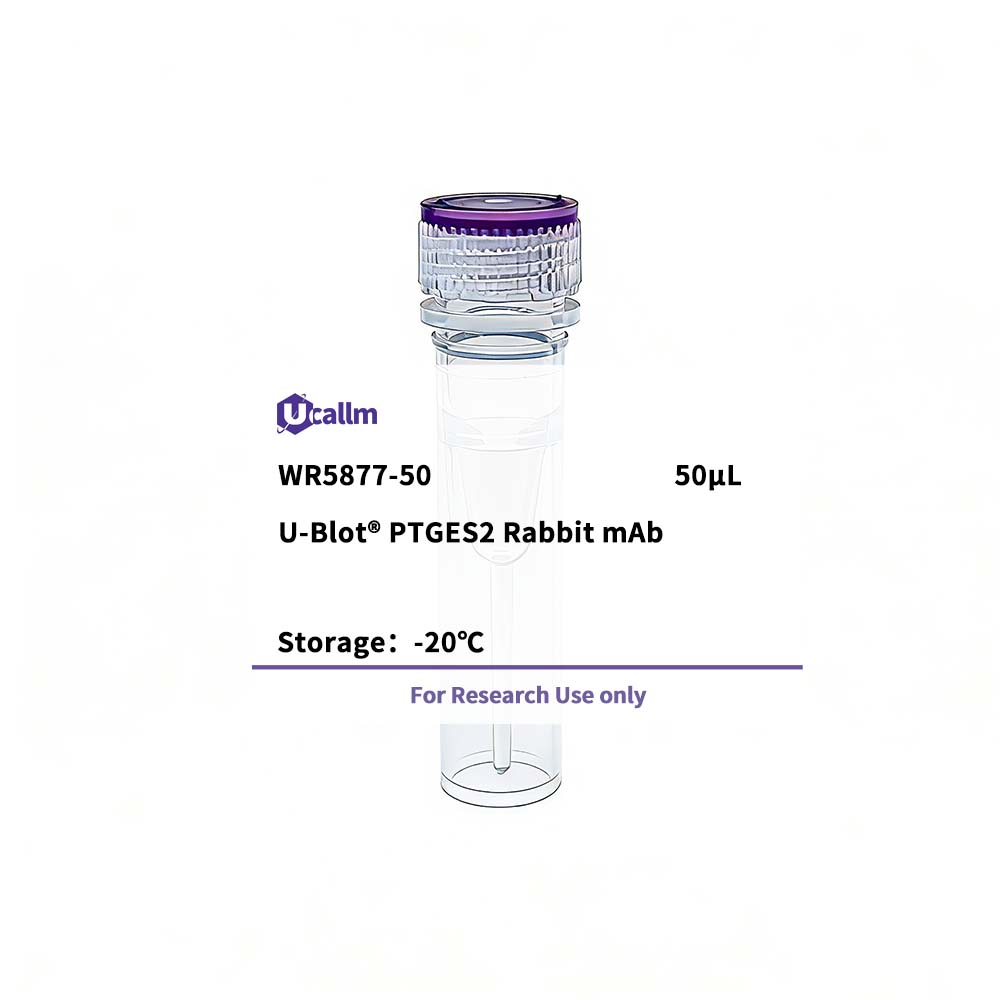
Specifications
| Size | 50μL/100μL |
| Target | PTGES2 |
| Reactivity | Human, Mouse, Rat |
| Applications | WB, IHC, IF, ELISA |
| MW(Calculated) | 42kD |
| MW(Observed) | 30kD |
| Host Species | Rabbit |
| Isotype | IgG,Kappa |
| Conjugate/Modification | Unmodified |
| Recommended Dilution Ratio | IHC 1:200-1:1000; WB 1:2000-1:10000; IF 1:200-1:1000; ELISA 1:5000-1:20000; / Note: For IHC, we suggest antigen retrieval with TE buffer pH 9.0 (Cat#WT1004) |
| Formulation | PBS, 50% glycerol, 0.05% Proclin 300, 0.05%BSA |
| Purification | Recombinant Antibody expressed in animal component-free (ACF) media, purified via Protein A affinity chromatography. |
| Storage | -15°C to -25°C/1 year(Do not lower than -25°C) |
| Concentration | |
| Clonality | Monoclonal |
| Clone Number | RM1888R |
| Immunogen | The specific immunogen used to produce this antibody is proprietary information. |
| Specificity | Endogenous |
| Gene Name | PTGES2 C9orf15 PGES2 |
| Protein Name | Prostaglandin E synthase 2 (Microsomal prostaglandin E synthase 2) (mPGES-2) [Cleaved into: Prostaglandin E synthase 2 truncated form] |
| Other Name | |
| Species | Human |
| Gene ID | 80142 |
| Uniprot | Q9H7Z7, |
| Species.1 | Mouse |
| Gene ID.1 | 96979 |
| Uniprot.1 | Q8BWM0 |
| Species.2 | |
| Gene ID.2 | |
| Uniprot.2 | |
| Cellular Localization | Golgi apparatus membrane; Single-pass membrane protein .; [Prostaglandin E synthase 2 truncated form]: Cytoplasm, perinuclear region . Synthesized as a Golgi membrane-bound protein, which is further cleaved into the predominant soluble truncated form. The truncated form is cytoplasmic and is enriched in the perinuclear region. . |
| Tissue Expression | Widely expressed. Expressed in the heart, including apex, inter-ventricular septum, both atria and ventricles, but not in the aorta. Also expressed in fetal heart. Detected in various regions of the brain: cerebellum; occipital, frontal and parietal lobes. Also expressed in the lymph nodes, skeletal muscle, kidney and trachea, but not in the thymus or lung. Overexpressed in colorectal cancer. |
| Signaling_pathway | |
| Research Areas | |
| Function | Isomerase that catalyzes the conversion of PGH2 into the more stable prostaglandin E2 (PGE2) (in vitro) . The biological function and the GSH-dependent property of PTGES2 is still under debate . In vivo, PTGES2 could form a complex with GSH and heme and would not participate in PGE2 synthesis but would catalyze the degradation of prostaglandin E2 H2 (PGH2) to 12(S)-hydroxy-5(Z),8(E),10(E)-heptadecatrienoic acid (HHT) and malondialdehyde (MDA) (By similarity). |





