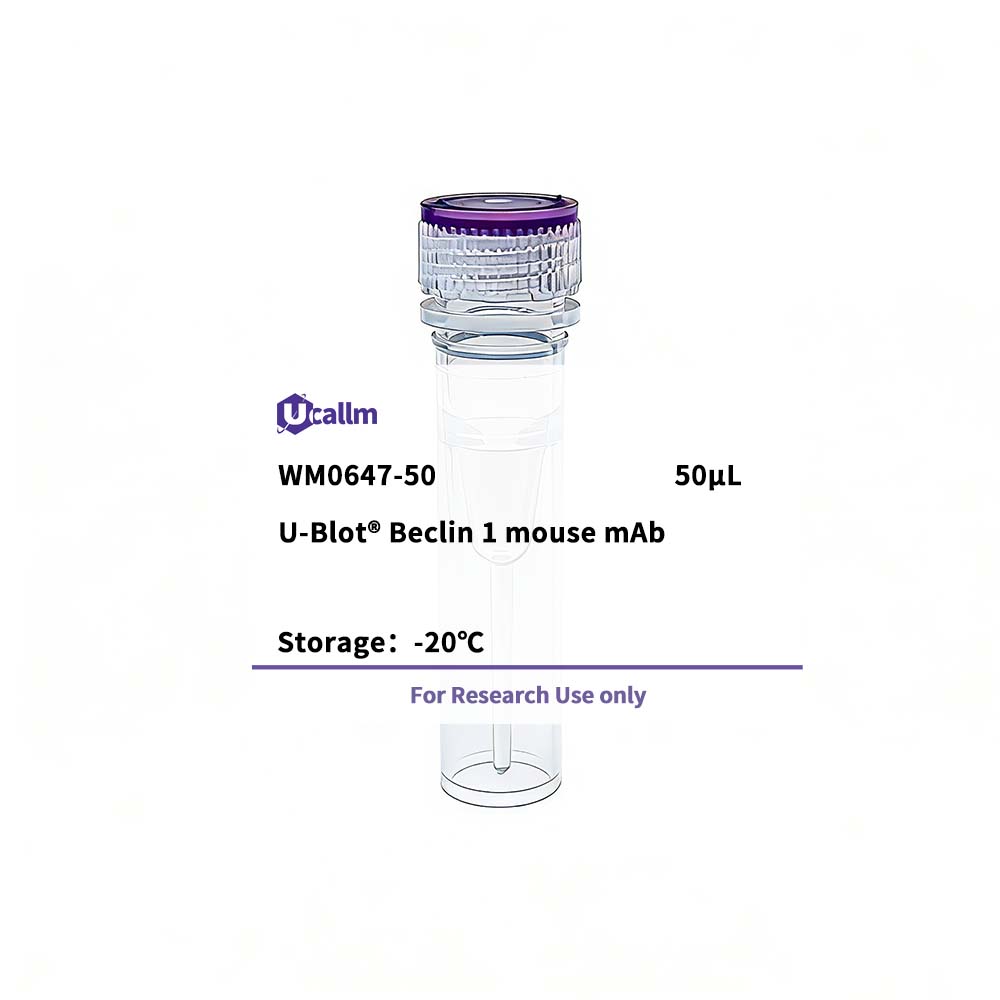
SKU: WM0647 Categories: ,

Beclin 1 mouse mAb

Price range: $268.00 through $328.00

SKU: WM0647-50
Enter the quantity you would like, or drag the panel to find the quantity and price that best for you
Bulk QuoteAuthorize OEM & ODM

Product details

Background:
beclin 1(BECN1) Homo sapiens This gene encodes a protein that regulates autophagy, a catabolic process of degradation induced by starvation. The encoded protein is a component of the phosphatidylinositol-3-kinase (PI3K) complex which mediates vesicle-trafficking processes. This protein is thought to play a role in multiple cellular processes, including tumorigenesis, neurodegeneration and apoptosis. Alternative splicing results in multiple transcript variants. [provided by RefSeq, Sep 2015],

Specifications

Size50μL/100μL
TargetBeclin 1
ReactivityHuman, Mouse, Rat, Monkey, Hamster
ApplicationsWB, IP
MW(Calculated)
MW(Observed)55kD
Host SpeciesMouse
Isotype
Conjugate/ModificationUnmodified
Recommended Dilution RatioWB 1:1000; IP 1:50-200
FormulationLiquid in PBS containing 50% glycerol, 0.5% BSA and 0.02% sodium azide.
PurificationThe antibody was affinity-purified from mouse ascites by affinity-chromatography using epitope-specific immunogen.
Storage-15°C to -25°C/1 year(Do not lower than -25°C)
Concentration
ClonalityMonoclonal
Clone Number13G2
ImmunogenPurified recombinant human Beclin 1 protein fragments expressed in E.coli.
SpecificityThis antibody detects endogenous levels of Beclin 1 and does not cross-react with related proteins.
Gene Namebecn1
Protein Name
Other NameAPG6; / ATG 6; / ATG6; / ATG6 autophagy related 6 homolog; / Bcl-2-interacting protein beclin; / Beclin 1; / coiled coil moesin like BCL2 interacting protein; / Beclin 1 autophagy related; / Beclin-1; / Beclin1; / BECN 1; / BECN1; / BECN1_HUMAN; / Coiled coil myosin like BCL2 interacting protein; / Coiled-coil myosin-like BCL2-interacting protein; / GT197; / Protein GT197; / VPS 30; / VPS30.
SpeciesHuman
Gene ID8678
UniprotQ14457,
Species.1Mouse
Gene ID.1
Uniprot.1O88597
Species.2
Gene ID.2
Uniprot.2
Cellular LocalizationCytoplasm . Golgi apparatus, trans-Golgi network membrane; Peripheral membrane protein . Endosome membrane; Peripheral membrane protein . Endoplasmic reticulum membrane; Peripheral membrane protein . Mitochondrion membrane; Peripheral membrane protein . Endosome . Cytoplasmic vesicle, autophagosome . Interaction with ATG14 promotes translocation to autophagosomes. Expressed in dendrites and cell bodies of cerebellar Purkinje cells (By similarity). .; [Beclin-1-C 35 kDa]: Mitochondrion . Nucleus . Cytoplasm .; [Beclin-1-C 37 kDa]: Mitochondrion .
Tissue ExpressionUbiquitous.
Signaling_pathwayCellular Processes >> Transport and catabolism >> Autophagy - animal;Cellular Processes >> Transport and catabolism >> Mitophagy - animal;Cellular Processes >> Cell growth and death >> Apoptosis - multiple species;Human Diseases >> Neurodegenerative disease >> Alzheimer disease;Human Diseases >> Neurodegenerative disease >> Amyotrophic lateral sclerosis;Human Diseases >> Neurodegenerative disease >> Huntington disease;Human Diseases >> Neurodegenerative disease >> Spinocerebellar ataxia;Human Diseases >> Neurodegenerative disease >> Pathways of neurodegeneration - multiple diseases;Environmental Information Processing >> Signal transduction >> Apelin signaling pathway
Research Areas>>Autophagy - other; / >>Mitophagy - animal; / >>Autophagy - animal; / >>Apoptosis - multiple species; / >>Apelin signaling pathway; / >>Alzheimer disease; / >>Amyotrophic lateral sclerosis; / >>Huntington disease; / >>Spinocerebellar ataxia; / >>Pathways of neurodegeneration - multiple diseases; / >>Shigellosis; / >>Kaposi sarcoma-associated herpesvirus infection
FunctionFunction:Plays a central role in autophagy (By similarity). May play a role in antiviral host defense. Protects against infection by a neurovirulent strain of Sindbis virus.,similarity:Belongs to the beclin family.,subcellular location:Expressed in dendrites and cell bodies of cerebellar Purkinje cells.,subunit:Interacts with GOPC and GRID2. Interacts with AMBRA1. Probably forms a complex with AMBRA1 and PIK3C3 (By similarity). Interacts with BCL2 and BCL2L1.,tissue specificity:Ubiquitous.,
Please login to post questions
Back to Top
Product has been added to your cart

