SKU: WR5896 Categories: ,

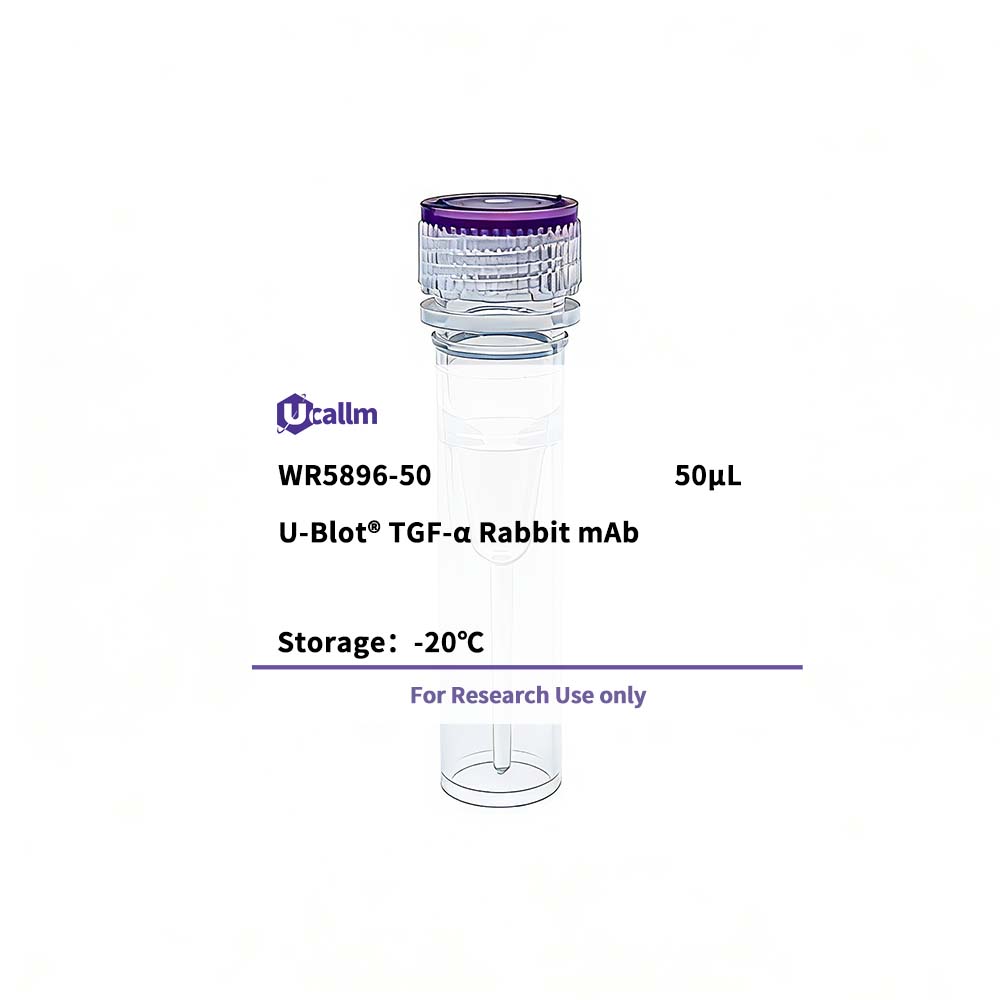
U-Blot® TGF-α Rabbit mAb

Price range: $268.00 through $328.00

SKU: WR5896-50
Enter the quantity you would like, or drag the panel to find the quantity and price that best for you
Bulk QuoteAuthorize OEM & ODM

Product details

Background:
This gene encodes a growth factor that is a ligand for the epidermal growth factor receptor , which activates a signaling pathway for cell proliferation , differentiation and development. This protein may act as either a transmembrane-bound ligand or a soluble ligand. This gene has been associated with many types of cancers , and it may also be involved in some cases of cleft lip/palate. Alternatively spliced transcript variants encoding different isoforms have been found for this gene. [provided by RefSeq , Sep 2011] ,

Specifications

Size50μL/100μL
TargetTGFα
ReactivityHuman, Mouse
ApplicationsWB, IHC, IF, IP, ELISA
MW(Calculated)17kD
MW(Observed)19kD
Host SpeciesRabbit
IsotypeIgG,Kappa
Conjugate/ModificationUnmodified
Recommended Dilution RatioIHC 1:200-1:1000; WB 1:500-1:2000; IF 1:200-1:1000; ELISA 1:5000-1:20000; IP 1:50-1:200; / Note: For IHC, we suggest antigen retrieval with TE buffer pH 9.0 (Cat#WT1004)
FormulationPBS, 50% glycerol, 0.05% Proclin 300, 0.05%BSA
PurificationRecombinant Antibody expressed in animal component-free (ACF) media, purified via Protein A affinity chromatography.
Storage-15°C to -25°C/1 year(Do not lower than -25°C)
Concentration
ClonalityMonoclonal
Clone NumberRM1724R
ImmunogenThe specific immunogen used to produce this antibody is proprietary information.
SpecificityEndogenous
Gene NameTGFA
Protein NameProtransforming growth factor alpha
Other NameTGFA; / Protransforming growth factor alpha
SpeciesHuman
Gene ID7039
UniprotP01135,
Species.1Mouse
Gene ID.121802
Uniprot.1P48030,
Species.2Rat
Gene ID.224827
Uniprot.2P01134
Cellular Localization[Transforming growth factor alpha]: Secreted, extracellular space.; [Protransforming growth factor alpha]: Cell membrane; Single-pass type I membrane protein.
Tissue ExpressionIsoform 1, isoform 3 and isoform 4 are expressed in keratinocytes and tumor-derived cell lines.
Signaling_pathwayOrganismal Systems >> Endocrine system >> Estrogen signaling pathway;Human Diseases >> Cancer: overview >> Pathways in cancer;Human Diseases >> Cancer: specific types >> Colorectal cancer;Human Diseases >> Cancer: specific types >> Pancreatic cancer;Human Diseases >> Cancer: specific types >> Hepatocellular carcinoma;Human Diseases >> Cancer: specific types >> Glioma;Human Diseases >> Cancer: specific types >> Renal cell carcinoma;Human Diseases >> Cancer: specific types >> Prostate cancer;Human Diseases >> Cancer: specific types >> Non-small cell lung cancer;Environmental Information Processing >> Signal transduction >> MAPK signaling pathway;Environmental Information Processing >> Signal transduction >> ErbB signaling pathway;Environmental Information Processing >> Signal transduction >> Ras signaling pathway;Environmental Information Processing >> Signal transduction >> Calcium signaling pathway;Environmental Information Processing >> Signal transduction >> PI3K-Akt signaling pathway
Research Areas>>EGFR tyrosine kinase inhibitor resistance; / >>MAPK signaling pathway; / >>ErbB signaling pathway; / >>Ras signaling pathway; / >>PI3K-Akt signaling pathway; / >>Estrogen signaling pathway; / >>Pathways in cancer; / >>Colorectal cancer; / >>Renal cell carcinoma; / >>Pancreatic cancer; / >>Glioma; / >>Prostate cancer; / >>Non-small cell lung cancer; / >>Hepatocellular carcinoma
FunctionFunction:TGF alpha is a mitogenic polypeptide that is able to bind to the EGF receptor and to act synergistically with TGF beta to promote anchorage-independent cell proliferation in soft agar.,similarity:Contains 1 EGF-like domain.,subunit:Interacts with the PDZ domains of MAGI3, SDCBP and SNTA1. The interaction with SDCBP, is required for the targeting to the cell surface. In the endoplasmic reticulum, in its immature form (i.e. with a prosegment and lacking full N-glycosylation), interacts with CNIH. In the Golgi apparatus, may form a complex with CNIH and GORASP2.,
Please login to post questions
Back to Top
Product has been added to your cart

