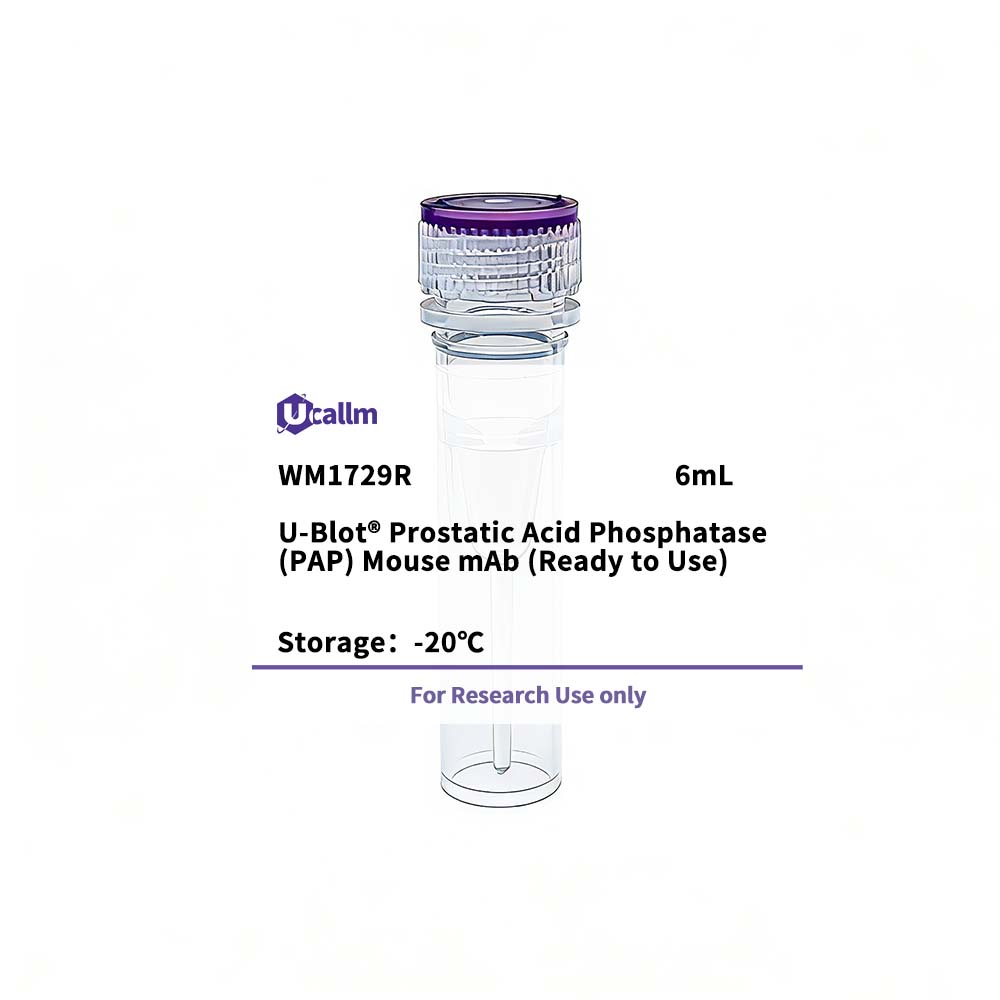
SKU: WM1729R Categories: ,

U-Blot® Prostatic Acid Phosphatase (PAP) Mouse mAb (Ready to Use)

$168.00

SKU: WM1729R
Enter the quantity you would like, or drag the panel to find the quantity and price that best for you
Bulk QuoteAuthorize OEM & ODM

Product details

Background:
This gene encodes an enzyme that catalyzes the conversion of orthophosphoric monoester to alcohol and orthophosphate. It is synthesized under androgen regulation and is secreted by the epithelial cells of the prostate gland. An alternatively spliced transcript variant encoding a longer isoform has been found for this gene. This isoform contains a transmembrane domain and is localized in the plasma membrane-endosomal-lysosomal pathway. [provided by RefSeq, Sep 2008],

Specifications

Size6mL
TargetPSAP
ReactivityHuman, Mouse, Rat
ApplicationsIHC
MW(Calculated)
MW(Observed)
Host SpeciesMouse
IsotypeIgG2b,Kappa
Conjugate/ModificationUnmodified
Recommended Dilution RatioReady to use for IHC / Note: For IHC, we suggest antigen retrieval with TE buffer pH 9.0 (Cat#WT1004)
FormulationThe prediluted ready-to-use antibody is diluted in phosphate buffer saline containing stabilizing protein and 0.05% Proclin 300
PurificationThe antibody was affinity-purified from ascites by affinity-chromatography using specific immunogen.
Storage2°C to 8°C/1 year,Ship by ice bag
Concentration
ClonalityMonoclonal
Clone NumberRMM119
ImmunogenSynthesized peptide derived from human PSAP AA range: 201-300
SpecificityThe antibody can specifically recognize human PSAP protein.
Gene NameACPP
Protein NameProstatic Acid Phosphatase(PSAP)
Other NameProstatic acid phosphatase; / PAP; / 5'-nucleotidase; / 5'-NT; / Ecto-5'-nucleotidase; / Thiamine monophosphatase; / TMPase; / [Cleaved into: PAPf39]
SpeciesHuman
Gene ID55
UniprotP15309
Species.1
Gene ID.1
Uniprot.1
Species.2
Gene ID.2
Uniprot.2
Cellular LocalizationCytoplasmic
Tissue ExpressionHighly expressed in the prostate, restricted to glandular and ductal epithelial cells. Also expressed in bladder, kidney, pancreas, lung, cervix, testis and ovary. Weak expression in a subset of pancreatic islet cells, squamous epithelia, the pilosebaceous unit, colonic neuroendocrine cells and skin adnexal structures. Low expression in prostate carcinoma cells and tissues.; [Isoform 2]: Widely expressed. Expressed in the sarcolemma of skeletal muscle.
Signaling_pathway
Research Areas
FunctionCatalytic activity:A phosphate monoester + H(2)O = an alcohol + phosphate.,similarity:Belongs to the histidine acid phosphatase family.,subcellular location:Predominantly localized in the plasma membrane but also detected in intracellular vesicles.,subunit:Homodimer.,
Please login to post questions
Back to Top
Product has been added to your cart