SKU: WR4002 Categories: ,

U-Blot® Ezrin Rabbit mAb

Price range: $268.00 through $328.00

SKU: WR4002-50
Enter the quantity you would like, or drag the panel to find the quantity and price that best for you
Bulk QuoteAuthorize OEM & ODM

Product details

Background:The cytoplasmic peripheral membrane protein encoded by this gene functions as a protein-tyrosine kinase substrate in microvilli. As a member of the ERM protein family, this protein serves as an intermediate between the plasma membrane and the actin cytoskeleton. This protein plays a key role in cell surface structure adhesion, migration and organization, and it has been implicated in various human cancers. A pseudogene located on chromosome 3 has been identified for this gene. Alternatively spliced variants have also been described for this gene. [provided by RefSeq, Jul 2008],


Specifications

Size50μL/100μL
TargetEzrin
ReactivityHuman, Mouse, Rat
ApplicationsWB, IHC, IF, IP, ELISA
MW(Calculated)69kD
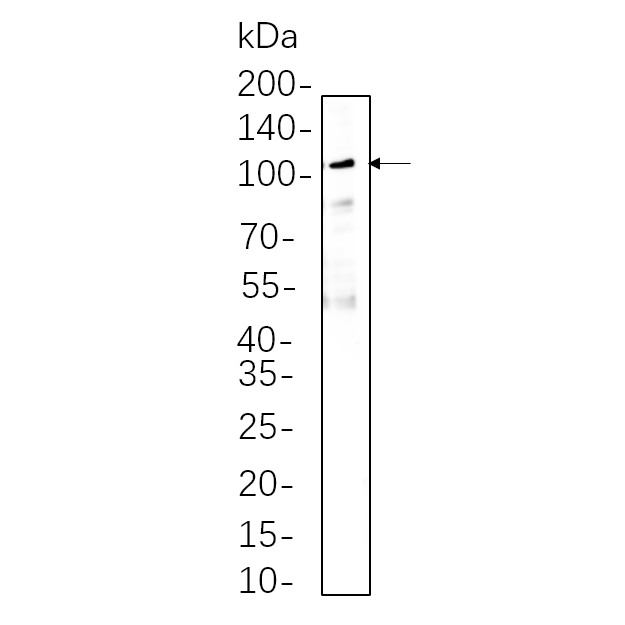
MW(Observed)80kD
Host SpeciesRabbit
IsotypeIgG,Kappa
Conjugate/ModificationUnmodified
Recommended Dilution RatioIHC 1:200-1000; WB 1:500-5000; IF 1:200-1000; ELISA 1:5000-20000; IP 1:50-200 / Note: For IHC, we suggest antigen retrieval with TE buffer pH 9.0 (Cat#WT1004)
FormulationPBS, 50% glycerol, 0.05% Proclin 300, 0.05%BSA
PurificationRecombinant Antibody expressed in animal component-free (ACF) media, purified via Protein A affinity chromatography.
Storage-15°C to -25°C/1 year(Do not lower than -25°C)
Concentration
ClonalityMonoclonal
Clone NumberRM0732R
ImmunogenThe specific immunogen used to produce this antibody is proprietary information.
SpecificityEndogenous
Gene NameEZR
Protein NameEzrin
Other NameEZR; / VIL2; / Ezrin; / Cytovillin; / Villin-2; / p81
SpeciesHuman
Gene ID4318
UniprotP15311,
Species.1Mouse
Gene ID.122350
Uniprot.1P26040,
Species.2Rat
Gene ID.254319
Uniprot.2P50282
Cellular LocalizationCytoplasm, Membrane
Tissue ExpressionDetected in neutrophils (at protein level) (PubMed:7683678). Produced by normal alveolar macrophages and granulocytes.
Signaling_pathwayOrganismal Systems >> Immune system >> IL-17 signaling pathway;Organismal Systems >> Immune system >> Leukocyte transendothelial migration;Organismal Systems >> Endocrine system >> Estrogen signaling pathway;Organismal Systems >> Endocrine system >> Relaxin signaling pathway;Human Diseases >> Cancer: overview >> Pathways in cancer;Human Diseases >> Cancer: overview >> Transcriptional misregulation in cancer;Human Diseases >> Cancer: overview >> MicroRNAs in cancer;Human Diseases >> Cancer: specific types >> Bladder cancer;Human Diseases >> Cancer: specific types >> Prostate cancer;Environmental Information Processing >> Signal transduction >> TNF signaling pathway
Research Areas>>Endocrine resistance; / >>IL-17 signaling pathway; / >>TNF signaling pathway; / >>Leukocyte transendothelial migration; / >>Estrogen signaling pathway; / >>Relaxin signaling pathway; / >>Hepatitis B; / >>Pathways in cancer; / >>Transcriptional misregulation in cancer; / >>Proteoglycans in cancer; / >>MicroRNAs in cancer; / >>Prostate cancer; / >>Bladder cancer; / >>Diabetic cardiomyopathy; / >>Lipid and atherosclerosis; / >>Fluid shear stress and atherosclerosis
Functiondevelopmental stage:Very strong staining is detected in the Purkinje cell layer and in part of the molecular layer of the infant brain compared to adult brain.,Function:Probably involved in connections of major cytoskeletal structures to the plasma membrane. In epithelial cells, required for the formation of microvilli and membrane ruffles on the apical pole. Along with PLEKHG6, required for normal macropinocytosis.,PTM:Phosphorylated by tyrosine-protein kinases.,similarity:Contains 1 FERM domain.,subcellular location:Localization to the apical membrane of parietal cells depends on the interaction with MPP5. Localizes to cell extensions and peripheral processes of astrocytes (By similarity). Microvillar peripheral membrane protein (cytoplasmic side).,subunit:Interacts with MPP5 (By similarity). Interacts with SLC9A3R1 and SCYL3/PACE1. Interacts with PLEKHG6. Interacts with NGX6.,tissue specificity:Expressed in cerebral cortex, basal ganglia, hippocampus, hypophysis, and optic nerve. Weakly expressed in brain stem and diencephalon. Stronger expression was detected in gray matter of frontal lobe compared to white matter (at protein level). Component of the microvilli of intestinal epithelial cells. Preferentially expressed in astrocytes of hippocampus, frontal cortex, thalamus, parahippocampal cortex, amygdala, insula, and corpus callosum. Not detected in neurons in most tissues studied.,
Please login to post questions

Back to Top
Product has been added to your cart
