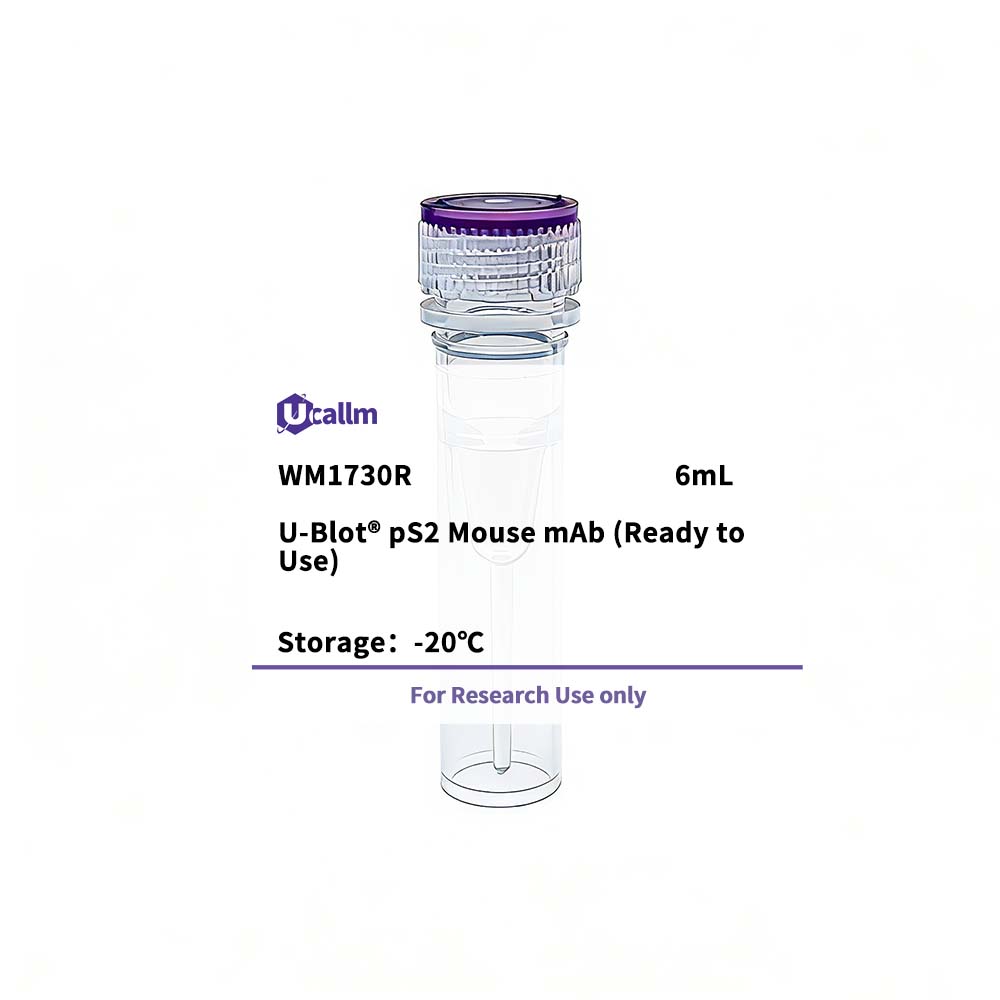
SKU: WM1730R Categories: ,

U-Blot® pS2 Mouse mAb (Ready to Use)

$168.00

SKU: WM1730R
Enter the quantity you would like, or drag the panel to find the quantity and price that best for you
Bulk QuoteAuthorize OEM & ODM

Product details

Background:
Members of the trefoil family are characterized by having at least one copy of the trefoil motif, a 40-amino acid domain that contains three conserved disulfides. They are stable secretory proteins expressed in gastrointestinal mucosa. Their functions are not defined, but they may protect the mucosa from insults, stabilize the mucus layer, and affect healing of the epithelium. This gene, which is expressed in the gastric mucosa, has also been studied because of its expression in human tumors. This gene and two other related trefoil family member genes are found in a cluster on chromosome 21. [provided by RefSeq, Jul 2008],

Specifications

TargetpS2
ReactivityHuman
ApplicationsIHC
MW(Calculated)
MW(Observed)
Host SpeciesMouse
IsotypeIgG1,Kappa
Conjugate/ModificationUnmodified
Modification
Recommended Dilution RatioReady to use for IHC / Note: For IHC, we suggest antigen retrieval with TE buffer pH 9.0 (Cat#YS0004)
FormulationThe prediluted ready-to-use antibody is diluted in phosphate buffer saline containing stabilizing protein and 0.05% Proclin 300
Source
PurificationThe antibody was affinity-purified from ascites by affinity-chromatography using specific immunogen.
Purity
Storage2°C to 8°C/1 year,Ship by ice bag
Concentration
ClonalityMonoclonal
Clone NumberABT265
ImmunogenSynthesized peptide derived from human pS2 AA range: 25-84
Sequence
SpecificityThe antibody can specifically recognize human pS2 protein.
Gene NameTFF1 BCEI PS2
Protein NamepS2
Other NameTrefoil factor 1; / Breast cancer estrogen-inducible protein; / PNR-2; / Polypeptide P1.A; / hP1.A; / Protein pS2
SpeciesHuman
Gene ID-17031
UniprotP04155
Species.1
Gene ID-2
Uniprot.1
Species.2
Gene ID-3
Uniprot.2
Organism-4
Gene ID-4
SwissProt-4
BackgroundMembers of the trefoil family are characterized by having at least one copy of the trefoil motif, a 40-amino acid domain that contains three conserved disulfides. They are stable secretory proteins expressed in gastrointestinal mucosa. Their functions are not defined, but they may protect the mucosa from insults, stabilize the mucus layer, and affect healing of the epithelium. This gene, which is expressed in the gastric mucosa, has also been studied because of its expression in human tumors. This gene and two other related trefoil family member genes are found in a cluster on chromosome 21. [provided by RefSeq, Jul 2008],
Cellular LocalizationCytoplasmic
Tissue ExpressionFound in stomach, with highest levels in the upper gastric mucosal cells (at protein level). Detected in goblet cells of the small and large intestine and rectum, small submucosal glands in the esophagus, mucous acini of the sublingual gland, submucosal glands of the trachea, and epithelial cells lining the exocrine pancreatic ducts but not in the remainder of the pancreas (at protein level). Scattered expression is detected in the epithelial cells of the gallbladder and submucosal glands of the vagina, and weak expression is observed in the bronchial goblet cells of the pseudostratified epithelia in the respiratory system (at protein level). Detected in urine (at protein level). Strongly expressed in breast cancer but at low levels in normal mammary tissue. It is regulated by estrogen in MCF-7 cells. Strong expression found in normal gastric mucosa and in the regenerative tissues surrounding ulcerous lesions of gastrointestinal tract, but lower expression found in gastric cancer (at protein level).
Signaling_pathwayOrganismal Systems >> Endocrine system >> Estrogen signaling pathway
Research Areas>>Estrogen signaling pathway
FunctionDisease:Expressed in a number of carcinomas including breast (50%), pancreas (70-75%), stomach (50-55%), and large bowel (58%).,Function:Stabilizer of the mucous gel overlying the gastrointestinal mucosa that provides a physical barrier against various noxious agents. May inhibit the growth of calcium oxalate crystals in urine.,similarity:Contains 1 P-type (trefoil) domain.,subunit:Heterodimer with GKN2; disulfide linked.,tissue specificity:Found in stomach, with highest levels in the upper gastric mucosal cells (at protein level). Detected in goblet cells of the small and large intestine and rectum, small submucosal glands in the esophagus, mucous acini of the sublingual gland, submucosal glands of the trachea, and epithelial cells lining the exocrine pancreatic ducts but not in the remainder of the pancreas (at protein level). Scattered expression is detected in the epithelial cells of the gallbladder and submucosal glands of the vagina, and weak expression is observed in the bronchial goblet cells of the pseudostratified epithelia in the respiratory system (at protein level). Detected in urine (at protein level). Strongly expressed in breast cancer but at low levels in normal mammary tissue. It is regulated by estrogen in MCF-7 cells. Strong expression found in normal gastric mucosa and in the regenerative tissues surrounding ulcerous lesions of gastrointestinal tract, but lower expression found in gastric cancer (at protein level).,
RRID
Please login to post questions
Back to Top
Product has been added to your cart