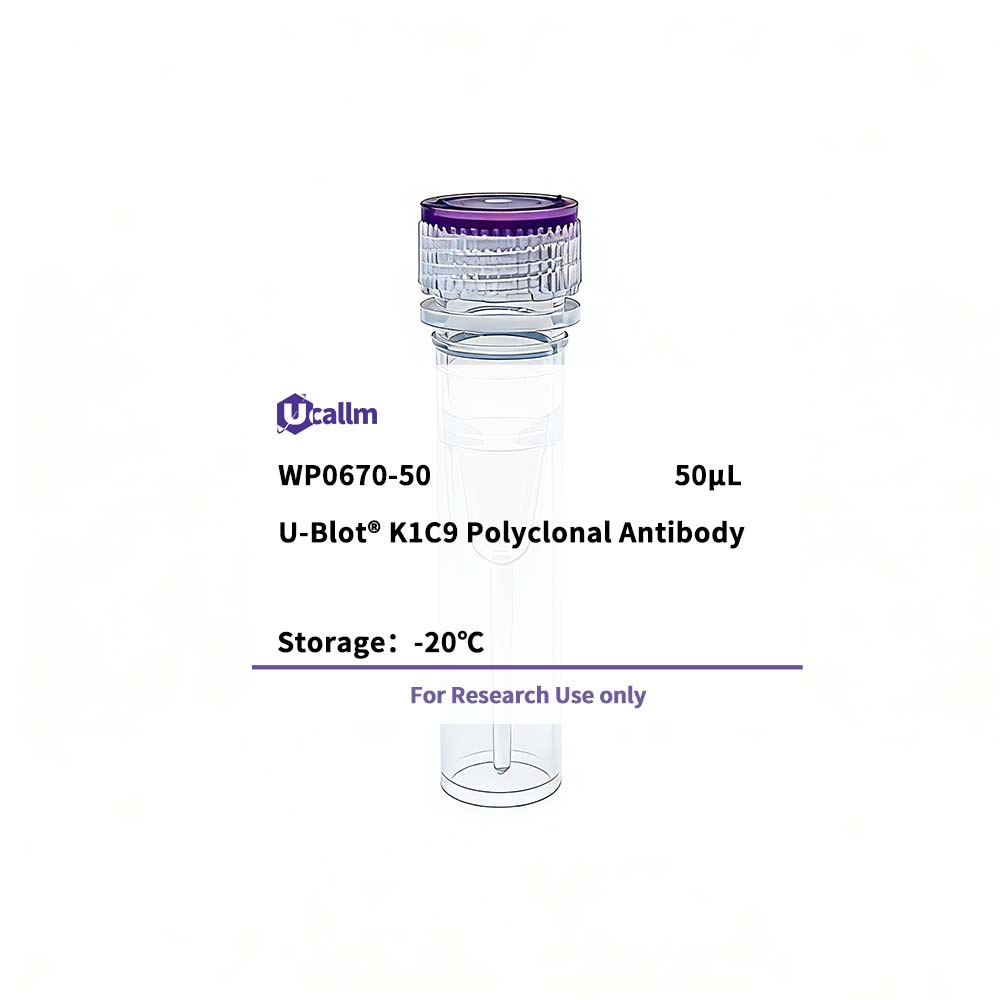
SKU: WP0670 Categories: ,

K1C9 Polyclonal Antibody

Price range: $268.00 through $328.00

SKU: WP0670-100
Enter the quantity you would like, or drag the panel to find the quantity and price that best for you
Bulk QuoteAuthorize OEM & ODM

Product details

Background:

keratin 9(KRT9) Homo sapiens This gene encodes the type I keratin 9, an intermediate filament chain expressed only in the terminally differentiated epidermis of palms and soles. Mutations in this gene cause epidermolytic palmoplantar keratoderma. [provided by RefSeq, Jul 2008],


Specifications

Size50μL/100μL
TargetK1C9
ReactivityHuman, Mouse, Rat
ApplicationsWB, ELISA
MW(Calculated)
MW(Observed)68kD
Host SpeciesRabbit
IsotypeIgG
Conjugate/ModificationUnmodified
Recommended Dilution RatioWB 1:500-2000; ELISA 1:5000-20000
FormulationLiquid in PBS containing 50% glycerol,0.5% BSA and 0.02% sodium azide.
PurificationThe antibody was affinity-purified from rabbit antiserum by affinity-chromatography using epitope-specific immunogen.
Storage-15°C to -25°C/1 year(Do not lower than -25°C)
Concentration1 mg/ml
ClonalityPolyclonal
Clone Number
ImmunogenSynthesized peptide derived from human protein . at AA range: 340-420
SpecificityK1C9 Polyclonal Antibody detects endogenous levels of protein.
Gene NameKRT9
Protein NameKeratin, type I cytoskeletal 9 (Cytokeratin-9) (CK-9) (Keratin-9) (K9)
Other Name
SpeciesHuman
Gene ID3857
UniprotP35527,
Species.1Mouse
Gene ID.1
Uniprot.1Q6RHW0,
Species.2Rat
Gene ID.2
Uniprot.2Q8CIS9
Cellular Localizationextracellular space,nucleus,intermediate filament,membrane,extracellular exosome,
Tissue ExpressionExpressed in the terminally differentiated epidermis of palms and soles.
Signaling_pathwayOrganismal Systems >> Endocrine system >> Estrogen signaling pathway
Research Areas>>Estrogen signaling pathway; / >>Staphylococcus aureus infection
FunctionCaution:Was originally (PubMed:2140676) thought to be a 60 kDa chain of placental scatter protein.,Disease:Defects in KRT9 are a cause of palmoplantar keratoderma epidermolytic (EPPK) [MIM:144200]; also abbreviated EHPPK. EPPK is a dermatological disorder characterized by diffuse thickening of the epidermis on the entire surface of palms and soles sharply bordered with erythematous margins.,Disease:Knuckle pads are sometimes associated with EPPK [MIM:149100]. Knuckle pads consist of an autosomal dominant trait, in which thick pads of skin appear over the proximal phalangeal joints.,Function:May serve an important special function either in the mature palmar and plantar skin tissue or in the morphogenetic program of the formation of these tissues. Plays a role in keratin filament assembly.,induction:Induced by intrinsic regulatory mechanisms and by extrinsic signals from a subset of dermal palmoplantar fibroblasts.,miscellaneous:There are two types of cytoskeletal and microfibrillar keratin, I (acidic) and II (neutral to basic) (40-55 and 56-70 kDa, respectively).,similarity:Belongs to the intermediate filament family.,subunit:Heterotetramer of two type I and two type II keratins.,tissue specificity:Expressed in the terminally differentiated epidermis of palms and soles.,
Please login to post questions
Back to Top
Product has been added to your cart


