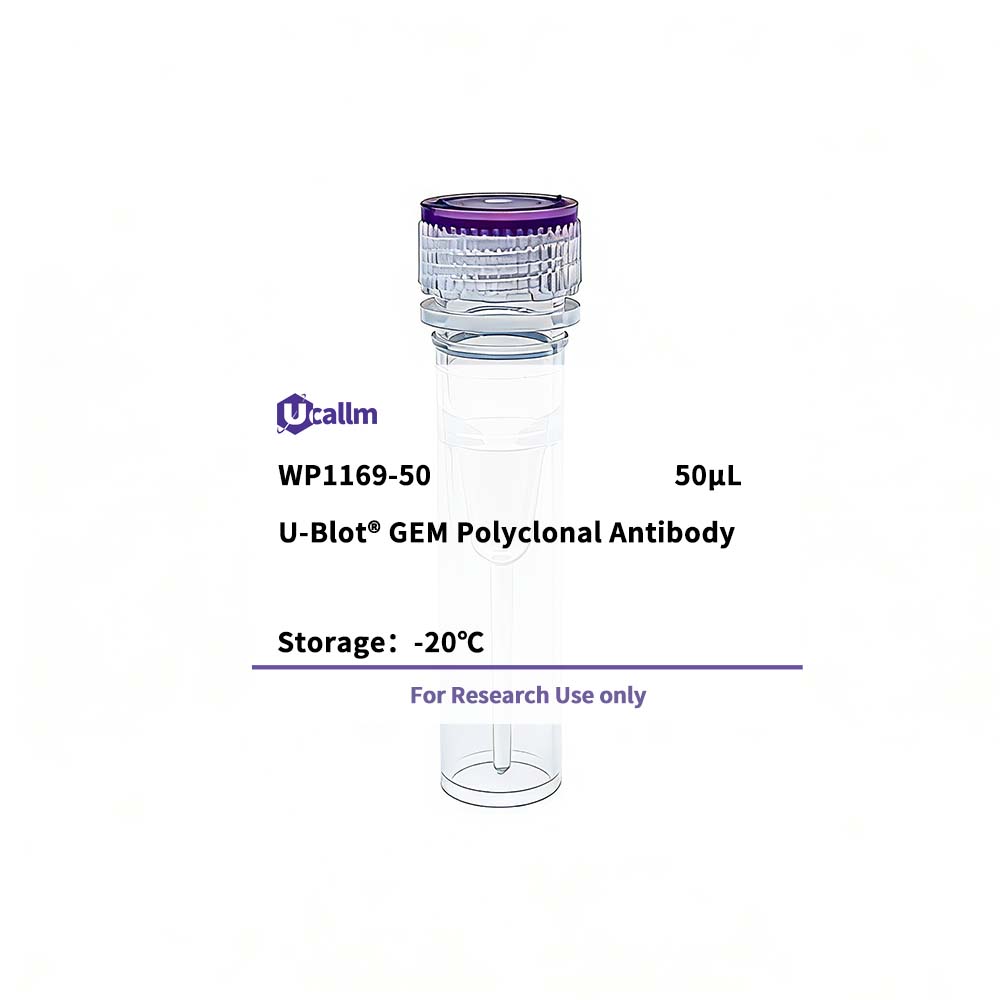
SKU: WP1169 Categories: ,

GEM Polyclonal Antibody

Price range: $268.00 through $328.00

SKU: WP1169-100
Enter the quantity you would like, or drag the panel to find the quantity and price that best for you
Bulk QuoteAuthorize OEM & ODM

Product details

Background:

The protein encoded by this gene belongs to the RAD/GEM family of GTP-binding proteins. It is associated with the inner face of the plasma membrane and could play a role as a regulatory protein in receptor-mediated signal transduction. Alternative splicing occurs at this locus and two transcript variants encoding the same protein have been identified. [provided by RefSeq, Jul 2008],

Specifications

Size50μL/100μL
TargetGEM
ReactivityHuman, Mouse
ApplicationsWB, ELISA
MW(Calculated)
MW(Observed)32kD
Host SpeciesRabbit
IsotypeIgG
Conjugate/ModificationUnmodified
Recommended Dilution RatioWB 1:500-2000; ELISA 1:5000-20000
FormulationLiquid in PBS containing 50% glycerol,0.5% BSA and 0.02% sodium azide.
PurificationThe antibody was affinity-purified from rabbit antiserum by affinity-chromatography using epitope-specific immunogen.
Storage-15°C to -25°C/1 year(Do not lower than -25°C)
Concentration1 mg/ml
ClonalityPolyclonal
Clone Number
ImmunogenSynthesized peptide derived from part region of human protein
SpecificityGEM Polyclonal Antibody detects endogenous levels of protein.
Gene NameGEM KIR
Protein NameGTP-binding protein GEM (GTP-binding mitogen-induced T-cell protein) (RAS-like protein KIR)
Other Name
SpeciesHuman
Gene ID2669
UniprotP55040,
Species.1Mouse
Gene ID.1
Uniprot.1P55041
Species.2
Gene ID.2
Uniprot.2
Cellular LocalizationCell membrane; Peripheral membrane protein; Cytoplasmic side.
Tissue ExpressionMost abundant in thymus, spleen, kidney, lung, and testis. Less abundant in heart, brain, liver and skeletal muscle.
Signaling_pathway
Research Areas
FunctionFunction:Could be a regulatory protein, possibly participating in receptor-mediated signal transduction at the plasma membrane. Has guanine nucleotide-binding activity but undetectable intrinsic GTPase activity.,induction:By mitogens.,PTM:Phosphorylated on tyrosine residues.,similarity:Belongs to the small GTPase superfamily. RGK family.,subunit:Interacts with calmodulin in a Ca(2+)-dependent manner. Binds ROCK1.,tissue specificity:Most abundant in thymus, spleen, kidney, lung, and testis. Less abundant in heart, brain, liver and skeletal muscle.,
Please login to post questions
Back to Top
Product has been added to your cart

