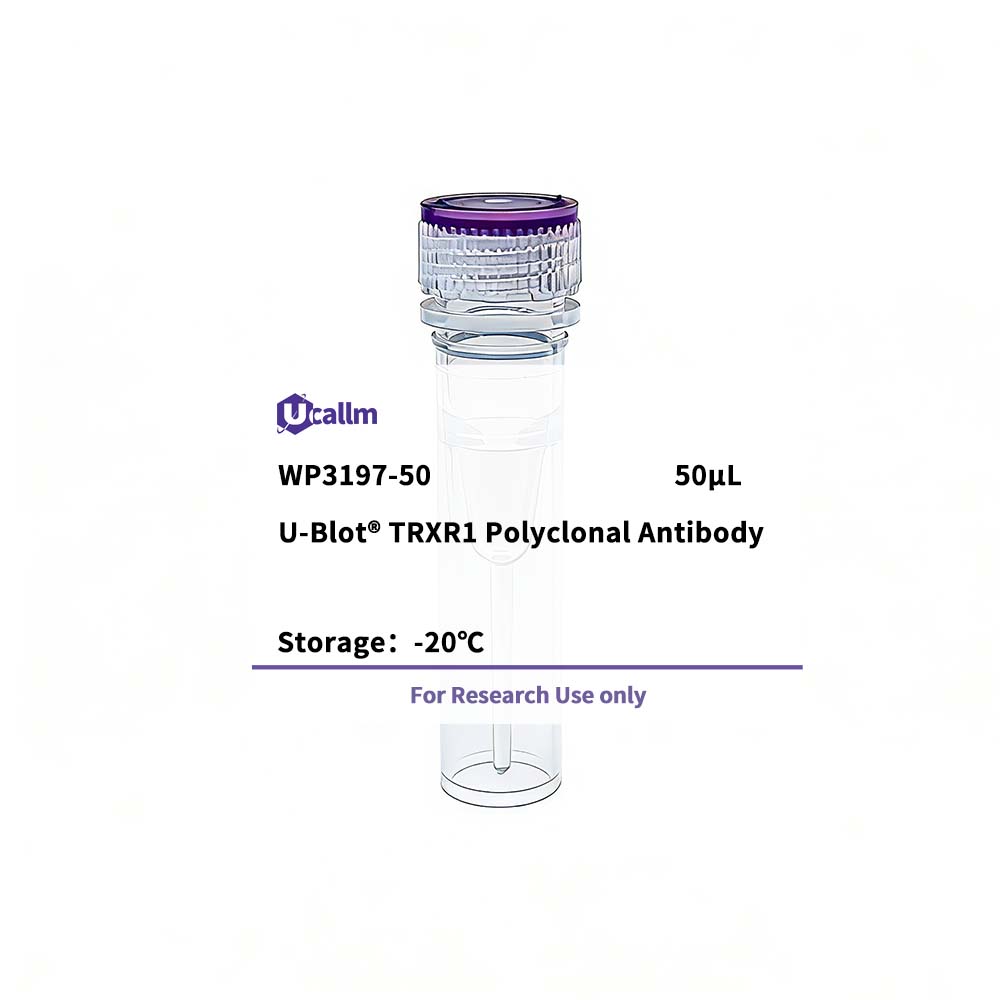
SKU: WP3197 Categories: ,

TRXR1 Polyclonal Antibody

Price range: $268.00 through $328.00

SKU: WP3197-100
Enter the quantity you would like, or drag the panel to find the quantity and price that best for you
Bulk QuoteAuthorize OEM & ODM

Product details

Background:

thioredoxin reductase 1(TXNRD1) Homo sapiens This gene encodes a member of the family of pyridine nucleotide oxidoreductases. This protein reduces thioredoxins as well as other substrates, and plays a role in selenium metabolism and protection against oxidative stress. The functional enzyme is thought to be a homodimer which uses FAD as a cofactor. Each subunit contains a selenocysteine (Sec) residue which is required for catalytic activity. The selenocysteine is encoded by the UGA codon that normally signals translation termination. The 3' UTR of selenocysteine-containing genes have a common stem-loop structure, the sec insertion sequence (SECIS), that is necessary for the recognition of UGA as a Sec codon rather than as a stop signal. Alternative splicing results in several transcript variants encoding the same or different isoforms. [provided by RefSeq, Jul 2008],


Specifications

Size50μL/100μL
TargetTXNRD1
ReactivityHuman, Mouse, Rat
ApplicationsWB, ELISA
MW(Calculated)
MW(Observed)71kD
Host SpeciesRabbit
IsotypeIgG
Conjugate/ModificationUnmodified
Recommended Dilution RatioWB 1:500-2000; ELISA 1:5000-20000
FormulationLiquid in PBS containing 50% glycerol,0.5% BSA and 0.02% sodium azide.
PurificationThe antibody was affinity-purified from rabbit antiserum by affinity-chromatography using epitope-specific immunogen.
Storage-15°C to -25°C/1 year(Do not lower than -25°C)
Concentration1 mg/ml
ClonalityPolyclonal
Clone Number
ImmunogenSynthesized peptide derived from part region of human protein AA range: 268-318
SpecificityTRXR1 Polyclonal Antibody detects endogenous levels of protein.
Gene NameTXNRD1 GRIM12 KDRF
Protein NameThioredoxin reductase 1, cytoplasmic (TR) (Gene associated with retinoic and interferon-induced mortality 12 protein) (GRIM-12) (Gene associated with retinoic and IFN-induced mortality 12 protein) (KM-102-derived reductase-like factor) (Thioredoxin reductase TR1)
Other Name
SpeciesHuman
Gene ID7296
UniprotQ16881,
Species.1Mouse
Gene ID.1
Uniprot.1Q9JMH6,
Species.2Rat
Gene ID.2
Uniprot.2O89049
Cellular Localization[Isoform 1]: Cytoplasm .; [Isoform 4]: Cytoplasm . Nucleus .; [Isoform 5]: Cytoplasm .
Tissue Expression[Isoform 1]: Expressed predominantly in Leydig cells (at protein level). Also expressed in ovary, spleen, heart, liver, kidney and pancreas and in a number of cancer cell lines.; [Isoform 4]: Widely expressed with highest levels in kidney, testis, uterus, ovary, prostate, placenta and fetal liver.
Signaling_pathwayHuman Diseases >> Cancer: overview >> Pathways in cancer;Human Diseases >> Cancer: specific types >> Hepatocellular carcinoma
Research Areas>>Selenocompound metabolism; / >>Pathways in cancer; / >>Hepatocellular carcinoma
FunctionCatalytic activity:Thioredoxin + NADP(+) = thioredoxin disulfide + NADPH.,cofactor:Binds 1 FAD per subunit.,Domain:The N-terminal glutaredoxin domain found in isoform 1 does not contain the C-P-Y-C redox-active motif normally found in glutaredoxins and has been found to be inactive in classical glutaredoxin assays.,Function:Isoform 1 may possess glutaredoxin activity as well as thioredoxin reductase activity and induces actin and tubulin polymerization, leading to formation of cell membrane protrusions. Isoform 4 enhances the transcriptional activity of estrogen receptors alpha and beta while isoform 5 enhances the transcriptional activity of the beta receptor only. Isoform 5 also mediates cell death induced by a combination of interferon-beta and retinoic acid.,induction:Isoform 5 is induced by a combination of interferon-beta and retinoic acid (at protein level). Isoform 1 is induced by estradiol or testosterone in HeLa cells.,miscellaneous:The thioredoxin reductase active site is a redox-active disulfide bond. The selenocysteine residue is also essential for catalytic activity.,PTM:The N-terminus of isoform 5 is blocked.,sequence Caution:Translated as Sec.,similarity:Belongs to the class-I pyridine nucleotide-disulfide oxidoreductase family.,similarity:Contains 1 glutaredoxin domain.,subunit:Homodimer. Isoform 4 interacts with ESR1 and ESR2.,tissue specificity:Isoform 1 is expressed predominantly in Leydig cells (at protein level). Also expressed in ovary, spleen, heart, liver, kidney and pancreas and in a number of cancer cell lines. Isoform 4 is widely expressed with highest levels in kidney, testis, uterus, ovary, prostate, placenta and fetal liver.,
Please login to post questions
Back to Top
Product has been added to your cart