

Product details
Background:
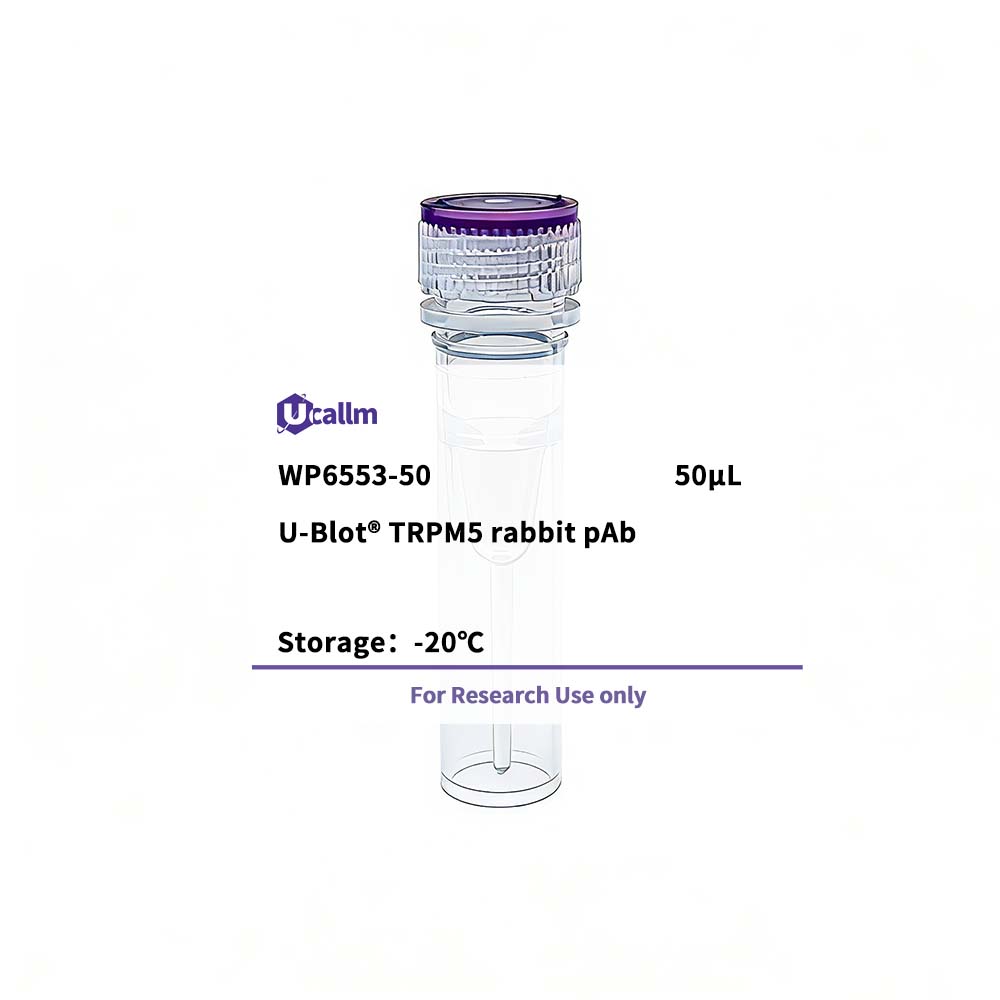
Price range: $268.00 through $328.00
Background:
| Size | 50μL/100μL |
| Target | TRPM5 |
| Reactivity | Human, Mouse |
| Applications | WB |
| MW(Calculated) | 128kD |
| MW(Observed) | |
| Host Species | Rabbit |
| Isotype | IgG |
| Conjugate/Modification | Unmodified |
| Recommended Dilution Ratio | WB 1:500-2000 |
| Formulation | Liquid in PBS containing 50% glycerol, 0.5% BSA and 0.02% sodium azide. |
| Purification | The antibody was affinity-purified from rabbit antiserum by affinity-chromatography using epitope-specific immunogen. |
| Storage | -15°C to -25°C/1 year(Do not lower than -25°C) |
| Concentration | 1 mg/ml |
| Clonality | Polyclonal |
| Clone Number | |
| Immunogen | Synthesized peptide derived from human TRPM5 |
| Specificity | This antibody detects endogenous levels of TRPM5 at Human, Mouse |
| Gene Name | TRPM5 LTRPC5 MTR1 |
| Protein Name | Transient receptor potential cation channel subfamily M member 5 (Long transient receptor potential channel 5) (LTrpC-5) (LTrpC5) (MLSN1- and TRP-related gene 1 protein) |
| Other Name | |
| Species | Human |
| Gene ID | 29850 |
| Uniprot | Q9NZQ8, |
| Species.1 | Mouse |
| Gene ID.1 | 56843 |
| Uniprot.1 | Q9JJH7 |
| Species.2 | |
| Gene ID.2 | |
| Uniprot.2 | |
| Cellular Localization | Cell membrane; Multi-pass membrane protein . |
| Tissue Expression | Strongly expressed in fetal brain, liver and kidney, and in adult prostate, testis, ovary, colon and peripheral blood leukocytes. Also expressed in a large proportion of Wilms' tumors and rhabdomyosarcomas. In monochromosomal cell lines shows exclusive paternal expression. |
| Signaling_pathway | |
| Research Areas | |
| Function | Voltage-modulated Ca(2+)-activated, monovalent cation channel (VCAM) that mediates a transient membrane depolarization and plays a central role in taste transduction. Monovalent-specific, non-selective cation channel that mediates the transport of Na(+), K(+) and Cs(+) ions equally well. Activated directly by increases in intracellular Ca(2+), but is impermeable to it. Gating is voltage-dependent and displays rapid activation and deactivation kinetics upon channel stimulation even during sustained elevations in Ca(2+). Also activated by a fast intracellular Ca(2+) increase in response to inositol 1,4,5-triphosphate-producing receptor agonists. The channel is blocked by extracellular acidification. External acidification has 2 effects, a fast reversible block of the current and a slower irreversible enhancement of current inactivation. Is a highly temperature-sensitive, heat activated channel showing a steep increase of inward currents at temperatures between 15 and 35 degrees Celsius. Heat activation is due to a shift of the voltage-dependent activation curve to negative potentials. Activated by arachidonic acid in vitro. May be involved in perception of bitter, sweet and umami tastes. May also be involved in sensing semiochemicals. |


