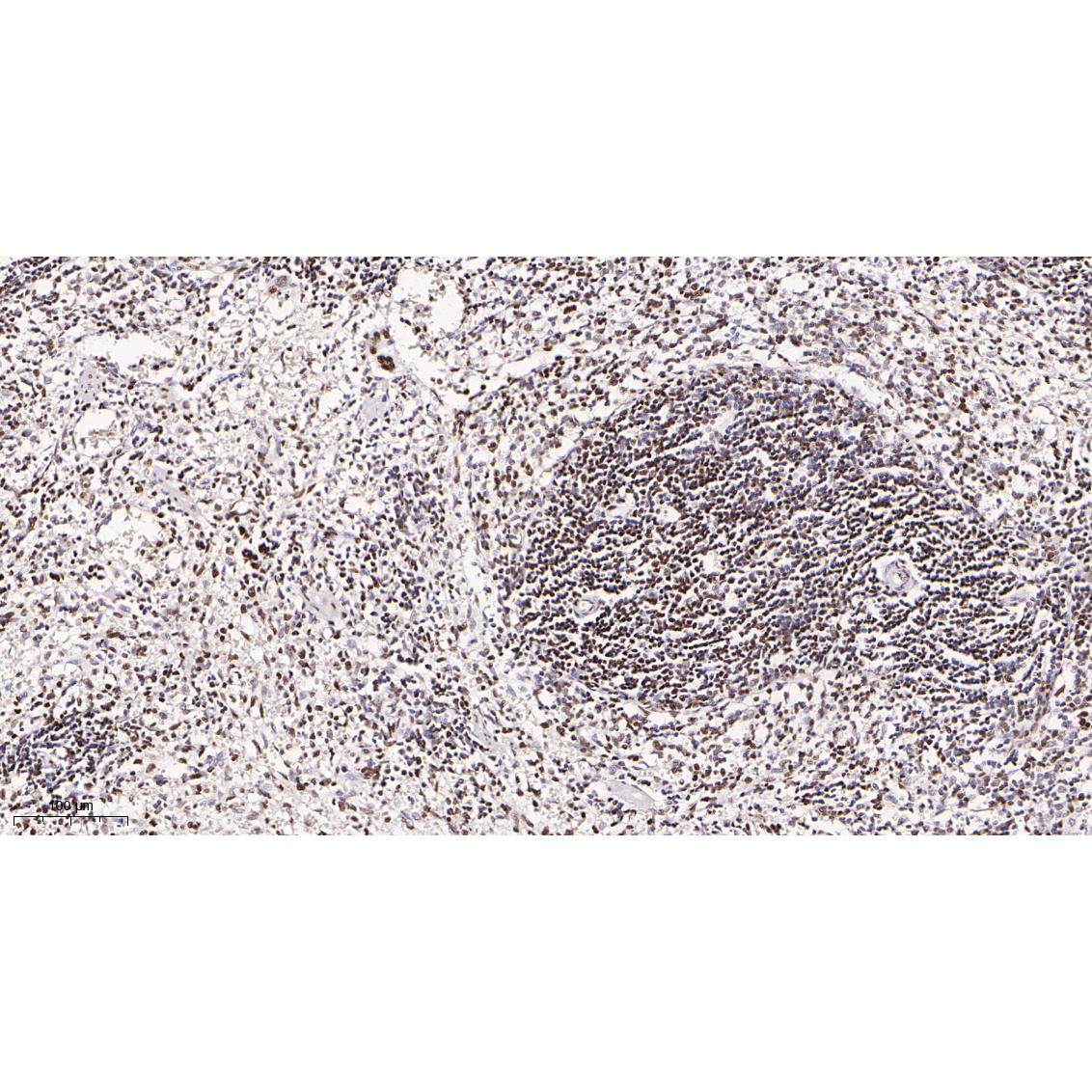
SKU: WR4014 Categories: ,

U-Blot® HDAC2 Rabbit mAb

Price range: $268.00 through $328.00

SKU: WR4014-50
Enter the quantity you would like, or drag the panel to find the quantity and price that best for you
Bulk QuoteAuthorize OEM & ODM

Product details

Background:This gene product belongs to the histone deacetylase family. Histone deacetylases act via the formation of large multiprotein complexes, and are responsible for the deacetylation of lysine residues at the N-terminal regions of core histones (H2A, H2B, H3 and H4). This protein forms transcriptional repressor complexes by associating with many different proteins, including YY1, a mammalian zinc-finger transcription factor. Thus, it plays an important role in transcriptional regulation, cell cycle progression and developmental events. Alternative splicing results in multiple transcript variants. [provided by RefSeq, Apr 2010],

Specifications

Size50μL/100μL
TargetHDAC2
ReactivityHuman, Mouse, Rat
ApplicationsWB, IHC, IF, IP, ELISA
MW(Calculated)55kD
MW(Observed)55kD
Host SpeciesRabbit
IsotypeIgG,Kappa
Conjugate/ModificationUnmodified
Recommended Dilution RatioIHC 1:200-500; WB 1:1000-5000; IF 1:200-1000; ELISA 1:5000-20000; IP 1:50-200 / Note: For IHC, we suggest antigen retrieval with TE buffer pH 9.0 (Cat#WT1004)
FormulationPBS, 50% glycerol, 0.05% Proclin 300, 0.05%BSA
PurificationRecombinant Antibody expressed in animal component-free (ACF) media, purified via Protein A affinity chromatography.
Storage-15°C to -25°C/1 year(Do not lower than -25°C)
Concentration
ClonalityMonoclonal
Clone NumberRM0063R
ImmunogenThe specific immunogen used to produce this antibody is proprietary information.
SpecificityEndogenous
Gene NameHDAC2
Protein NameHistone deacetylase 2
Other NameHDAC2; / Histone deacetylase 2; / HD2
SpeciesHuman
Gene ID3066
UniprotQ92769,
Species.1Mouse
Gene ID.115182
Uniprot.1P70288
Species.2
Gene ID.2
Uniprot.2
Cellular LocalizationNuclear
Tissue ExpressionWidely expressed; lower levels in brain and lung.
Signaling_pathwayCellular Processes >> Cell growth and death >> Cell cycle;Organismal Systems >> Immune system >> Neutrophil extracellular trap formation;Organismal Systems >> Endocrine system >> Thyroid hormone signaling pathway;Organismal Systems >> Aging >> Longevity regulating pathway - multiple species;Human Diseases >> Cancer: overview >> Pathways in cancer;Human Diseases >> Cancer: overview >> Transcriptional misregulation in cancer;Human Diseases >> Cancer: overview >> MicroRNAs in cancer;Human Diseases >> Cancer: specific types >> Chronic myeloid leukemia;Human Diseases >> Neurodegenerative disease >> Huntington disease;Environmental Information Processing >> Signal transduction >> Notch signaling pathway;Environmental Information Processing >> Signal transduction >> TGF-beta signaling pathway;Genetic Information Processing >> Chromosome >> ATP-dependent chromatin remodeling
Research Areas>>Cell cycle; / >>Longevity regulating pathway - multiple species; / >>Notch signaling pathway; / >>Neutrophil extracellular trap formation; / >>Thyroid hormone signaling pathway; / >>Huntington disease; / >>Amphetamine addiction; / >>Alcoholism; / >>Human papillomavirus infection; / >>Epstein-Barr virus infection; / >>Pathways in cancer; / >>Transcriptional misregulation in cancer; / >>Viral carcinogenesis; / >>MicroRNAs in cancer; / >>Chronic myeloid leukemia
FunctionCatalytic activity:Hydrolysis of an N(6)-acetyl-lysine residue of a histone to yield a deacetylated histone.,Function:Forms transcriptional repressor complexes by associating with MAD, SIN3, YY1 and N-COR. Interacts in the late S-phase of DNA-replication with DNMT1 in the other transcriptional repressor complex composed of DNMT1, DMAP1, PCNA, CAF1.,Function:Responsible for the deacetylation of lysine residues on the N-terminal part of the core histones (H2A, H2B, H3 and H4). Histone deacetylation gives a tag for epigenetic repression and plays an important role in transcriptional regulation, cell cycle progression and developmental events. Histone deacetylases act via the formation of large multiprotein complexes.,sequence Caution:Intron retention.,similarity:Belongs to the histone deacetylase family. Type 1 subfamily.,subunit:Interacts with the non-histone region of H2AFY (By similarity). Part of the core histone deacetylase (HDAC) complex composed of HDAC1, HDAC2, RBBP4 and RBBP7. The core complex associates with MTA2, MBD3, MTA1L1, CHD3 and CHD4 to form the nucleosome remodeling and histone deacetylation (NuRD) complex, or with SIN3, SAP18 and SAP30 to form the SIN3 HDAC complex. Component of a BHC histone deacetylase complex that contains HDAC1, HDAC2, HMG20B/BRAF35, AOF2/LSD1, RCOR1/CoREST and PHF21A/BHC80. The BHC complex may also contain ZMYM2, ZNF217, ZMYM3, GSE1 and GTF2I. Part of a complex containing the core histones H2A, H2B, H3 and H4, DEK and unphosphorylated DAXX. Part of a complex containing ATR and CHD4. Forms a heterologous complex at least with YY1. Interacts with ATR, DNMT1, MINT, HDAC7, HDAC10, HCFC1, NRIP1, MJD2A/JHDM3A, PRDM6, SAP30, SETDB1 and SUV39H1. Interacts with the non-histone region of H2AFY. Interacts with PELP1. Component of a mSin3A corepressor complex that contains SIN3A, SAP130, SUDS3/SAP45, ARID4B/SAP180, HDAC1 and HDAC2. Interacts with CBFA2T3. Interacts with SAP30L.,tissue specificity:Widely expressed; lower levels in brain and lung.,
Please login to post questions

Back to Top
Product has been added to your cart
