Product details
Background:
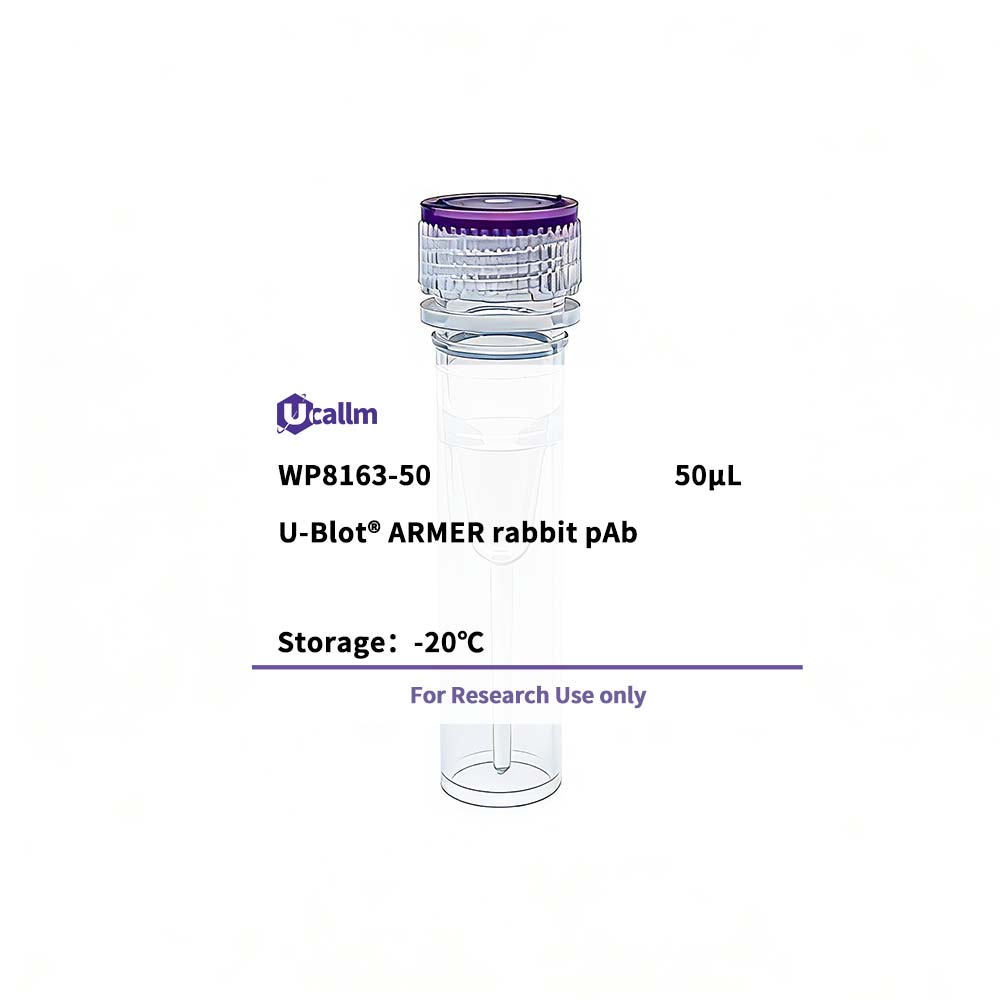
Price range: $268.00 through $328.00
Background:
| Target | ARL6IP1 |
| Reactivity | Human, Mouse |
| Applications | WB |
| MW(Calculated) | 22kD |
| MW(Observed) | |
| Host Species | Rabbit |
| Isotype | IgG |
| Conjugate/Modification | Unmodified |
| Modification | |
| Recommended Dilution Ratio | WB 1:500-2000 |
| Formulation | Liquid in PBS containing 50% glycerol, 0.5% BSA and 0.02% sodium azide. |
| Source | |
| Purification | The antibody was affinity-purified from rabbit antiserum by affinity-chromatography using epitope-specific immunogen. |
| Purity | |
| Storage | -15°C to -25°C/1 year(Do not lower than -25°C) |
| Concentration | 1 mg/ml |
| Clonality | Polyclonal |
| Clone Number | |
| Immunogen | Synthesized peptide derived from human ARMER |
| Sequence | |
| Specificity | This antibody detects endogenous levels of ARMER at Human, Mouse |
| Gene Name | ARL6IP1 ARL6IP KIAA0069 |
| Protein Name | ADP-ribosylation factor-like protein 6-interacting protein 1 (ARL-6-interacting protein 1) (Aip-1) |
| Other Name | |
| Species | Human |
| Gene ID-1 | 23204 |
| Uniprot | Q15041, |
| Species.1 | Mouse |
| Gene ID-2 | 54208 |
| Uniprot.1 | Q9JKW0 |
| Species.2 | |
| Gene ID-3 | |
| Uniprot.2 | |
| Organism-4 | |
| Gene ID-4 | |
| SwissProt-4 | |
| Background | |
| Cellular Localization | Endomembrane system; Multi-pass membrane protein . Endoplasmic reticulum membrane; Multi-pass membrane protein . Endoplasmic reticulum . Predominantly localized to intracytoplasmic membranes. Preferentially localizes at the ER tubules and the edge of the ER sheets, both of which are characterized by a high membrane curvature. . |
| Tissue Expression | Expressed in all hematopoietic cell lineages, but the highest level of expression is found in early myeloid progenitor cells. Expressed in brain, bone marrow, thymus and lung. Expressed at low level in liver, kidney and spleen. Not detected in heart. |
| Signaling_pathway | |
| Research Areas | |
| Function | Positively regulates SLC1A1/EAAC1-mediated glutamate transport by increasing its affinity for glutamate in a PKC activity-dependent manner. Promotes the catalytic efficiency of SLC1A1/EAAC1 probably by reducing its interaction with ARL6IP5, a negative regulator of SLC1A1/EAAC1-mediated glutamate transport (By similarity). Plays a role in the formation and stabilization of endoplasmic reticulum tubules . Negatively regulates apoptosis, possibly by modulating the activity of caspase-9 (CASP9). Inhibits cleavage of CASP9-dependent substrates and downstream markers of apoptosis but not CASP9 itself . May be involved in protein transport, membrane trafficking, or cell signaling during hematopoietic maturation . |
| RRID |