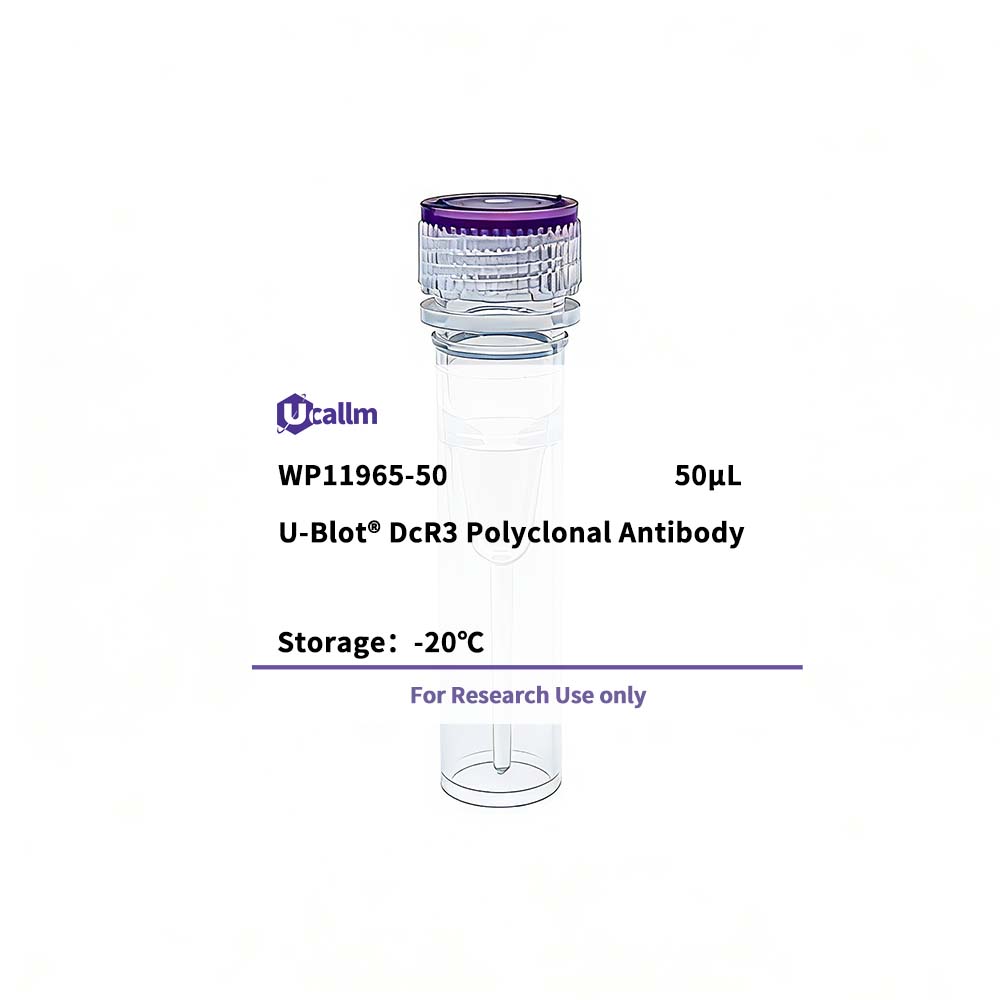
SKU: WP11965 Categories: ,

DcR3 Polyclonal Antibody

Price range: $268.00 through $328.00

SKU: WP11965-100
Enter the quantity you would like, or drag the panel to find the quantity and price that best for you
Bulk QuoteAuthorize OEM & ODM

Product details

Background:

This gene belongs to the tumor necrosis factor receptor superfamily. The encoded protein is postulated to play a regulatory role in suppressing FasL- and LIGHT-mediated cell death. It acts as a decoy receptor that competes with death receptors for ligand binding. Over-expression of this gene has been noted in gastrointestinal tract tumors. Read-through transcription into this gene from the neighboring upstream gene, which encodes regulator of telomere elongation helicase 1 (RTEL1), generates a non-coding transcript. [provided by RefSeq, Feb 2011],

Specifications

Size50μL/100μL
TargetDcR3
ReactivityHuman
ApplicationsWB, IHC, IF, ELISA
MW(Calculated)
MW(Observed)32kD
Host SpeciesRabbit
IsotypeIgG
Conjugate/ModificationUnmodified
Recommended Dilution RatioWB 1:500-1:2000; IHC 1:100-1:300; IF 1:200-1:1000; ELISA 1:5000; Not yet tested in other applications. / Note: For IHC, we suggest antigen retrieval with TE buffer pH 9.0 (Cat#WT1004)
FormulationLiquid in PBS containing 50% glycerol, 0.5% BSA and 0.02% sodium azide.
PurificationThe antibody was affinity-purified from rabbit antiserum by affinity-chromatography using epitope-specific immunogen.
Storage-15°C to -25°C/1 year(Do not lower than -25°C)
Concentration1 mg/ml
ClonalityPolyclonal
Clone Number
ImmunogenThe antiserum was produced against synthesized peptide derived from human TNFRSF6B. AA range:251-300
SpecificityDcR3 Polyclonal Antibody detects endogenous levels of DcR3 protein.
Gene NameTNFRSF6B
Protein NameTumor necrosis factor receptor superfamily member 6B
Other NameTNFRSF6B; / DCR3; / TR6; / Tumor necrosis factor receptor superfamily member 6B; / Decoy receptor 3; / DcR3; / Decoy receptor for Fas ligand; / M68
SpeciesHuman
Gene ID8771
UniprotO95407
Species.1
Gene ID.1
Uniprot.1
Species.2
Gene ID.2
Uniprot.2
Cellular LocalizationSecreted.
Tissue ExpressionDetected in fetal lung, brain and liver. Detected in adult stomach, spinal cord, lymph node, trachea, spleen, colon and lung. Highly expressed in several primary tumors from colon, stomach, rectum, esophagus and in SW480 colon carcinoma cells.
Signaling_pathwayEnvironmental Information Processing >> Signaling molecules and interaction >> Cytokine-cytokine receptor interaction
Research Areas>>Cytokine-cytokine receptor interaction
FunctionAlternative products:Additional isoforms seem to exist,Function:ATP-dependent DNA helicase required to suppress inappropriate homologous recombination, thereby playing a central role DNA repair and in the maintenance of genomic stability. Antagonizes homologous recombination by promoting the disassembly of D loop recombination intermediates. Also required to regulate telomere length; probably due to its anti-recombinase function.,Function:Decoy receptor for the cytotoxic ligands TNFS14/LIGHT and TNFSF6/FASL. Protects against apoptosis.,miscellaneous:Amplified in gastric tumors.,similarity:Belongs to the helicase family. RAD3/XPD subfamily.,similarity:Contains 1 helicase ATP-binding domain.,similarity:Contains 4 TNFR-Cys repeats.,tissue specificity:Detected in fetal lung, brain and liver. Detected in adult stomach, spinal cord, lymph node, trachea, spleen, colon and lung. Highly expressed in several primary tumors from colon, stomach, rectum, esophagus and in SW480 colon carcinoma cells.,
Please login to post questions
Back to Top
Product has been added to your cart

