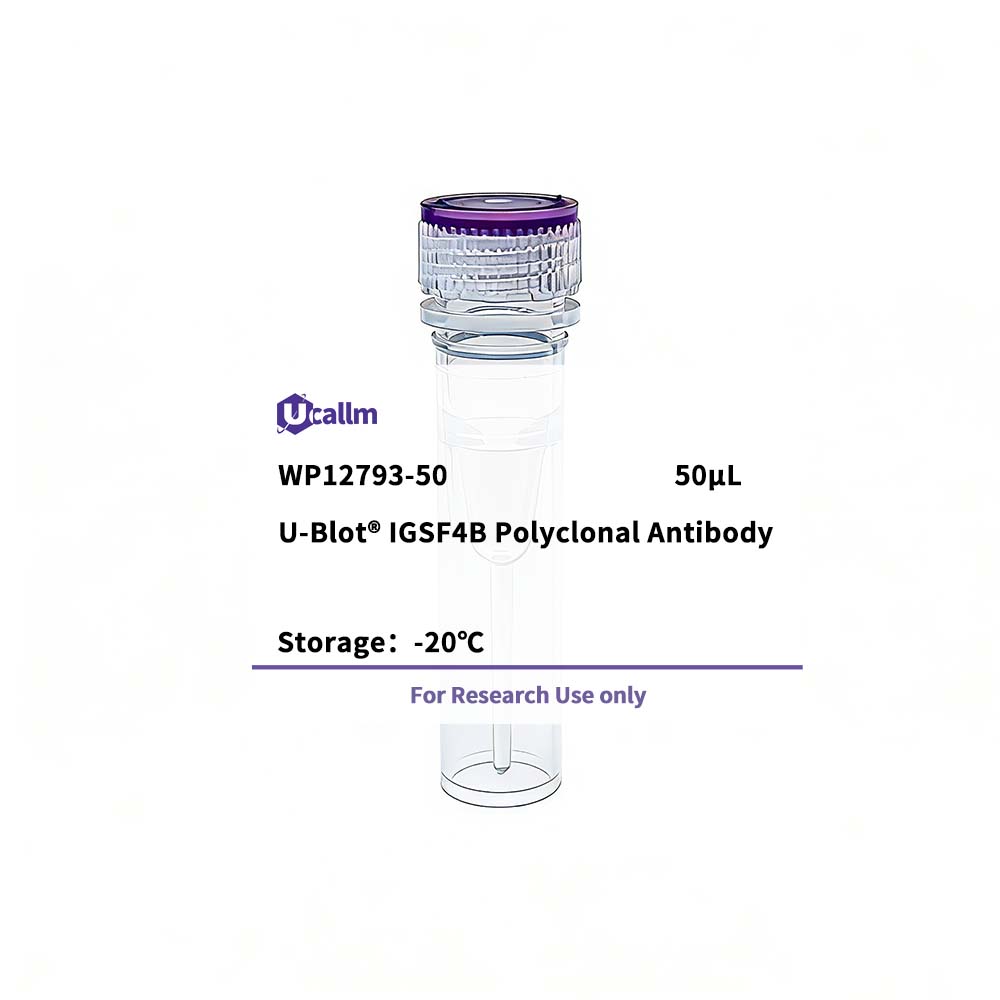
SKU: WP12793 Categories: ,

IGSF4B Polyclonal Antibody

Price range: $268.00 through $328.00

SKU: WP12793-100
Enter the quantity you would like, or drag the panel to find the quantity and price that best for you
Bulk QuoteAuthorize OEM & ODM

Product details

Background:

cell adhesion molecule 3(CADM3) Homo sapiens IGSF4B is a brain-specific protein related to the calcium-independent cell-cell adhesion molecules known as nectins (see PVRL3; MIM 607147) (Kakunaga et al., 2005 [PubMed 15741237]).[supplied by OMIM, Mar 2008],

Specifications

Size50μL/100μL
TargetIGSF4B
ReactivityHuman, Mouse, Rat
ApplicationsWB, IHC, IF, ELISA
MW(Calculated)
MW(Observed)43kD
Host SpeciesRabbit
IsotypeIgG
Conjugate/ModificationUnmodified
Recommended Dilution RatioWB 1:500-1:2000; IHC 1:100-1:300; IF 1:200-1:1000; ELISA 1:5000; Not yet tested in other applications. / Note: For IHC, we suggest antigen retrieval with TE buffer pH 9.0 (Cat#WT1004)
FormulationLiquid in PBS containing 50% glycerol, 0.5% BSA and 0.02% sodium azide.
PurificationThe antibody was affinity-purified from rabbit antiserum by affinity-chromatography using epitope-specific immunogen.
Storage-15°C to -25°C/1 year(Do not lower than -25°C)
Concentration1 mg/ml
ClonalityPolyclonal
Clone Number
ImmunogenThe antiserum was produced against synthesized peptide derived from human CADM3. AA range:141-190
SpecificityIGSF4B Polyclonal Antibody detects endogenous levels of IGSF4B protein.
Gene NameCADM3
Protein NameCell adhesion molecule 3
Other NameCADM3; / IGSF4B; / NECL1; / SYNCAM3; / TSLL1; / Cell adhesion molecule 3; / Brain immunoglobulin receptor; / Immunoglobulin superfamily member 4B; / IgSF4B; / Nectin-like protein 1; / NECL-1; / Synaptic cell adhesion molecule 3; / SynCAM3; / TSLC1-like protein 1; / TS
SpeciesHuman
Gene ID57863
UniprotQ8N126,
Species.1Mouse
Gene ID.194332
Uniprot.1Q99N28,
Species.2Rat
Gene ID.2360882
Uniprot.2Q1WIM3
Cellular LocalizationCell membrane; Single-pass type I membrane protein . Cell junction .
Tissue ExpressionIsoform 1 is expressed mainly in adult and fetal brain. Isoform 2 is highly expressed in adult brain and weakly expressed in placenta. In brain, Isoform 2 is highly expressed in cerebellum.
Signaling_pathwayEnvironmental Information Processing >> Signaling molecules and interaction >> Cell adhesion molecules
Research Areas>>Cell adhesion molecules
FunctionDomain:The cytoplasmic region mediates interaction with EPB41L1, DLG3, MPP6 and CASK.,Function:Involved in the cell-cell adhesion. Has both calcium-independent homophilic cell-cell adhesion activity and calcium-independent heterophilic cell-cell adhesion activity with IGSF4, PVRL1 and PVRL3. Interaction with EPB41L1 may regulate structure or function of cell-cell junctions.,induction:Markedly in glioma cell lines and prostate cancer cell lines.,similarity:Belongs to the nectin family.,similarity:Contains 1 Ig-like V-type (immunoglobulin-like) domain.,similarity:Contains 2 Ig-like C2-type (immunoglobulin-like) domains.,subcellular location:Localized at the cell-cell attached sites of the plasma membrane.,subunit:Homodimer. Can form trans-heterodimers with PVRL3/nectin-3. Interacts with EPB41L1, DLG3, MPP6 and CASK.,tissue specificity:Isoform 1 is expressed mainly in adult and fetal brain. Isoform 2 is highly expressed in adult brain and weakly expressed in placenta. In brain, Isoform 2 is highly expressed in cerebellum.,
Please login to post questions
Back to Top
Product has been added to your cart

