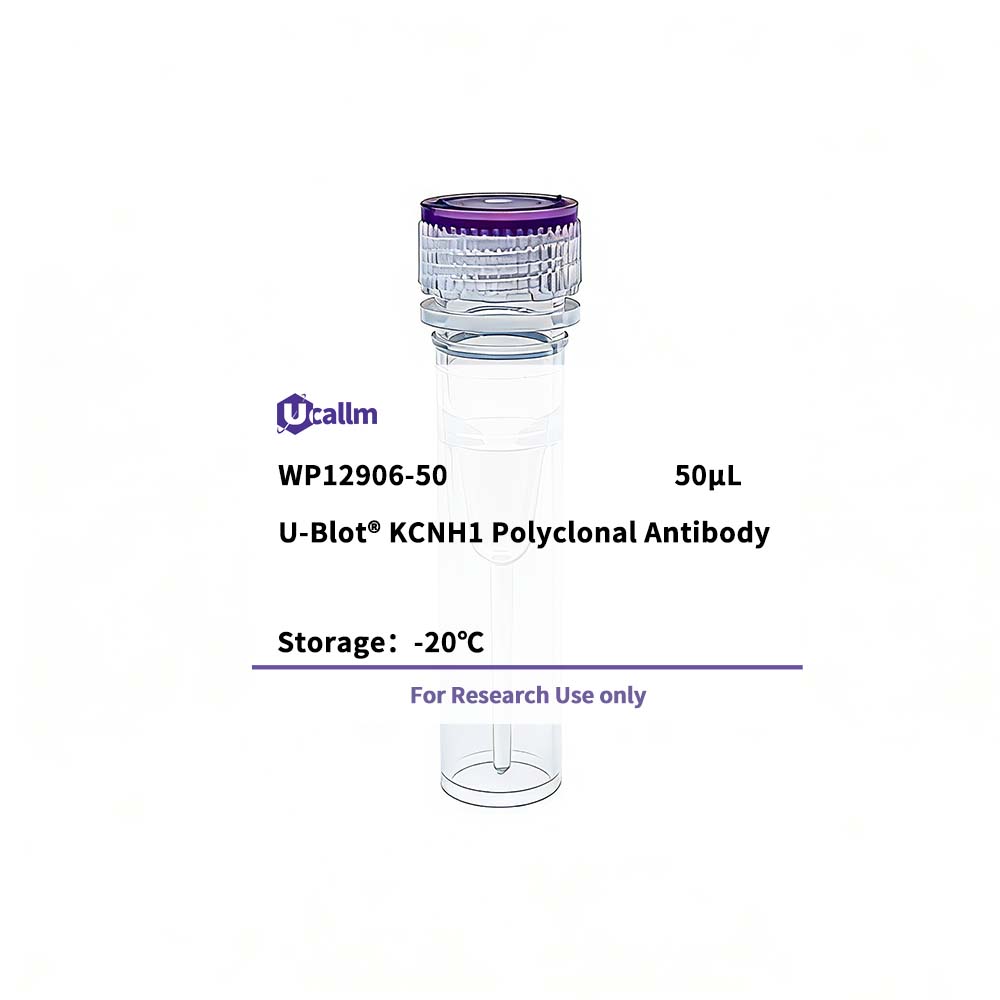
SKU: WP12906 Categories: ,

KCNH1 Polyclonal Antibody

Price range: $268.00 through $328.00

SKU: WP12906-100
Enter the quantity you would like, or drag the panel to find the quantity and price that best for you
Bulk QuoteAuthorize OEM & ODM

Product details

Background:

Voltage-gated potassium (Kv) channels represent the most complex class of voltage-gated ion channels from both functional and structural standpoints. Their diverse functions include regulating neurotransmitter release, heart rate, insulin secretion, neuronal excitability, epithelial electrolyte transport, smooth muscle contraction, and cell volume. This gene encodes a member of the potassium channel, voltage-gated, subfamily H. This member is a pore-forming (alpha) subunit of a voltage-gated non-inactivating delayed rectifier potassium channel. It is activated at the onset of myoblast differentiation. The gene is highly expressed in brain and in myoblasts. Overexpression of the gene may confer a growth advantage to cancer cells and favor tumor cell proliferation. Alternative splicing of this gene results in two transcript variants encoding distinct isoforms. [provided

Specifications

Size50μL/100μL
TargetKCNH1
ReactivityHuman, Mouse, Rat
ApplicationsWB, ELISA, IHC
MW(Calculated)
MW(Observed)110kD
Host SpeciesRabbit
IsotypeIgG
Conjugate/ModificationUnmodified
Recommended Dilution RatioWB 1:500-2000; IHC 1:50-300; ELISA 1:2000-20000 / Note: For IHC, we suggest antigen retrieval with TE buffer pH 9.0 (Cat#WT1004)
FormulationLiquid in PBS containing 50% glycerol, 0.5% BSA and 0.02% sodium azide.
PurificationThe antibody was affinity-purified from rabbit antiserum by affinity-chromatography using epitope-specific immunogen.
Storage-15°C to -25°C/1 year(Do not lower than -25°C)
Concentration1 mg/ml
ClonalityPolyclonal
Clone Number
ImmunogenThe antiserum was produced against synthesized peptide derived from human KCNH1. AA range:720-769
SpecificityKCNH1 Polyclonal Antibody detects endogenous levels of KCNH1 protein.
Gene NameKCNH1
Protein NamePotassium voltage-gated channel subfamily H member 1
Other NameKCNH1; / EAG; / EAG1; / Potassium voltage-gated channel subfamily H member 1; / Ether-a-go-go potassium channel 1; / EAG channel 1; / h-eag; / hEAG1; / Voltage-gated potassium channel subunit Kv10.1
SpeciesHuman
Gene ID3756
UniprotO95259,
Species.1Mouse
Gene ID.116510
Uniprot.1Q60603,
Species.2Rat
Gene ID.265198
Uniprot.2Q63472
Cellular LocalizationCell membrane; Multi-pass membrane protein . Nucleus inner membrane; Multi-pass membrane protein . Cell projection, dendrite . Cell projection, axon . Cell junction, synapse, presynaptic cell membrane . Perikaryon . Cell junction, synapse, postsynaptic density membrane . Early endosome membrane . Perinuclear KCNH1 is located to NPC-free islands.
Tissue ExpressionHighly expressed in brain and in myoblasts at the onset of fusion, but not in other tissues. Detected in HeLa (cervical carcinoma), SH-SY5Y (neuroblastoma) and MCF-7 (epithelial tumor) cells, but not in normal epithelial cells.
Signaling_pathway
Research Areas
FunctionDisease:Overexpression of EAG may confer a growth advantage to cancer cells and favor tumor cell proliferation.,Domain:The segment S4 is probably the voltage-sensor and is characterized by a series of positively charged amino acids at every third position.,Function:Pore-forming (alpha) subunit of voltage-gated non-inactivating delayed rectifier potassium channel. Channel properties may be modulated by cAMP and subunit assembly. Mediates IK(NI) current in myoblasts.,similarity:Belongs to the potassium channel family. H (Eag) subfamily.,similarity:Contains 1 cyclic nucleotide-binding domain.,similarity:Contains 1 PAC (PAS-associated C-terminal) domain.,similarity:Contains 1 PAS (PER-ARNT-SIM) domain.,subunit:The potassium channel is probably composed of a homo- or heterotetrameric complex of pore-forming alpha subunits that can associate with modulating beta subunits. Heteromultimer with KCNH5/EAG2. Interacts with ALG10B.,tissue specificity:Highly expressed in brain and in myoblasts at the onset of fusion, but not in other tissues. Detected in HeLa (cervical carcinoma), SH-SY5Y (neuroblastoma) and MCF-7 (epithelial tumor) cells, but not in normal epithelial cells.,
Please login to post questions
Back to Top
Product has been added to your cart

