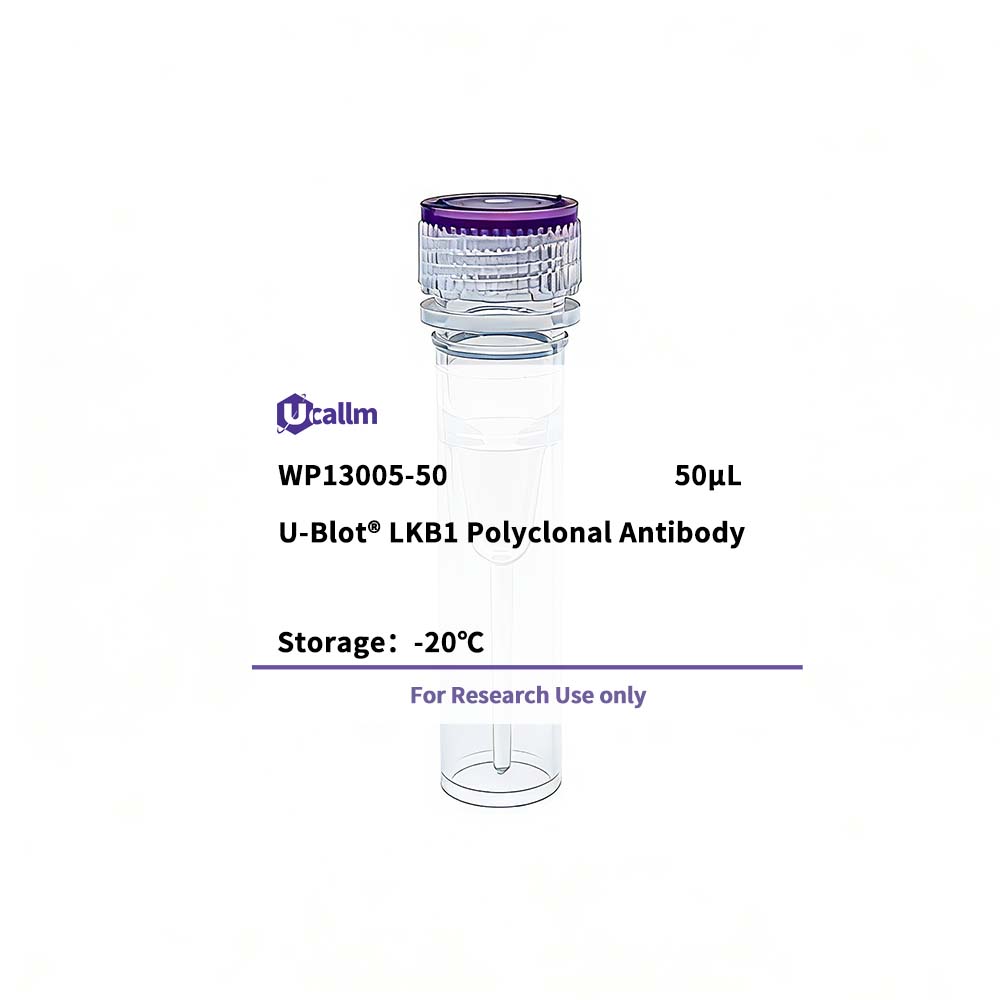
SKU: WP13005 Categories: ,

LKB1 Polyclonal Antibody

Price range: $268.00 through $328.00

SKU: WP13005-100
Enter the quantity you would like, or drag the panel to find the quantity and price that best for you
Bulk QuoteAuthorize OEM & ODM

Product details

Background:

This gene, which encodes a member of the serine/threonine kinase family, regulates cell polarity and functions as a tumor suppressor. Mutations in this gene have been associated with Peutz-Jeghers syndrome, an autosomal dominant disorder characterized by the growth of polyps in the gastrointestinal tract, pigmented macules on the skin and mouth, and other neoplasms. Alternate transcriptional splice variants of this gene have been observed but have not been thoroughly characterized. [provided by RefSeq, Jul 2008],


Specifications

Size50μL/100μL
TargetLKB1
ReactivityHuman, Mouse
ApplicationsWB, IHC, IF, ELISA
MW(Calculated)49kD
MW(Observed)
Host SpeciesRabbit
IsotypeIgG
Conjugate/ModificationUnmodified
Recommended Dilution RatioWB 1:500-2000; IHC 1:100-1:300; IF 1:200-1:1000; ELISA 1:20000; Not yet tested in other applications. / Note: For IHC, we suggest antigen retrieval with TE buffer pH 9.0 (Cat#WT1004)
FormulationLiquid in PBS containing 50% glycerol, 0.5% BSA and 0.02% sodium azide.
PurificationThe antibody was affinity-purified from rabbit antiserum by affinity-chromatography using epitope-specific immunogen.
Storage-15°C to -25°C/1 year(Do not lower than -25°C)
Concentration1 mg/ml
ClonalityPolyclonal
Clone Number
ImmunogenThe antiserum was produced against synthesized peptide derived from human LKB1. AA range:384-433
SpecificityLKB1 Polyclonal Antibody detects endogenous levels of LKB1 protein.
Gene NameSTK11
Protein NameSerine/threonine-protein kinase STK11
Other NameSTK11; / LKB1; / PJS; / Serine/threonine-protein kinase STK11; / Liver kinase B1; / LKB1; / hLKB1; / Renal carcinoma antigen NY-REN-19
SpeciesHuman
Gene ID6794
UniprotQ15831,
Species.1Mouse
Gene ID.120869
Uniprot.1Q9WTK7
Species.2
Gene ID.2
Uniprot.2
Cellular LocalizationNucleus. Cytoplasm. Membrane . Mitochondrion. A small fraction localizes at membranes (By similarity). Relocates to the cytoplasm when bound to STRAD (STRADA or STRADB) and CAB39/MO25 (CAB39/MO25alpha or CAB39L/MO25beta). Translocates to the mitochondrion during apoptosis. PTEN promotes cytoplasmic localization. .; [Isoform 2]: Nucleus . Cytoplasm . Predominantly nuclear, but translocates to the cytoplasm in response to metformin or peroxynitrite treatment.
Tissue ExpressionUbiquitously expressed. Strongest expression in testis and fetal liver.
Signaling_pathwayCellular Processes >> Transport and catabolism >> Autophagy - animal;Cellular Processes >> Cellular community - eukaryotes >> Tight junction;Organismal Systems >> Endocrine system >> Adipocytokine signaling pathway;Organismal Systems >> Aging >> Longevity regulating pathway;Environmental Information Processing >> Signal transduction >> FoxO signaling pathway;Environmental Information Processing >> Signal transduction >> PI3K-Akt signaling pathway;Environmental Information Processing >> Signal transduction >> AMPK signaling pathway;Environmental Information Processing >> Signal transduction >> mTOR signaling pathway
Research Areas>>FoxO signaling pathway; / >>Autophagy - animal; / >>mTOR signaling pathway; / >>PI3K-Akt signaling pathway; / >>AMPK signaling pathway; / >>Longevity regulating pathway; / >>Tight junction; / >>Adipocytokine signaling pathway
FunctionCatalytic activity:ATP + a protein = ADP + a phosphoprotein.,cofactor:Magnesium or manganese.,Disease:Defects in STK11 are a cause of Peutz-Jeghers syndrome (PJS) [MIM:175200]. PJS is a rare hereditary disease in which there is predisposition to benign and malignant tumors of many organ systems. PJS is an autosomal dominant disorder characterized by melanocytic macules of the lips, multiple gastrointestinal hamartomatous polyps and an increased risk for various neoplasms, including gastrointestinal cancer.,Disease:Defects in STK11 have been associated with testicular tumors [MIM:273300]. It includes germ cell tumor (GCT) or testicular germ cell tumor (TGCT).,enzyme regulation:Activated by binding of a complex consisting of CAB39 and STRAD or CAB39 and ALS2CR2.,Function:Essential role in G1 cell cycle arrest. Phosphorylates and activates members of the AMPK-related subfamily of protein kinases. Tumor suppressor.,online information:PJS entry,PTM:Phosphorylated by a cAMP-dependent protein kinase.,similarity:Belongs to the protein kinase superfamily.,similarity:Belongs to the protein kinase superfamily. CAMK Ser/Thr protein kinase family. LKB1 subfamily.,similarity:Contains 1 protein kinase domain.,subcellular location:Relocates to the cytoplasm when bound to CAB39 and STRAD or CAB39 and ALS2CR2.,subunit:Found in a ternary complex composed of SMAD4, STK11 and STK11IP. Interacts with SMAD4 and STK11IP.,tissue specificity:Ubiquitously expressed. Strongest expression in testis and fetal liver.,
Please login to post questions
Back to Top
Product has been added to your cart
