Product details
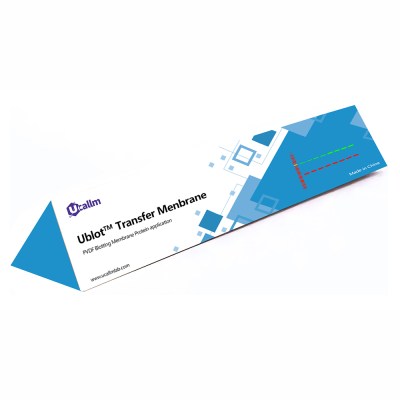
Ublot™ NC Membrane is a pure, unsupported nitrocellulose microporous membrane designed for transferring proteins and nucleic acids from various gel matrices.
This transfer blotting membrane is available in two pore sizes: 0.2μm and 0.45μm, allowing it to bind a wide range of molecular weights:
- 0.45μm pore size: Suitable for most protein samples and offers higher detection sensitivity.
- 0.2μm pore size: Ideal for proteins with molecular weights below 20,000, providing better adsorption and retention of small proteins.
The Ublot™ NC Membrane has strong tensile strength, making it less prone to tearing and cracking compared to other nitrocellulose membranes. It also has a higher binding capacity for both proteins and nucleic acids, making it an excellent choice for immunodetection and nucleic acid detection.
Ublot™ NC Membrane Selection Guide
The table below provides a selection of membranes for specific protein post-blotting applications. Due to variations in protein properties, such as charge density, conformation, and hydrophobicity, not all proteins behave the same on membrane surfaces. Experimentation with different Ublot™ NC Membranes may be required to optimize results for specific applications.
| Applications | Membrane selection |
| General immunoassays | Ublot™ NC 0.45μm |
| Amino acid analysis | Ublot™ NC 0.45μm |
| Immunoassays for low-abundance or small-molecular-weight proteins | Ublot™ NC 0.2μm |
| Sequencing for low-abundance or small-molecular-weight proteins | Ublot™ NC 0.2μm |