

U-Blot® 53BP1 Rabbit mAb
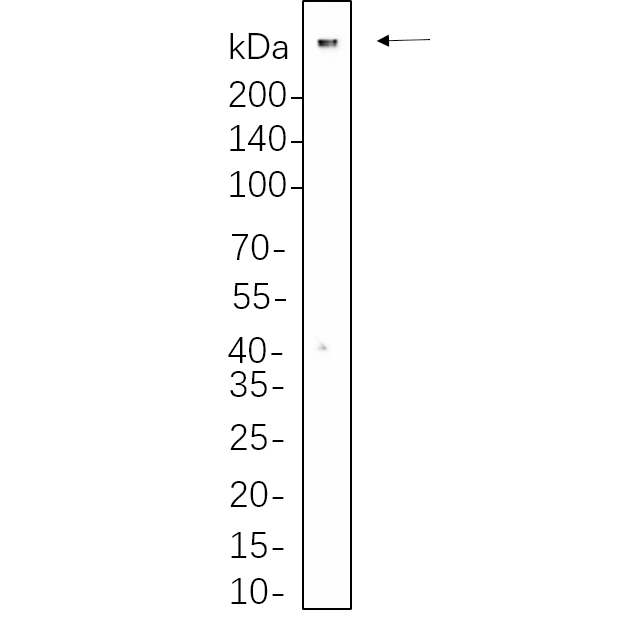
WR4267 Hela whole cell lysates were separated by 10% SDS-PAGE, and the membrane was blotted with primary antibody(1:1000). The HRP-conjugated Goat anti-Rabbit IgG(H + L) antibody was used to detect the antibody.
Price range: $268.00 through $328.00
Product details
Background:This gene encodes a protein that functions in the DNA double-strand break repair pathway choice, promoting non-homologous end joining (NHEJ) pathways, and limiting homologous recombination. This protein plays multiple roles in the DNA damage response, including promoting checkpoint signaling following DNA damage, acting as a scaffold for recruitment of DNA damage response proteins to damaged chromatin, and promoting NHEJ pathways by limiting end resection following a double-strand break. These roles are also important during V(D)J recombination, class switch recombination and at unprotected telomeres. Alternative splicing results in multiple transcript variants encoding different isoforms. [provided by RefSeq, Aug 2017]
Specifications
| Size | 50μL/100μL |
| Target | 53BP1 |
| Reactivity | Human, Mouse, Rat |
| Applications | WB, IHC, IF, ELISA, CHIP, Cut&Tag |
| MW(Calculated) | 214kD |
| MW(Observed) | 450kD |
| Host Species | Rabbit |
| Isotype | IgG,Kappa |
| Conjugate/Modification | Unmodified |
| Recommended Dilution Ratio | WB 1:2000-1:10000; IHC 1:200-1:1000; IF 1:200-1:1000; ELISA 1:5000-1:20000; CHIP 1:50-1:100; Cut&Tag 1:50-1:100; / Note: For IHC, we suggest antigen retrieval with TE buffer pH 9.0 (Cat#WT1004) |
| Formulation | PBS, 50% glycerol, 0.05% Proclin 300, 0.05%BSA |
| Purification | Recombinant Antibody expressed in animal component-free (ACF) media, purified via Protein A affinity chromatography. |
| Storage | -15°C to -25°C/1 year(Do not lower than -25°C) |
| Concentration | |
| Clonality | Monoclonal |
| Clone Number | RM0456R |
| Immunogen | The specific immunogen used to produce this antibody is proprietary information. |
| Specificity | Endogenous |
| Gene Name | TP53BP1 |
| Protein Name | Tumor suppressor p53-binding protein 1 |
| Other Name | TP53BP1; / Tumor suppressor p53-binding protein 1; / 53BP1; / p53-binding protein 1; / p53BP1 |
| Species | Human |
| Gene ID | 7158 |
| Uniprot | Q12888, |
| Species.1 | Mouse |
| Gene ID.1 | 27223 |
| Uniprot.1 | P70399 |
| Species.2 | |
| Gene ID.2 | |
| Uniprot.2 | |
| Cellular Localization | Nucleus |
| Tissue Expression | Cerebellum,Cervix,Epithelium,Myeloid leukemia cell,Skeletal muscle, |
| Signaling_pathway | Organismal Systems >> Immune system >> NOD-like receptor signaling pathway |
| Research Areas | >>NOD-like receptor signaling pathway |
| Function | Function:May have a role in checkpoint signaling during mitosis (By similarity). Enhances TP53-mediated transcriptional activation. Plays a role in the response to DNA damage.,PTM:Asymmetrically dimethylated on Arg residues by PRMT1. Methylation is required for DNA binding.,PTM:Phosphorylated at basal level in the absence of DNA damage. Hyper-phosphorylated in an ATM-dependent manner in response to DNA damage induced by ionizing radiation. Hyper-phosphorylated in an ATR-dependent manner in response to DNA damage induced by UV irradiation.,similarity:Contains 2 BRCT domains.,subcellular location:Associated with kinetochores. Both nuclear and cytoplasmic in some cells. Recruited to sites of DNA damage, such as double stand breaks. Methylation of histone H4 at 'Lys-20' is required for efficient localization to double strand breaks.,subunit:Interacts with IFI202A (By similarity). Binds to the central domain of TP53/p53. May form homo-oligomers. Interacts with DCLRE1C. Interacts with histone H2AFX and this requires phosphorylation of H2AFX on 'Ser-139'. Interacts with histone H4 that has been dimethylated at 'Lys-20'. Has low affinity for histone H4 containing monomethylated 'Lys-20'. Does not bind histone H4 containing unmethylated or trimethylated 'Lys-20'. Has low affinity for histone H3 that has been dimethylated on 'Lys-79'. Has very low affinity for histone H3 that has been monomethylated on 'Lys-79' (in vitro). Does not bind unmethylated histone H3., |
Please login to post questions
Related products





