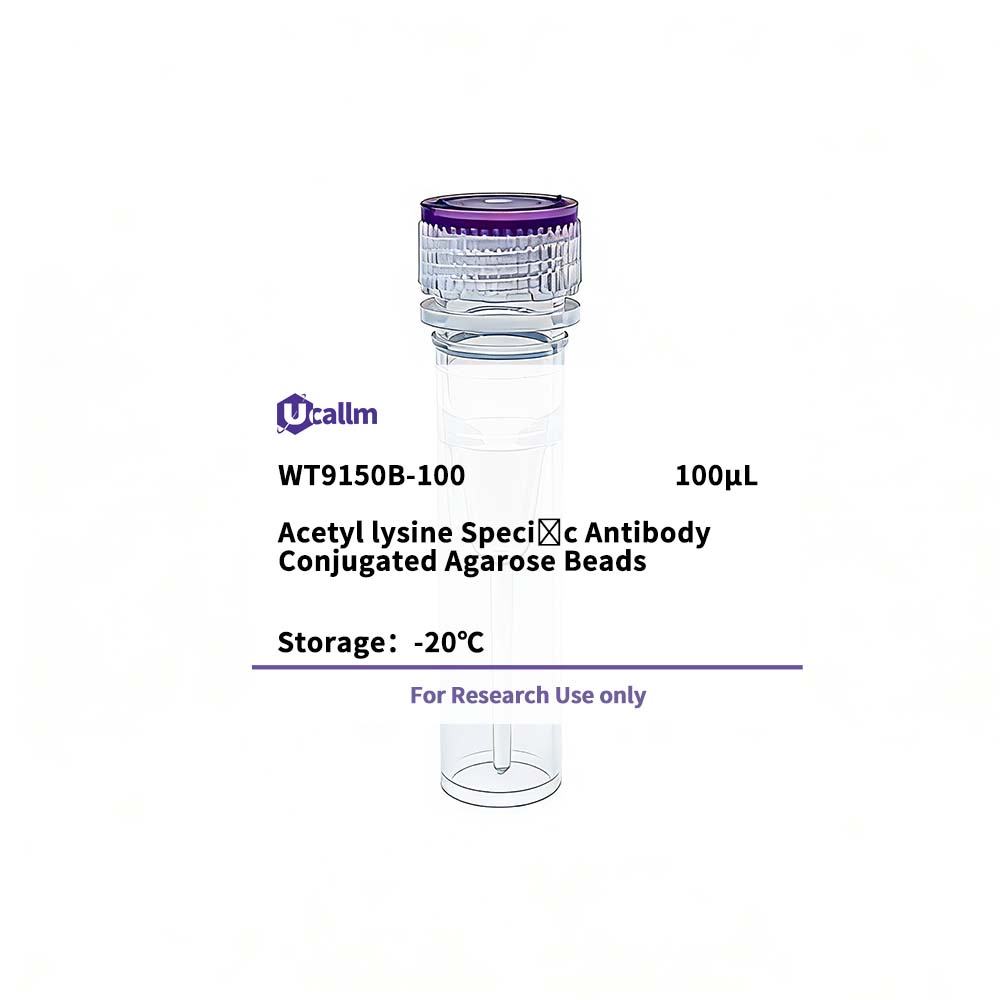
Acetyl lysine Specific Antibody Conjugated Agarose Beads

$999.00

SKU: WT9150B-300
Enter the quantity you would like, or drag the panel to find the quantity and price that best for you
Bulk QuoteAuthorize OEM & ODM

Product details

Acetyllysine Specific Antibody Conjugated Agarose Beads is an immunoaffinity enrichment tool for acetyllysine peptides in mass spectrometry-based proteomics. The highly specific antibody selectively captures target modified peptides without cross-reactivity, is applicable to all species, efficiently enriches low-abundance peptides and reduces background interference, delivering stable and reliable results for acetyllysine modification research.

Specifications

TargetAcetyllysine
ReactivitySpecies Independent
ApplicationIAC, IAP, IP
MW(Calculated)
MW(Observed)
Host Species
Isotype
ConjugateAgarose Beads
ModificationLysine lactylation
Modified siteLys(K)
Recommended dilution ratio
Composition
Purification processProtein A
Purity
Storage50% slurry in PBS pH7.4, 0.05% Proclin 300. Ensure thorough mixing before each use. Wide-mouth pipette tips are recommended. In case of difficulty in aspiration due to improper operation, additional Storage Buffer can be added at your discretion.
Stability12 months from date of receipt / reconstitution, 2 to 8 °C as supplied
ClonalRecombinant monoclonal
Clone Number
Immunogen
Sequence
Specificity
Gene name
Protein Name
Alternative nameKac
Organism-1
GeneID-1
SwissProt-1
Organism-2
GeneID-2
SwissProt-2
Organism-3
GeneID-3
SwissProt-3
Organism-4
GeneID-4
SwissProt-4
BackgroundAcetyllysine (abbreviated as Kac) is a classic and widespread post-translational modification of lysine acetylation. This modification covalently adds an acetyl group to the side-chain amino group of lysine residues, altering the charge and structure of proteins to regulate their functions. Lysine acetylation is an important epigenetic marker on histones, involved in chromatin remodeling and gene transcription regulation. It also widely exists in non-histone proteins such as metabolic enzymes, signaling proteins, and transcription factors, playing essential roles in cellular metabolism, signal transduction, cell cycle progression, and DNA repair. Dysregulation of lysine acetylation is closely associated with the development of cancer, metabolic diseases, neurodegenerative diseases, and other disorders.
Cellular Localization
Please login to post questions
Back to Top
Product has been added to your cart
