

ACSL6 Polyclonal Antibody
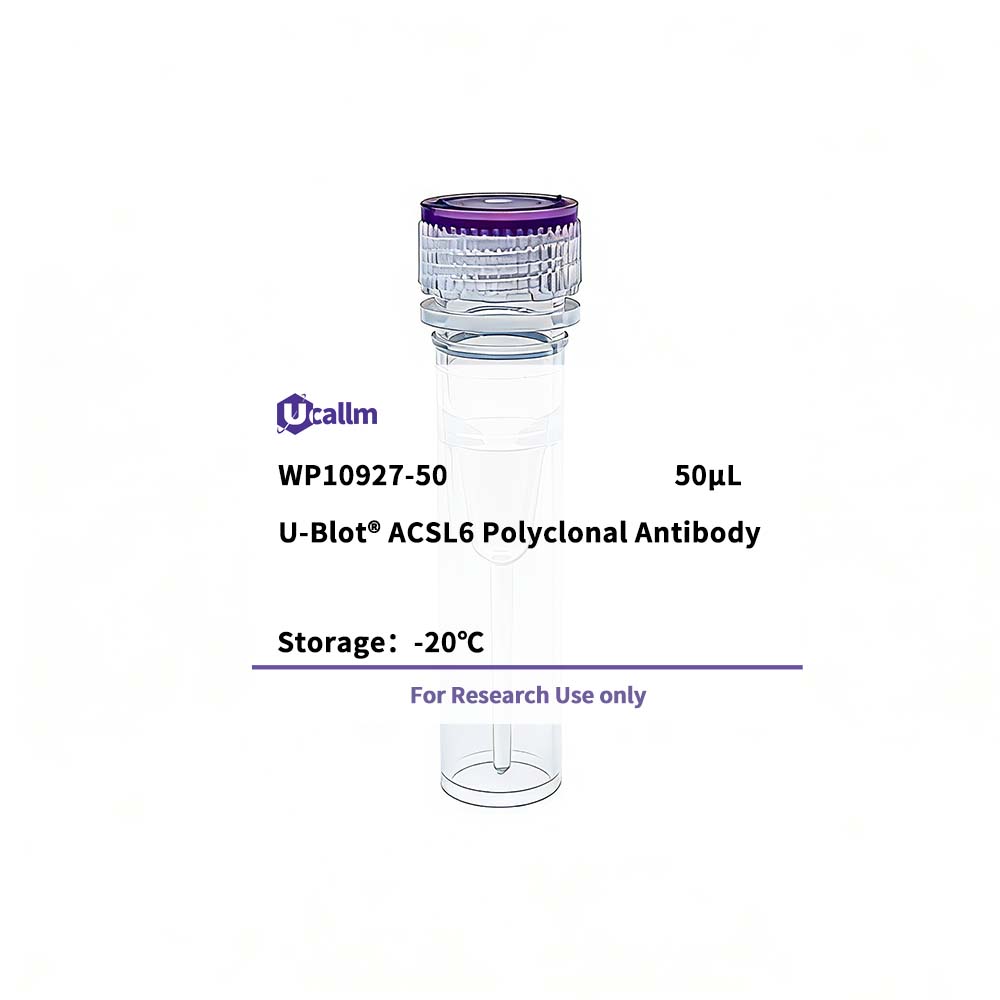
Ucallm_WP10927-50
Price range: $268.00 through $328.00
Product details
Background:
The protein encoded by this gene catalyzes the formation of acyl-CoA from fatty acids, ATP, and CoA, using magnesium as a cofactor. The encoded protein plays a major role in fatty acid metabolism in the brain. Translocations with the ETV6 gene are causes of myelodysplastic syndrome with basophilia, acute myelogenous leukemia with eosinophilia, and acute eosinophilic leukemia. Several transcript variants encoding different isoforms have been found for this gene.[provided by RefSeq, Apr 2011],
Specifications
| Size | 50μL/100μL |
| Target | ACSL6 |
| Reactivity | Human, Mouse, Rat |
| Applications | WB, IHC, IF, ELISA |
| MW(Calculated) | |
| MW(Observed) | 78kD |
| Host Species | Rabbit |
| Isotype | IgG |
| Conjugate/Modification | Unmodified |
| Recommended Dilution Ratio | WB 1:500-1:2000; IHC 1:100-1:300; ELISA 1:40000; IF 1:50-200 / Note: For IHC, we suggest antigen retrieval with TE buffer pH 9.0 (Cat#WT1004) |
| Formulation | Liquid in PBS containing 50% glycerol, 0.5% BSA and 0.02% sodium azide. |
| Purification | The antibody was affinity-purified from rabbit antiserum by affinity-chromatography using epitope-specific immunogen. |
| Storage | -15°C to -25°C/1 year(Do not lower than -25°C) |
| Concentration | 1 mg/ml |
| Clonality | Polyclonal |
| Clone Number | |
| Immunogen | The antiserum was produced against synthesized peptide derived from human ACSL6. AA range:499-548 |
| Specificity | ACSL6 Polyclonal Antibody detects endogenous levels of ACSL6 protein. |
| Gene Name | ACSL6 |
| Protein Name | Long-chain-fatty-acid--CoA ligase 6 |
| Other Name | ACSL6; / ACS2; / FACL6; / KIAA0837; / LACS5; / Long-chain-fatty-acid--CoA ligase 6; / Long-chain acyl-CoA synthetase 6; / LACS 6 |
| Species | Human |
| Gene ID | 23305 |
| Uniprot | Q9UKU0, |
| Species.1 | Mouse |
| Gene ID.1 | 216739 |
| Uniprot.1 | Q91WC3, |
| Species.2 | Rat |
| Gene ID.2 | 117243 |
| Uniprot.2 | P33124 |
| Cellular Localization | Mitochondrion outer membrane; Single-pass type III membrane protein . Peroxisome membrane; Single-pass type III membrane protein . Microsome membrane; Single-pass type III membrane protein . Endoplasmic reticulum membrane; Single-pass type III membrane protein . |
| Tissue Expression | Expressed predominantly in erythrocyte precursors, in particular in reticulocytes, fetal blood cells derived from fetal liver, hemopoietic stem cells from cord blood, bone marrow and brain. |
| Signaling_pathway | Cellular Processes >> Transport and catabolism >> Peroxisome;Cellular Processes >> Cell growth and death >> Ferroptosis;Organismal Systems >> Endocrine system >> Adipocytokine signaling pathway;Organismal Systems >> Endocrine system >> PPAR signaling pathway |
| Research Areas | >>Fatty acid biosynthesis; / >>Fatty acid degradation; / >>Metabolic pathways; / >>Fatty acid metabolism; / >>PPAR signaling pathway; / >>Peroxisome; / >>Ferroptosis; / >>Thermogenesis; / >>Adipocytokine signaling pathway |
| Function | Catalytic activity:ATP + a long-chain carboxylic acid + CoA = AMP + diphosphate + an acyl-CoA.,cofactor:Magnesium.,developmental stage:Expression is low at earlier stages of erythroid development but is very high in reticulocytes.,Disease:A chromosomal aberration involving ACSL6 may be a cause of acute eosinophilic leukemia (AEL). Translocation t(5; 12)(q31; p13) with ETV6.,Disease:A chromosomal aberration involving ACSL6 may be a cause of acute myelogenous leukemia with eosinophilia. Translocation t(5; 12)(q31; p13) with ETV6.,Disease:A chromosomal aberration involving ACSL6 may be a cause of myelodysplastic syndrome with basophilia. Translocation t(5; 12)(q31; p13) with ETV6.,Function:Activation of long-chain fatty acids for both synthesis of cellular lipids, and degradation via beta-oxidation. Plays an important role in fatty acid metabolism in brain and the acyl-CoAs produced may be utilized exclusively for the synthesis of the brain lipid.,similarity:Belongs to the ATP-dependent AMP-binding enzyme family.,tissue specificity:Expressed predominantly in erythrocyte precursors, in particular in reticulocytes, fetal blood cells derived from fetal liver, haemopoietic stem cells from cord blood, bone marrow, and brain., |
Please login to post questions
Related products





