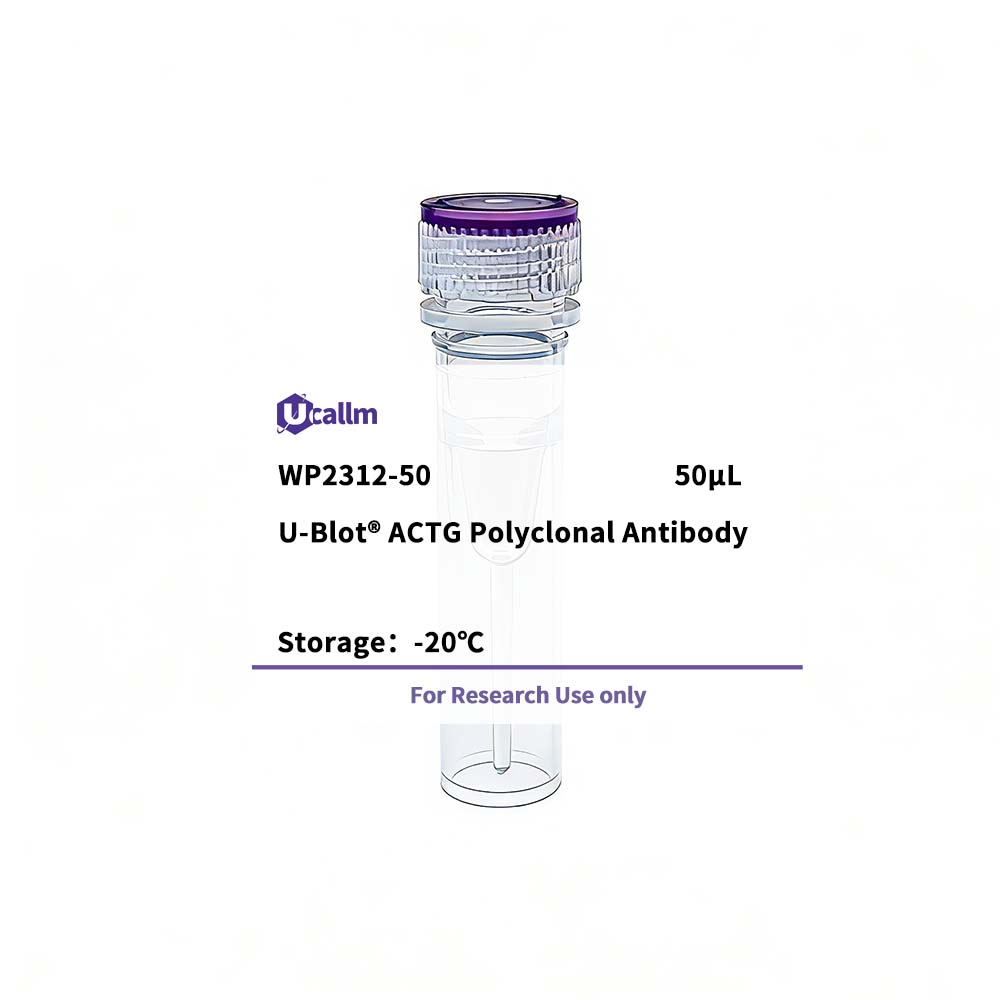
SKU: WP2312 Categories: ,

ACTG Polyclonal Antibody

Price range: $268.00 through $328.00

SKU: WP2312-100
Enter the quantity you would like, or drag the panel to find the quantity and price that best for you
Bulk QuoteAuthorize OEM & ODM

Product details

Background:

Actins are highly conserved proteins that are involved in various types of cell motility, and maintenance of the cytoskeleton. In vertebrates, three main groups of actin isoforms, alpha, beta and gamma have been identified. The alpha actins are found in muscle tissues and are a major constituent of the contractile apparatus. The beta and gamma actins co-exist in most cell types as components of the cytoskeleton, and as mediators of internal cell motility. Actin, gamma 1, encoded by this gene, is a cytoplasmic actin found in non-muscle cells. Mutations in this gene are associated with DFNA20/26, a subtype of autosomal dominant non-syndromic sensorineural progressive hearing loss. Alternative splicing results in multiple transcript variants.[provided by RefSeq, Jan 2011],

Specifications

Size50μL/100μL
TargetACTG
ReactivityHuman, Mouse, Rat
ApplicationsWB, ELISA
MW(Calculated)
MW(Observed)41kD
Host SpeciesRabbit
IsotypeIgG
Conjugate/ModificationUnmodified
Recommended Dilution RatioWB 1:500-2000; ELISA 1:5000-20000
FormulationLiquid in PBS containing 50% glycerol,0.5% BSA and 0.02% sodium azide.
PurificationThe antibody was affinity-purified from rabbit antiserum by affinity-chromatography using epitope-specific immunogen.
Storage-15°C to -25°C/1 year(Do not lower than -25°C)
Concentration1 mg/ml
ClonalityPolyclonal
Clone Number
ImmunogenSynthesized peptide derived from part region of human protein
SpecificityACTG Polyclonal Antibody detects endogenous levels of protein.
Gene NameACTG1 ACTB ACTG
Protein NameActin, cytoplasmic 2 (Gamma-actin) [Cleaved into: Actin, cytoplasmic 2, N-terminally processed]
Other Name
SpeciesHuman
Gene ID71
UniprotP63261,
Species.1Mouse
Gene ID.1
Uniprot.1P63260,
Species.2Rat
Gene ID.2
Uniprot.2P63259
Cellular LocalizationCytoplasm, cytoskeleton .
Tissue ExpressionB-cell,B-cell lymphoma,Brain,Cajal-Retzius cell,Eye,Hepatocellular carcinoma,Lung,Muscle,No
Signaling_pathwayCellular Processes >> Transport and catabolism >> Phagosome;Cellular Processes >> Cell growth and death >> Apoptosis;Cellular Processes >> Cellular community - eukaryotes >> Focal adhesion;Cellular Processes >> Cellular community - eukaryotes >> Adherens junction;Cellular Processes >> Cellular community - eukaryotes >> Tight junction;Cellular Processes >> Cell motility >> Regulation of actin cytoskeleton;Organismal Systems >> Immune system >> Platelet activation;Organismal Systems >> Immune system >> Neutrophil extracellular trap formation;Organismal Systems >> Immune system >> Leukocyte transendothelial migration;Organismal Systems >> Endocrine system >> Oxytocin signaling pathway;Organismal Systems >> Endocrine system >> Thyroid hormone signaling pathway;Human Diseases >> Cancer: specific types >> Hepatocellular carcinoma;Human Diseases >> Neurodegenerative disease >> Amyotrophic lateral sclerosis;Environmental Information Processing >> Signal transduction >> Rap1 signaling pathway;Environmental Information Processing >> Signal transduction >> Hippo signaling pathway;Genetic Information Processing >> Chromosome >> ATP-dependent chromatin remodeling
Research Areas>>Rap1 signaling pathway; / >>Phagosome; / >>Apoptosis; / >>Hippo signaling pathway; / >>Focal adhesion; / >>Adherens junction; / >>Tight junction; / >>Platelet activation; / >>Neutrophil extracellular trap formation; / >>Leukocyte transendothelial migration; / >>Thermogenesis; / >>Regulation of actin cytoskeleton; / >>Thyroid hormone signaling pathway; / >>Oxytocin signaling pathway; / >>Gastric acid secretion; / >>Amyotrophic lateral sclerosis; / >>Bacterial invasion of epithelial cells; / >>Vibrio cholerae infection; / >>Pathogenic Escherichia coli infection; / >>Shigellosis; / >>Salmonella infection; / >>Yersinia infection; / >>Influenza A; / >>Proteoglycans in cancer; / >>Hepatocellular carcinoma; / >>Hypertrophic cardiomyopathy; / >>Arrhythmogenic right ventricular cardiomyopathy; / >>Dilated cardiomyopathy; / >>Viral myocarditis; / >>Fluid shear stress and atherosclerosis
FunctionDisease:Defects in ACTG1 are the cause of non-syndromic sensorineural deafness autosomal dominant type 20 (DFNA20) [MIM:604717]; also called autosomal dominant deafness type 26 (DFNA26). DFNA20 is a form of sensorineural hearing loss. Sensorineural deafness results from damage to the neural receptors of the inner ear, the nerve pathways to the brain, or the area of the brain that receives sound information.,Function:Actins are highly conserved proteins that are involved in various types of cell motility and are ubiquitously expressed in all eukaryotic cells.,miscellaneous:In vertebrates 3 main groups of actin isoforms, alpha, beta and gamma have been identified. The alpha actins are found in muscle tissues and are a major constituent of the contractile apparatus. The beta and gamma actins coexist in most cell types as components of the cytoskeleton and as mediators of internal cell motility.,similarity:Belongs to the actin family.,subunit:Polymerization of globular actin (G-actin) leads to a structural filament (F-actin) in the form of a two-stranded helix. Each actin can bind to 4 others.,
Please login to post questions
Back to Top
Product has been added to your cart