

Actin, Muscle Specific [ABT-MSA] Mouse mAb
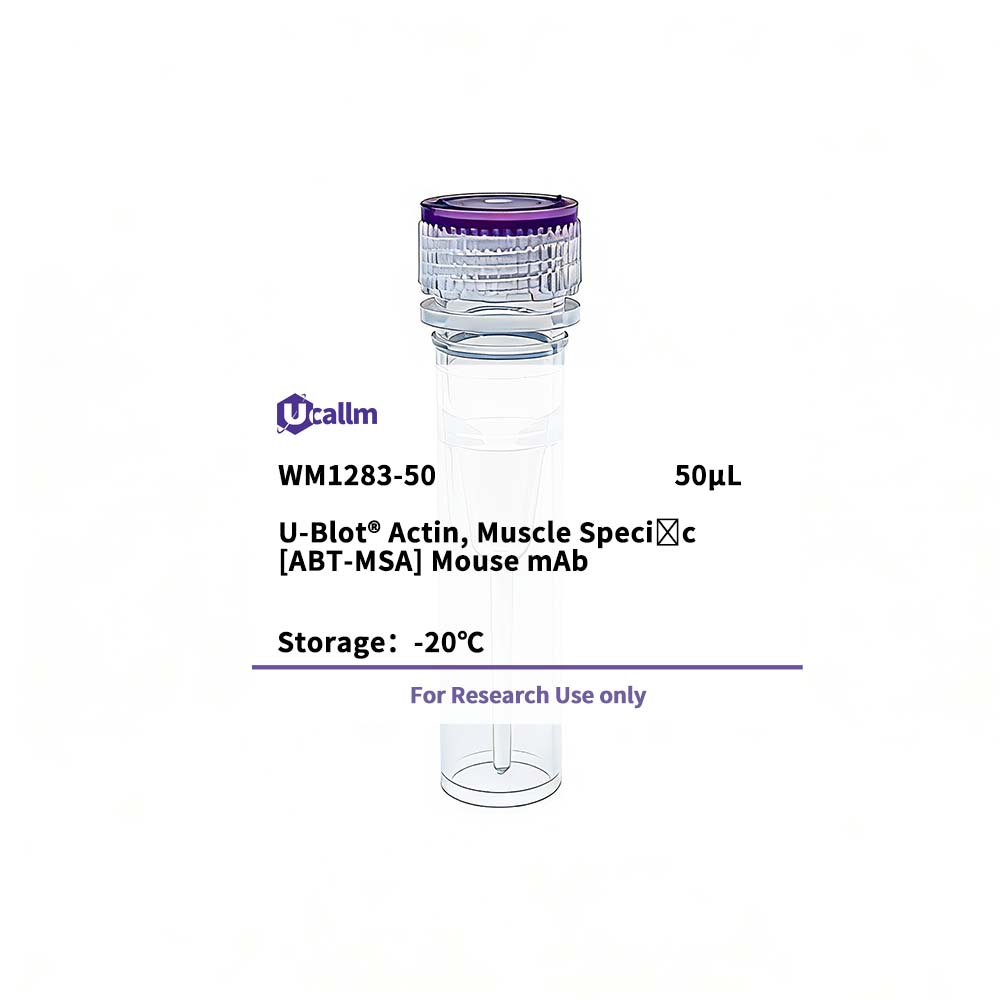
Ucallm_WM1283-50
Price range: $268.00 through $328.00
Product details
Background:
Actin is a a highly conserved cytoskeletal protein, which contains 6 isoformes, of which 4 are muscle tissue specific: α- skeletal muscle actin, α- cardiac muscle actin, α- smooth muscle actin, γ- Smooth muscle actin. Muscle actin is expressed in skeletal muscle, cardiac and smooth muscle, and muscle derived tumors such as leiomyoma and rhabdomyosarcoma. It is usually not expressed in endothelial cells, connective tissue, melanoma, lymphoma and non myogenic sarcoma.
Specifications
| Size | 50μL/100μL |
| Target | Actin_Muscle Specific |
| Reactivity | Human, Mouse, Rat, Monkey, Bovine, Pig, Chicken |
| Applications | IHC, WB, IF, ELISA |
| MW(Calculated) | |
| MW(Observed) | 42kD |
| Host Species | Mouse |
| Isotype | IgG1,Kappa |
| Conjugate/Modification | Unmodified |
| Recommended Dilution Ratio | IHC 1:200-1000; WB 1:500-2000; IF 1:100-500; ELISA 1:1000-5000 / Note: For IHC, we suggest antigen retrieval with TE buffer pH 9.0 (Cat#WT1004) |
| Formulation | PBS, 50% glycerol, 0.05% Proclin 300, 0.05%BSA |
| Purification | Recombinant Antibody expressed in animal component-free (ACF) media, purified via Protein G affinity chromatography. |
| Storage | -15°C to -25°C/1 year(Do not lower than -25°C) |
| Concentration | |
| Clonality | Monoclonal |
| Clone Number | RMM-MSA |
| Immunogen | Synthesized peptide derived from human Actin, Muscle Specific AA range: 2-50 |
| Specificity | The antibody can specifically recognize proteins from smooth muscle, myocardium and skeletal muscle α actin and smooth muscle derived γ actin, and β actin or non smooth muscle derived γ actin does not respond. |
| Gene Name | ACTA1; ACTA2; ACTC1; ACTG2 |
| Protein Name | α-Skeletal Muscle Actin (α-SA); α-Cardiac Muscle Actin (α-CA); α-Smooth Muscle Actin (α-SMA); γ-Smooth Muscle Actin (γ-SMA) |
| Other Name | |
| Species | Human |
| Gene ID | 58;59;70;72 |
| Uniprot | P68032;P68133;P63267;P62736 |
| Species.1 | |
| Gene ID.1 | |
| Uniprot.1 | |
| Species.2 | |
| Gene ID.2 | |
| Uniprot.2 | |
| Cellular Localization | Cytoplasmic |
| Tissue Expression | Muscle,Tongue, |
| Signaling_pathway | Organismal Systems >> Endocrine system >> Relaxin signaling pathway;Organismal Systems >> Circulatory system >> Cardiac muscle contraction;Organismal Systems >> Circulatory system >> Adrenergic signaling in cardiomyocytes;Organismal Systems >> Circulatory system >> Vascular smooth muscle contraction;Environmental Information Processing >> Signal transduction >> Apelin signaling pathway |
| Research Areas | >>Cardiac muscle contraction; / >>Adrenergic signaling in cardiomyocytes; / >>Hypertrophic cardiomyopathy; / >>Dilated cardiomyopathy |
| Function | Disease:Defects in ACTC1 are the cause of cardiomyopathy dilated type 1R (CMD1R) [MIM:102540]. Dilated cardiomyopathy is a disorder characterized by ventricular dilation and impaired systolic function, resulting in congestive heart failure and arrhythmia. Patients are at risk of premature death.,Disease:Defects in ACTC1 are the cause of cardiomyopathy familial hypertrophic type 11 (CMH11) [MIM:612098]. Familial hypertrophic cardiomyopathy is a hereditary heart disorder characterized by ventricular hypertrophy, which is usually asymmetric and often involves the interventricular septum. The symptoms include dyspnea, syncope, collapse, palpitations, and chest pain. They can be readily provoked by exercise. The disorder has inter- and intrafamilial variability ranging from benign to malignant forms with high risk of cardiac failure and sudden cardiac death.,Function:Actins are highly conserved proteins that are involved in various types of cell motility and are ubiquitously expressed in all eukaryotic cells.,miscellaneous:In vertebrates 3 main groups of actin isoforms, alpha, beta and gamma have been identified. The alpha actins are found in muscle tissues and are a major constituent of the contractile apparatus. The beta and gamma actins coexist in most cell types as components of the cytoskeleton and as mediators of internal cell motility.,similarity:Belongs to the actin family.,subunit:Polymerization of globular actin (G-actin) leads to a structural filament (F-actin) in the form of a two-stranded helix. Each actin can bind to 4 others., |
Please login to post questions
Related products





