

AIG-1 Polyclonal Antibody
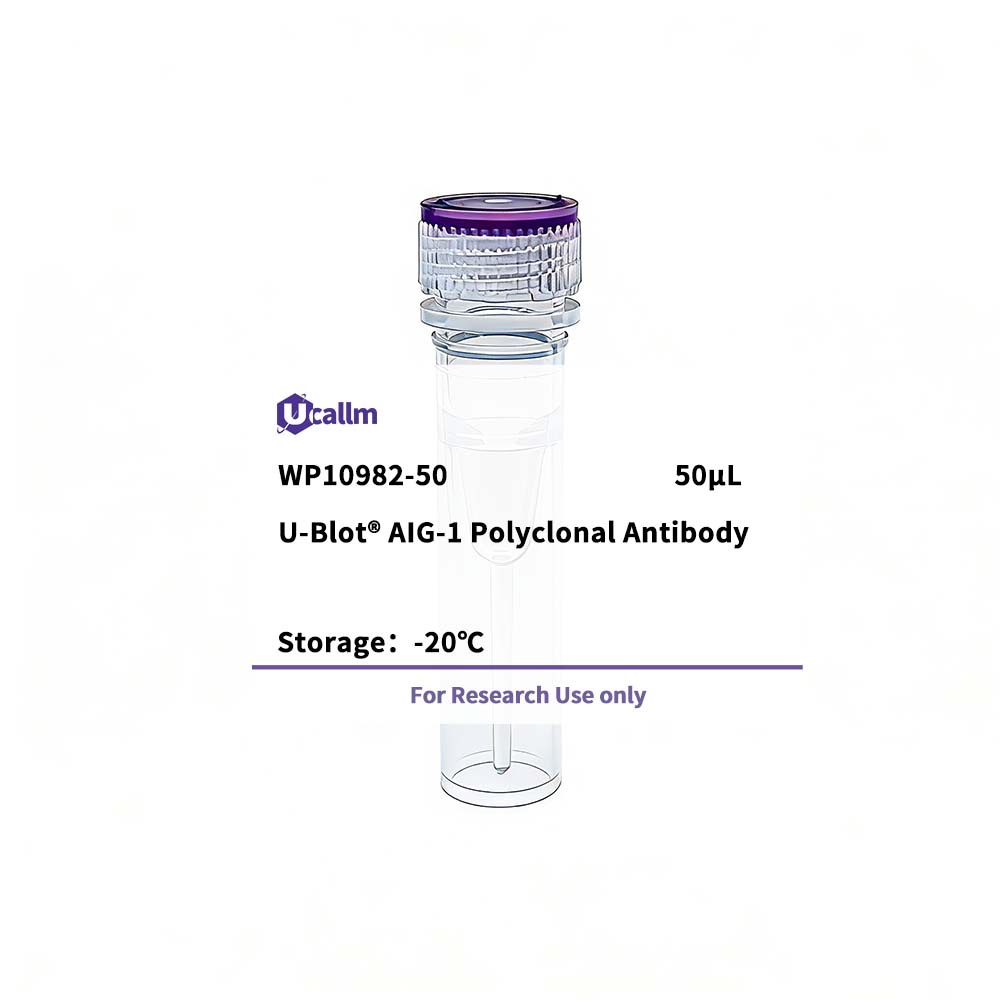
Ucallm_WP10982-50
Price range: $268.00 through $328.00
Product details
Background:
function:May play a role in androgen-regulated growth of hair follicles., induction:By dihydrotestosterone (DHT)., similarity:Belongs to the AIG1 family., tissue specificity:Highly expressed in heart, ovary, testis, liver, and kidney, at lower levels in spleen, prostate, brain, skeletal muscle, pancreas, small intestine and colon, and undetected in peripheral blood leukocytes, thymus, lung and placenta. AIG1 expression is higher in hair follicles from males than from females.,
Specifications
| Size | 50μL/100μL |
| Target | AIG-1 |
| Reactivity | Human, Mouse |
| Applications | WB, ELISA |
| MW(Calculated) | |
| MW(Observed) | 32kD |
| Host Species | Rabbit |
| Isotype | IgG |
| Conjugate/Modification | Unmodified |
| Recommended Dilution Ratio | WB 1:500-1:2000; ELISA 1:40000; Not yet tested in other applications. |
| Formulation | Liquid in PBS containing 50% glycerol, 0.5% BSA and 0.02% sodium azide. |
| Purification | The antibody was affinity-purified from rabbit antiserum by affinity-chromatography using epitope-specific immunogen. |
| Storage | -15°C to -25°C/1 year(Do not lower than -25°C) |
| Concentration | 1 mg/ml |
| Clonality | Polyclonal |
| Clone Number | |
| Immunogen | The antiserum was produced against synthesized peptide derived from human AIG1. AA range:196-245 |
| Specificity | AIG-1 Polyclonal Antibody detects endogenous levels of AIG-1 protein. |
| Gene Name | AIG1 |
| Protein Name | Androgen-induced gene 1 protein |
| Other Name | AIG1; / CGI-103; / Androgen-induced gene 1 protein; / AIG-1 |
| Species | Human |
| Gene ID | 51390 |
| Uniprot | Q9NVV5, |
| Species.1 | Mouse |
| Gene ID.1 | |
| Uniprot.1 | Q9D8B1 |
| Species.2 | |
| Gene ID.2 | |
| Uniprot.2 | |
| Cellular Localization | Cell membrane; Multi-pass membrane protein . |
| Tissue Expression | Highly expressed in heart, ovary, testis, liver, and kidney, at lower levels in spleen, prostate, brain, skeletal muscle, pancreas, small intestine and colon, and undetected in peripheral blood leukocytes, thymus, lung and placenta. AIG1 expression is higher in hair follicles from males than from females. |
| Signaling_pathway | |
| Research Areas | |
| Function | Function:May play a role in androgen-regulated growth of hair follicles.,induction:By dihydrotestosterone (DHT).,similarity:Belongs to the AIG1 family.,tissue specificity:Highly expressed in heart, ovary, testis, liver, and kidney, at lower levels in spleen, prostate, brain, skeletal muscle, pancreas, small intestine and colon, and undetected in peripheral blood leukocytes, thymus, lung and placenta. AIG1 expression is higher in hair follicles from males than from females., |
Please login to post questions
Related products




