

ALB Monoclonal Antibody
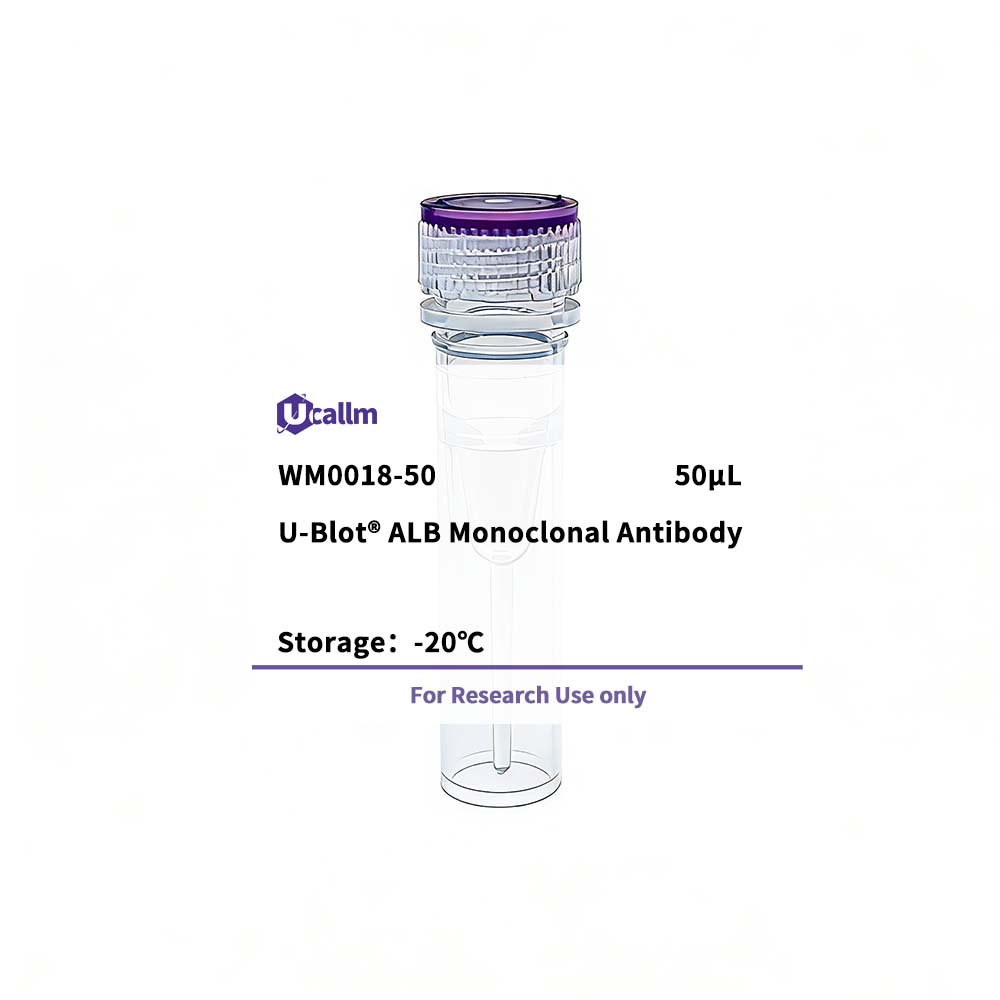
Ucallm_WM0018-50
Price range: $268.00 through $328.00
Product details
Background:
This gene encodes the most abundant protein in human blood. This protein functions in the regulation of blood plasma colloid osmotic pressure and acts as a carrier protein for a wide range of endogenous molecules including hormones, fatty acids, and metabolites, as well as exogenous drugs. Additionally, this protein exhibits an esterase-like activity with broad substrate specificity. The encoded preproprotein is proteolytically processed to generate the mature protein. A peptide derived from this protein, EPI-X4, is an endogenous inhibitor of the CXCR4 chemokine receptor. [provided by RefSeq, Jul 2016],
Specifications
| Size | 50μL/100μL |
| Target | Albumin |
| Reactivity | Human |
| Applications | WB, ELISA |
| MW(Calculated) | 69kD |
| MW(Observed) | |
| Host Species | Mouse |
| Isotype | |
| Conjugate/Modification | Unmodified |
| Recommended Dilution Ratio | WB 1:500-1:2000; ELISA 1:10000; Not yet tested in other applications. |
| Formulation | Liquid in PBS containing 50% glycerol, 0.5% BSA and 0.02% sodium azide. |
| Purification | Affinity purification |
| Storage | -15°C to -25°C/1 year(Do not lower than -25°C) |
| Concentration | |
| Clonality | Monoclonal |
| Clone Number | 5E7 |
| Immunogen | Human sera albumin. |
| Specificity | ALB Monoclonal Antibody detects endogenous levels of ALB protein. |
| Gene Name | ALB |
| Protein Name | ALB(Albumin) |
| Other Name | ALB; / GIG20; / GIG42; / Serum albumin |
| Species | Human |
| Gene ID | 213 |
| Uniprot | P02768, |
| Species.1 | Mouse |
| Gene ID.1 | |
| Uniprot.1 | P07724, |
| Species.2 | Rat |
| Gene ID.2 | |
| Uniprot.2 | P02770 |
| Cellular Localization | Secreted. |
| Tissue Expression | Plasma. |
| Signaling_pathway | |
| Research Areas | >>Thyroid hormone synthesis |
| Function | Caution:A peptide arising from positions 166 to 174 was originally (PubMed:3087352 and PubMed:2437111) termed neurotensin-related peptide (NRP) or kinetensin and was thought to regulates fat digestion, lipid absorption, and blood flow.,Disease:A variant structure of albumin could lead to increased binding of zinc resulting in an asymptomatic augmentation of zinc concentration in the blood [MIM:194470].,Disease:Defects in ALB are a cause of familial dysalbuminemic hyperthyroxinemia (FDH) [MIM:103600]. FDH is a form of euthyroid hyperthyroxinemia that is due to increased affinity of ALB for T(4). It is the most common cause of inherited euthyroid hyperthyroxinemia in Caucasian population.,Function:Serum albumin, the main protein of plasma, has a good binding capacity for water, Ca(2+), Na(+), K(+), fatty acids, hormones, bilirubin and drugs. Its main function is the regulation of the colloidal osmotic pressure of blood.,miscellaneous:Acetylated on Lys-223 by acetylsalicylic acid.,online information:Serum albumin entry,polymorphism:The sequence shown is that of variant albumin A.,PTM:Glycated in diabetic patients.,PTM:Kenitra variant is partially O-glycosylated at Thr-620. It has two new disulfide bonds Cys-600 to Cys-602 and Cys-601 to Cys-606.,similarity:Belongs to the ALB/AFP/VDB family.,similarity:Contains 3 albumin domains.,tissue specificity:Plasma., |
Please login to post questions
Related products





