

ANO5 rabbit pAb
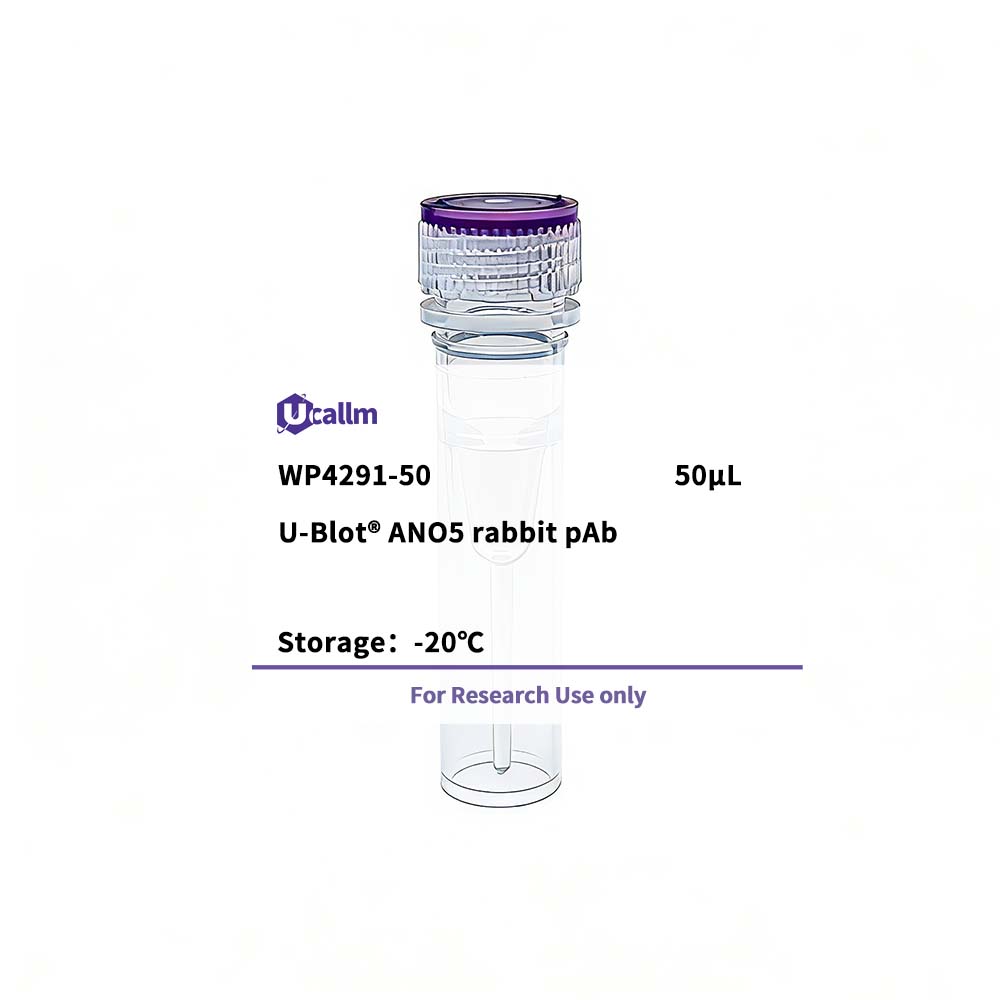
Ucallm_WP4291-50
Price range: $268.00 through $328.00
Product details
Background:
This gene encodes a member of the anoctamin family of transmembrane proteins. The encoded protein is likely a calcium activated chloride channel. Mutations in this gene have been associated with gnathodiaphyseal dysplasia. Alternatively spliced transcript variants have been described. [provided by RefSeq, Nov 2009],
Specifications
| Size | 50μL/100μL |
| Target | ANO5 |
| Reactivity | Human, Mouse |
| Applications | WB |
| MW(Calculated) | 100kD |
| MW(Observed) | |
| Host Species | Rabbit |
| Isotype | IgG |
| Conjugate/Modification | Unmodified |
| Recommended Dilution Ratio | WB 1:500-2000 |
| Formulation | Liquid in PBS containing 50% glycerol, 0.5% BSA and 0.02% sodium azide. |
| Purification | The antibody was affinity-purified from rabbit antiserum by affinity-chromatography using epitope-specific immunogen. |
| Storage | -15°C to -25°C/1 year(Do not lower than -25°C) |
| Concentration | 1 mg/ml |
| Clonality | Polyclonal |
| Clone Number | |
| Immunogen | Synthesized peptide derived from human ANO5 AA range: 276-326 |
| Specificity | This antibody detects endogenous levels of ANO5 at Human/Mouse |
| Gene Name | ANO5 GDD1 TMEM16E |
| Protein Name | ANO5 |
| Other Name | |
| Species | Human |
| Gene ID | 203859 |
| Uniprot | Q75V66, |
| Species.1 | Mouse |
| Gene ID.1 | 233246 |
| Uniprot.1 | Q75UR0 |
| Species.2 | |
| Gene ID.2 | |
| Uniprot.2 | |
| Cellular Localization | Endoplasmic reticulum membrane; Multi-pass membrane protein . Cell membrane; Multi-pass membrane protein . Colocalized with CALR/calreticulin (PubMed:15124103). Shows an intracellular localization according to PubMed:22075693. . |
| Tissue Expression | Highly expressed in brain, heart, kidney, lung, and skeletal muscle. Weakly expressed in bone marrow, fetal liver, placenta, spleen, thymus, osteoblasts and periodontal ligament cells. |
| Signaling_pathway | |
| Research Areas | |
| Function | Disease:Defects in ANO5 are the cause of gnathodiaphyseal dysplasia (GDD) [MIM:166260]; also called osteogenesis imperfecta with unusual skeletal lesions or gnathodiaphyseal sclerosis. GDD is a rare skeletal syndrome characterized by bone fragility, sclerosis of tubular bones, and cemento-osseous lesions of the jawbone. Patients experience frequent bone fractures caused by trivial accidents in childhood; however the fractures heal normally without bone deformity. The jaw lesions replace the tooth-bearing segments of the maxilla and mandible with fibrous connective tissues, including various amounts of cementum-like calcified mass, sometimes causing facial deformities. Patients also have a propensity for jaw infection and often suffer from purulent osteomyelitis-like symptoms, such as swelling of and pus discharge from the gums, mobility of the teeth, insufficient healing after tooth extraction and exposure of the lesions into the oral cavity.,Function:May act as a calcium-activated chloride channel.,similarity:Belongs to the anoctamin family.,subcellular location:Co-localized with CALR/calreticulin.,tissue specificity:Highly expressed in brain, heart, kidney, lung, and skeletal muscle. Weakly expressed in bone marrow, fetal liver, placenta, spleen, thymus, osteoblasts and periodontal ligament cells., |
Please login to post questions
Related products





