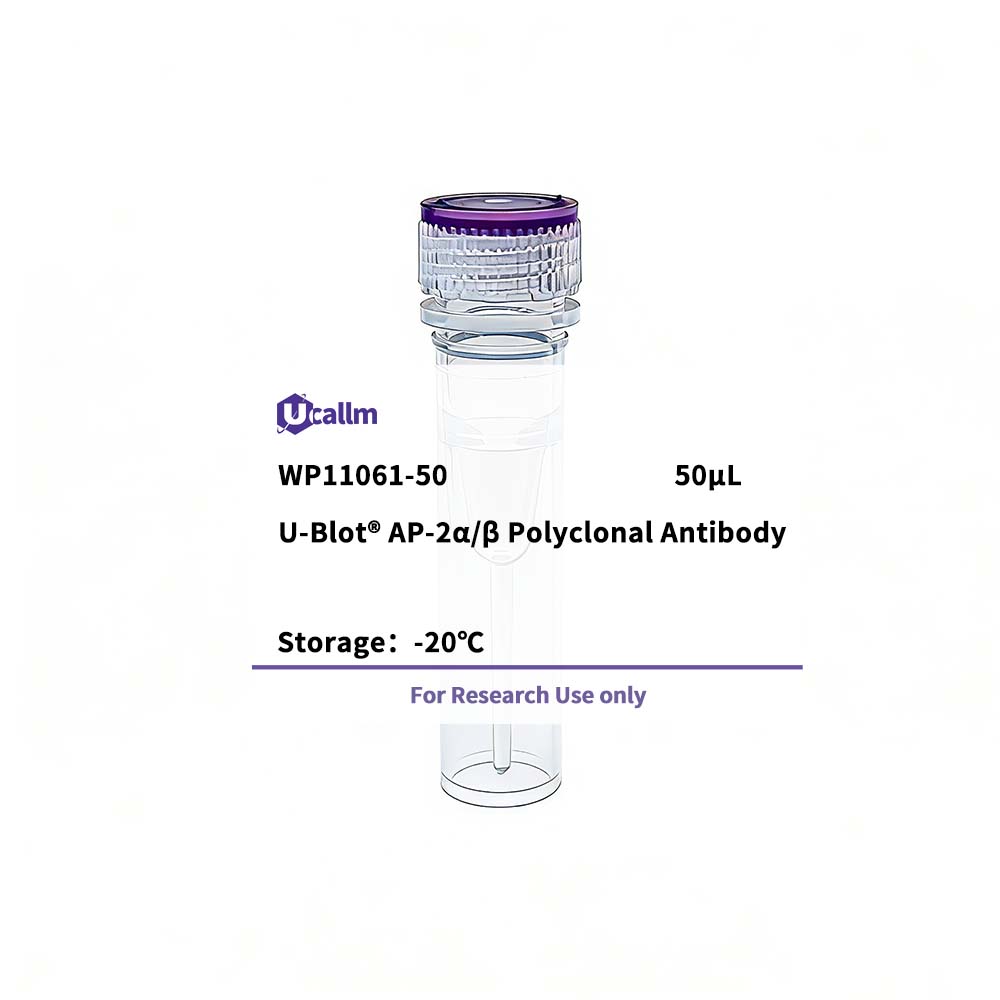
SKU: WP11061 Categories: ,

AP-2α/β Polyclonal Antibody

Price range: $268.00 through $328.00

SKU: WP11061-100
Enter the quantity you would like, or drag the panel to find the quantity and price that best for you
Bulk QuoteAuthorize OEM & ODM

Product details

Background:

transcription factor AP-2 alpha(TFAP2A) Homo sapiens The protein encoded by this gene is a transcription factor that binds the consensus sequence 5'-GCCNNNGGC-3'. The encoded protein functions as either a homodimer or as a heterodimer with similar family members. This protein activates the transcription of some genes while inhibiting the transcription of others. Defects in this gene are a cause of branchiooculofacial syndrome (BOFS). Three transcript variants encoding different isoforms have been found for this gene.[provided by RefSeq, Dec 2009],

Specifications

Size50μL/100μL
TargetAP-2α/β
ReactivityHuman, Mouse, Rat
ApplicationsWB, IHC, IF, ELISA
MW(Calculated)
MW(Observed)49kD
Host SpeciesRabbit
IsotypeIgG
Conjugate/ModificationUnmodified
Recommended Dilution RatioWB 1:500-1:2000; IHC 1:100-1:300; ELISA 1:10000; IF 1:50-200 / Note: For IHC, we suggest antigen retrieval with TE buffer pH 9.0 (Cat#WT1004)
FormulationLiquid in PBS containing 50% glycerol, 0.5% BSA and 0.02% sodium azide.
PurificationThe antibody was affinity-purified from rabbit antiserum by affinity-chromatography using epitope-specific immunogen.
Storage-15°C to -25°C/1 year(Do not lower than -25°C)
Concentration1 mg/ml
ClonalityPolyclonal
Clone Number
ImmunogenThe antiserum was produced against synthesized peptide derived from human AP-2. AA range:388-437
SpecificityAP-2α/β Polyclonal Antibody detects endogenous levels of AP-2α/β protein.
Gene NameTFAP2A/TFAP2B
Protein NameTranscription factor AP-2-alpha/beta
Other NameTFAP2A; / AP2TF; / TFAP2; / Transcription factor AP-2-alpha; / AP2-alpha; / AP-2 transcription factor; / Activating enhancer-binding protein 2-alpha; / Activator protein 2; / AP-2; / TFAP2B; / Transcription factor AP-2-beta; / AP2-beta; / Activating enhancer-bindi
SpeciesHuman
Gene ID7020
UniprotP05549;Q92481,
Species.1Mouse
Gene ID.121418;21419,
Uniprot.1
Species.2Rat
Gene ID.2
Uniprot.2P58197
Cellular LocalizationNucleus .
Tissue ExpressionProstate,Teratocarcinoma,
Signaling_pathway
Research Areas
FunctionAlternative products:Experimental confirmation may be lacking for some isoforms,Disease:Defects in TFAP2A are the cause of branchiooculofacial syndrome (BOFS) [MIM:113620]; also known as branchial clefts with characteristic facies, growth retardation, imperforate nasolacrimal duct, and premature aging or lip pseudocleft-hemangiomatous branchial cyst syndrome. BOFS is a rare autosomal dominant cleft palate craniofacial disorder with variable expressivity. The major features include cutaneous anomalies, ocular anomalies, characteristic facial appearance (malformed pinnae, oral clefts), and, less commonly, renal and ectodermal (dental and hair) anomalies.,Domain:The WW-binding motif mediates interaction with WWOX.,Function:Sequence-specific DNA-binding protein that interacts with inducible viral and cellular enhancer elements to regulate transcription of selected genes. AP-2 factors bind to the consensus sequence 5'-GCCNNNGGC-3' and activate genes involved in a large spectrum of important biological functions including proper eye, face, body wall, limb and neural tube development. They also suppress a number of genes including MCAM/MUC18, C/EBP alpha and MYC. AP-2 alpha is the only AP-2 protein required for early morphogenesis of the lens vesicle.,online information:Activatin protein 2 entry,PTM:Sumoylated on Lys-10; which inhibits transcriptional activity.,similarity:Belongs to the AP-2 family.,subunit:Binds DNA as a dimer. Can form homodimers or heterodimers with other AP-2 family members. Interacts with WWOX. Interacts with CITED4. Interacts with UBE2I. Interacts with RALBP1 in a complex also containing EPN1 and NUMB during interphase and mitosis.,
Please login to post questions
Back to Top
Product has been added to your cart


